LinkedIn Ads for B2B: Costs, Ad Formats, and Lead Generation Strategies

B2B Performance Marketing
(also known as LinkedIn advertising, LinkedIn Campaign Manager, or B2B advertising on LinkedIn)
LinkedIn Ads for B2B: The Complete Guide to Costs, Ad Formats, and Lead Generation Strategies
LinkedIn is the paid channel that generates fewer clicks than other platforms, but delivers the highest-quality leads in B2B digital advertising. Understanding how it works—including costs, ad formats, targeting, and Lead Gen Forms—makes the difference between investing wisely and simply spending money.
In Summary
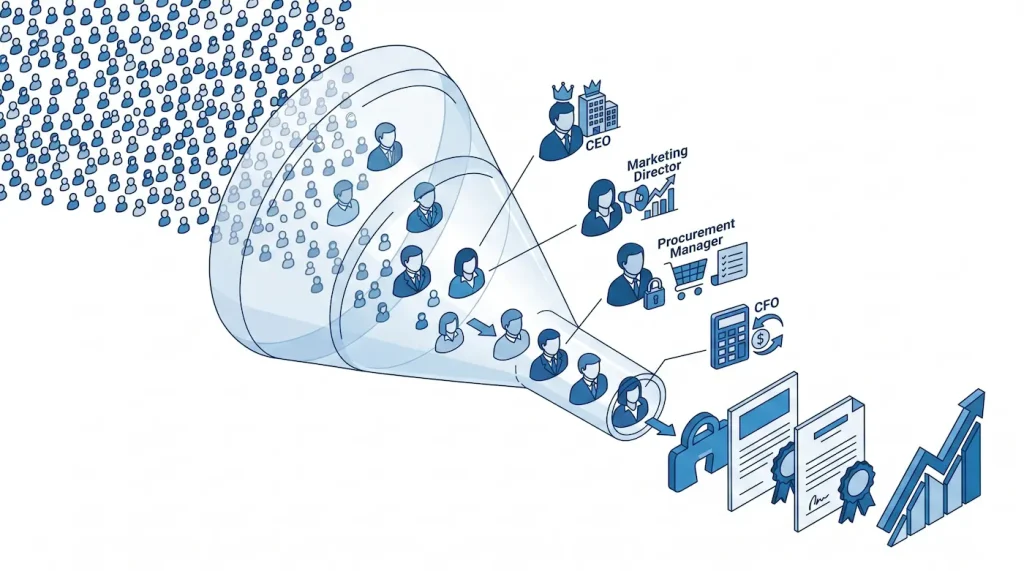
LinkedIn Ads is LinkedIn’s advertising platform, specifically designed for B2B marketing. It enables businesses to reach professionals by filtering audiences based on job title, industry, company size, seniority, and skills—offering a level of targeting precision that no other social advertising platform can match.
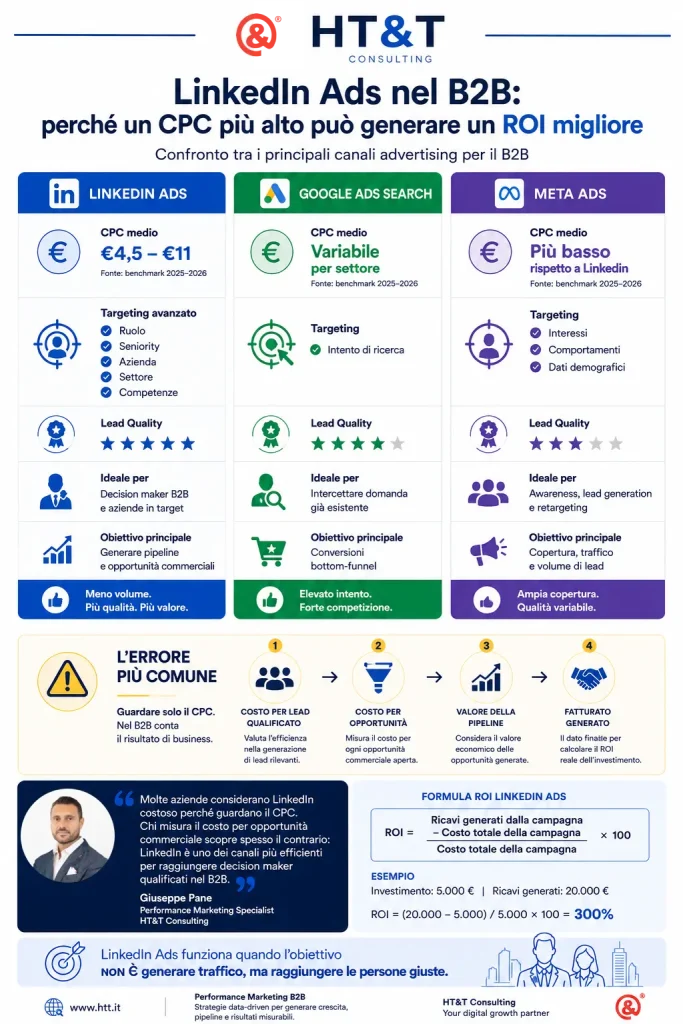
The average cost per click ranges from €4.50 to €11, significantly higher than Meta Ads or Google Search. However, lead quality more than offsets the higher investment. According to industry data, LinkedIn lead generation delivers a cost per qualified lead that is 28% lower than B2B paid search because its targeting dramatically reduces wasted impressions.
The most effective ad formats are Thought Leader Ads (lower CPC, up to 77% less expensive than traditional Single Image Ads) and native Lead Gen Forms, which automatically pre-fill user profile information and can increase completion rates by as much as 13%.
LinkedIn Ads for B2B: The Numbers
Why does LinkedIn work for B2B in a way that no other platform can replicate?
LinkedIn surpassed 1.3 billion registered members in December 2025, with approximately 310 million monthly active users—roughly one out of every four members. While these figures are smaller than Meta or Google, LinkedIn offers one unique advantage: every profile is connected to a company, a job title, a seniority level, and a verifiable professional history.
This is what makes LinkedIn fundamentally different. On most other platforms, B2B targeting is based on inference—interests, behaviors, and lookalike audiences. On LinkedIn, targeting is based on declared and verifiable data: job title, business function, industry, company size, and skills listed directly in users’ profiles. The result is traffic with a fundamentally higher commercial quality.
“Many companies think LinkedIn is expensive because they only look at CPC. Those who measure cost per sales opportunity often discover the opposite: LinkedIn is one of the most efficient channels for reaching qualified B2B decision-makers.”
The most significant figure for businesses evaluating the platform is this: according to Dreamdata’s analysis, LinkedIn now accounts for 41% of total B2B media budgets, continuing its steady growth, while the share allocated to non-branded paid search has declined from 37% to 33% over the same period. This budget reallocation reflects a broader shift in confidence among B2B marketers: search captures existing demand, while LinkedIn creates and qualifies demand.
For companies running integrated B2B marketing strategies, it’s also worth reading our guide to Meta Ads for B2B: How to Generate Leads with Facebook and Instagram.
Rather than competing directly, the two channels complement each other by serving different roles throughout the marketing funnel.
How Much Does LinkedIn Advertising Cost? CPC, CPM, and CPL
Cost is often the first psychological barrier for companies considering LinkedIn. Average CPCs are among the highest in digital advertising. However, the comparison should be based on cost per qualified lead, not cost per click. On LinkedIn, these are two metrics that often tell very different stories.
LinkedIn Ads Cost Benchmarks by Industry (2025–2026)
| Industry | Average CPC | Notes |
|---|---|---|
| Financial Services | €5.5–9 | Affluent and highly competitive audience |
| B2B SaaS / Technology | €5.5–9 | Industry with the highest concentration of LinkedIn ad spend |
| Healthcare | €5.5–9 | High demand for role-based targeting |
| HR & Staffing | €3.7–6.4 | Among the most efficient industries in terms of LinkedIn ROI |
| Retail / Ecommerce | €2.8–5.5 | Less competitive audience and lower CPMs |
| Manufacturing / Industrial | €2.8–5.5 | Lower competition, ideal for niche B2B markets |
| Education | €2.8–5.5 | Lower advertising costs with variable conversion rates |
Other key metrics should also be monitored. The median CPM is approximately €28, with estimates ranging from €23 to €32 according to Lever Digital. The average CTR ranges between 0.44% and 0.65% across all industries—lower than Google Search (2–5%), but with significantly higher traffic quality. People who click on LinkedIn ads are verified professionals with clearly identifiable business affiliations.
Regarding cost per lead (CPL), geographic variation is substantial. The lowest average CPL is reported in Latin America (around €55), while the highest is found in North America (approximately €210). There is no universally reliable CPL benchmark; your own historical campaign data will always provide the most meaningful reference.
How to Calculate the ROI of LinkedIn Ads Campaigns
The ROI of LinkedIn Ads cannot be measured by looking only at CPC, CTR, or cost per lead. In B2B marketing, these metrics are useful but incomplete. A campaign may generate expensive clicks while still producing highly valuable business opportunities, or it may deliver inexpensive leads that never become customers.
To accurately evaluate the performance of a LinkedIn Ads campaign, media metrics must be connected with commercial outcomes: generated leads, qualified leads, sales opportunities, pipeline value, and closed deals.
Key Metrics for Measuring LinkedIn Ads ROI
| Metric | What It Measures | Why It Matters |
|---|---|---|
| CPC | Average cost of each click generated by the campaign | Helps evaluate traffic efficiency but does not measure commercial quality |
| CPL | Average cost of acquiring each lead | Only meaningful when evaluated together with lead quality |
| MQL | Leads that match the predefined marketing target | Shows whether targeting is reaching the right companies and professional profiles |
| SQL | Leads validated by the sales team as genuine business opportunities | One of the most important indicators of campaign quality |
| Cost per Opportunity | Advertising investment divided by the number of qualified sales opportunities created | Allows comparisons between LinkedIn, Google Ads, Meta Ads, trade shows, outbound marketing, and other acquisition channels |
| Generated Pipeline | Estimated monetary value of sales opportunities generated by the campaign | Measures business impact before contracts are actually signed |
| Closed Revenue | Revenue generated from customers acquired through the campaign | The definitive metric for calculating actual return on investment |
For example, if a LinkedIn Ads campaign costs €5,000 and generates 25 leads, the CPL is €200. Taken alone, this figure may appear high. However, if those 25 leads produce five qualified sales opportunities and ultimately one contract worth €20,000, the campaign delivers a positive ROI.
In this scenario, paying €200 per lead is not what matters. What matters is having transformed a €5,000 media investment into €20,000 in revenue. The resulting return on investment is:
For this reason, LinkedIn Ads should primarily be evaluated based on cost per opportunity, pipeline value, and closed revenue. A high CPC is not necessarily a problem if the platform consistently reaches real decision-makers, companies that fit your ideal customer profile, and sales opportunities with a high average contract value.
“The biggest mistake in B2B LinkedIn Ads campaigns is judging the platform by its cost per click. In B2B, the click is only the beginning. The metric that truly matters is the cost of generating a qualified sales opportunity.”
LinkedIn Ads Formats and When to Use Them
LinkedIn organizes its ad formats into four categories: Sponsored Content (in-feed), Sponsored Messaging (in-inbox), Dynamic Ads (personalized sidebar ads), and Lead Gen Forms (native form). Each format plays a specific role within the funnel.
LinkedIn Ads Formats by Funnel Stage
| Format | Funnel Stage | Main Strength | Indicative CPC |
|---|---|---|---|
| Thought Leader Ads | Awareness / Trust | Promotes posts from personal profiles, with a much lower cost | ~€2.8 |
| Single Image Ads | Awareness / Traffic | The most widely used format, with a clear message in a single frame | €10–12 |
| Video Ads | Awareness / Storytelling | High visibility, but lower median CTR (0.24%) | ~€14 |
| Document Ads | Engagement / Lead gen | The asset itself—whitepaper, report, or guide—becomes the conversion | Variable |
| Carousel Ads | Engagement | Sequential storytelling, social proof, and multiple products or messages | Variable |
| Lead Gen Form | Conversion | Pre-filled form, with completion rates of 6–13% | Combined with other formats |
| Message / Conversation Ads | Conversion / Outreach | Direct inbox message, with reply rates of 11–18% | Send-based pricing |
| Article / Newsletter Ads | Trust / Nurturing | Native long-form content that keeps users on LinkedIn | Variable |
One important update: LinkedIn has introduced Connected TV Ads, which extend B2B brand messaging into premium streaming environments. This is a format designed for higher-level awareness, outside the traditional LinkedIn feed.
Thought Leader Ads: The Format Changing the Rules of Cost per Click
Thought Leader Ads (TLA) are the most interesting ad format to emerge over the past two years. They allow companies to sponsor posts published by personal profiles—employees, founders, executives—instead of sponsoring content from the company page. The promoted post appears as boosted organic content, not as a traditional advertisement.
The data that makes this format both interesting and strategic is clear: an average CPC of €2.80 compared with €12.20 for Single Image Ads, a 77% reduction. The reason is straightforward: content from personal profiles generates higher organic engagement—up to eight times higher than company pages, according to industry data—and LinkedIn rewards ads with a high relevance score through lower CPCs.
For B2B brands working on an expertise-driven positioning, combining Thought Leader Ads with a structured editorial strategy produces compounding results over time. On this topic, it is useful to read LinkedIn: A Strategic Ally for Your Company Website’s SEO,
which explores how organic and sponsored LinkedIn content reinforce each other.
B2B Targeting on LinkedIn: How to Build the Right Audience
Targeting is LinkedIn’s true competitive advantage over any other advertising platform. The main targeting dimensions include:
- Job Function and Seniority: reach specific audiences such as CFOs, Marketing Directors, and Procurement Managers.
- Industry: target vertical industries such as manufacturing, SaaS, healthcare, and retail.
- Company Size: segment audiences based on the number of employees, making it easier to differentiate enterprise and SMB strategies.
- Skills: target professionals who have listed specific skills on their LinkedIn profiles.
- Matched Audiences: upload CRM contact lists or retarget website visitors.
- Lookalike Audiences: build audiences similar to your highest-performing existing customers.
The most common mistake is stacking too many targeting filters, shrinking the audience to only a few thousand people and driving CPMs dramatically higher. The most effective approach is to begin with two or three high-priority filters (for example, job function + industry + company size) and refine the audience progressively based on performance data—not the other way around.
To build campaigns that integrate seamlessly into a broader lead generation strategy, it is worth reading our guide to Lead Generation: The Key to Winning More Customers, which explains how LinkedIn fits into a comprehensive customer acquisition strategy.
Lead Gen Forms: How to Optimize Native Conversion
The Lead Gen Form is LinkedIn’s native lead capture format, allowing users to complete a form without leaving the platform. Fields are automatically pre-filled with profile information—including name, email address, company, and job title—dramatically reducing friction compared with an external landing page.
Completion rates for well-optimized campaigns typically range from 6% to 13%, significantly higher than those of traditional B2B landing pages. The trade-off is that Lead Gen Forms do not generate a website visit, meaning you lose valuable retargeting signals and the richer analytics data that an external landing page can provide.
One best practice that is often underestimated is connecting Lead Gen Forms to an immediate automated lead nurturing workflow. Leads are at their warmest immediately after submitting the form, and following up within the first few hours dramatically increases the likelihood of converting them into qualified sales opportunities. For a deeper look at this topic, read our guide to Marketing Automation: What It Is, How It Works, and Which Tools to Choose, which explains how to build effective B2B lead nurturing workflows.
Tracking and Attribution: Insight Tag, Conversion API, and Dynamic UTM Parameters
The Insight Tag is LinkedIn’s tracking pixel installed on your website, used to measure visits and standard browser-based conversions. Like every advertising platform, it is subject to the same client-side tracking limitations affecting Google and Meta, including ad blockers, browser restrictions, and denied user consent.
LinkedIn’s Conversion API (CAPI) allows conversion events to be sent directly from the server, integrating data that browsers cannot capture, such as phone sales, offline leads collected during events, and CRM-recorded conversions. LinkedIn automatically deduplicates events received through both the Insight Tag and CAPI, preventing double counting.
Since March 2025, LinkedIn has introduced support for dynamic UTM parameters within Campaign Manager. Campaign, ad group, and creative parameters can now be appended automatically to destination URLs without requiring manual configuration for every individual ad. This significantly simplifies cross-channel attribution within analytics platforms.
Server-side tracking is just as important on LinkedIn as it is on Google and Meta. For a comprehensive overview of the architecture and benefits, our guide to
server-side tracking explains how Conversion APIs and first-party data work together to reduce dependence on browser-based tracking alone.
Common Mistakes in LinkedIn B2B Campaigns
Common Mistakes and How to Fix Them
| Mistake | Symptom | Solution |
|---|---|---|
| Targeting that is too narrow | Extremely high CPM and audience exhaustion within a few days | Reduce targeting to two or three key dimensions and allow the algorithm to identify the best-performing audience segment |
| Using only static formats (Single Image Ads) | High CPC with no comparison against more efficient alternatives | Test Thought Leader Ads alongside traditional formats to reduce the average CPC of your campaign mix |
| No Lead Gen Forms connected to a nurturing workflow | Leads are generated but not contacted promptly, resulting in low conversion rates | Automate follow-up communications within the first few hours after form submission |
| Evaluating only CPC and CTR | Budget decisions based solely on in-platform metrics instead of actual sales pipeline performance | Measure cost per opportunity and cost per closed deal—not just cost per click |
| Creative assets without clear branding | Significantly lower ROAS compared with branded campaigns | Always include your logo and visible company branding. Industry data shows a nearly 19× ROAS gap between branded and generic campaigns. |
| No frequency control for messaging campaigns | Declining reply rates and increased perception of spam | Limit Message Ads and Conversation Ads to one or two sends per recipient every 30 days |
Branded campaigns generate an average ROAS of approximately €11.90 compared with just €0.62 for generic campaigns—a difference of nearly nineteen times. Including your brand within the creative dramatically improves advertising performance, even on highly performance-oriented formats such as LinkedIn Lead Gen Forms.
LinkedIn vs Google Ads vs Meta for B2B: Which Channel Should You Choose?
There is no single answer to this question. The right choice depends on the stage of the marketing funnel and the type of offer. Each platform plays a distinct role within a successful B2B strategy.
LinkedIn vs Google Ads vs Meta for B2B Marketing Strategies
| Channel | Primary Strength | Ideal Funnel Stage | Main Limitation |
|---|---|---|---|
| LinkedIn Ads | Company and job-role targeting with high-quality leads | Awareness, nurturing, and lead generation | Higher cost per click and lower CTR |
| Google Ads (Search) | Captures existing demand and high purchase intent | Bottom of the funnel / Decision stage | Does not create demand and depends on available search volume |
| Meta Ads | Very low cost per impression and broad reach | Awareness and retargeting | Less precise B2B targeting and a more general audience |
In practice, the most mature B2B marketing strategies do not rely on a single advertising channel. Instead, they build a complementary media mix: LinkedIn develops awareness and trust among the right decision-makers, Google Search captures prospects already evaluating solutions, and Meta expands reach at a lower cost. To learn how to coordinate Google Ads and LinkedIn campaigns effectively, read our guide on how to calculate a Google Ads budget.
Frequently Asked Questions About LinkedIn Ads for B2B
How much does it cost to advertise on LinkedIn?
The average CPC ranges from €4.50 to €11 depending on the industry, reaching €5.50–9 in highly competitive sectors such as finance, SaaS, and healthcare. LinkedIn requires a minimum daily budget of approximately €9 per campaign. The median CPM is around €28. Thought Leader Ads are the most cost-effective format, with an average CPC of approximately €2.80.
Are LinkedIn Ads really worth it for B2B compared with Google or Meta?
It depends on your objective. LinkedIn generates 80% of all B2B social media leads and delivers a cost per qualified lead that is 28% lower than B2B paid search, despite having a higher CPC. Google Search remains the most effective channel for prospects already in the decision-making stage. Meta offers broader reach at a lower cost but provides less precise B2B targeting. Most mature B2B marketing strategies combine all three channels, assigning each a different role within the funnel.
What are Thought Leader Ads and why do they cost less?
Thought Leader Ads promote posts published by personal profiles—employees, executives, or founders—instead of company pages. They cost less because content from personal profiles generates significantly higher organic engagement, and LinkedIn rewards ads with higher relevance scores by lowering CPCs. Recent benchmarks show an average CPC of €2.80 compared with €12.20 for traditional Single Image Ads.
What is a Lead Gen Form and how does it differ from a landing page?
A Lead Gen Form is LinkedIn’s native lead capture form that users complete without leaving the platform. Its fields are automatically pre-filled using profile information. Completion rates range from 6% to 13%, significantly higher than those of traditional landing pages. The downside is that no website visit is generated, meaning you lose retargeting signals and behavioral analytics that a landing page would normally provide. In many cases, testing both approaches delivers the best results.
How do you build effective B2B targeting on LinkedIn?
The primary targeting dimensions include job function, seniority, industry, company size, and profile skills. It is generally best to begin with two or three high-priority filters rather than combining too many criteria, which dramatically reduces audience size and increases CPM. Matched Audiences (CRM list uploads) and Lookalike Audiences are highly effective tools for refining targeting over time.
What is the difference between the Insight Tag and the Conversion API on LinkedIn?
The Insight Tag is LinkedIn’s website pixel that tracks browser-based conversions and is subject to the same limitations as other advertising platforms, including ad blockers and privacy restrictions. The Conversion API sends conversion events directly from the server, capturing data that browsers cannot see, such as phone sales, offline leads, and CRM-recorded conversions. LinkedIn automatically deduplicates events received from both sources.
Should you prioritize branding in LinkedIn creatives or focus purely on performance?
The data is clear: campaigns with visible branding—company logo and recognizable brand identity—generate an average ROAS of approximately €11.90 compared with just €0.62 for generic campaigns, a difference of nearly nineteen times according to LinkedIn B2B Institute’s analysis of more than 1,400 campaigns. Even on a performance-driven platform such as LinkedIn, strong branding significantly improves advertising effectiveness.
What is the minimum budget required to start advertising on LinkedIn?
LinkedIn’s technical minimum is approximately €9 per day per campaign. To generate statistically meaningful performance data and begin optimization, most agencies recommend a monthly budget of at least €1,500–3,000, allowing initial testing across two or three audiences and ad formats before scaling based on results.
Checklist: Before Launching a LinkedIn Ads B2B Campaign
- Insight Tag installed and verified on the website.
- Conversion API configured to capture offline conversions and CRM-generated leads.
- Targeting limited to two or three key audience dimensions without excessive overlap.
- At least one Thought Leader Ads campaign tested alongside standard ad formats.
- Lead Gen Forms connected to an automated follow-up workflow within the first few hours.
- Branding (logo and company identity) clearly visible in every creative, including performance campaigns.
- Message Ads and Conversation Ads limited to a maximum of one or two sends per recipient every 30 days.
- Primary KPIs defined around cost per opportunity rather than only CPC or CTR.
- Budget planned with seasonality in mind (Q3 is typically the most expensive quarter).
- Dynamic UTM parameters enabled within Campaign Manager for accurate cross-channel attribution.
Sources and References
LinkedIn Marketing Solutions — Ads Guide
Official documentation covering advertising formats, technical specifications, and recommended use cases for every campaign type.
LinkedIn B2B Institute — Easy to Find Report
Analysis of more than 1,400 campaigns examining the ROAS gap between branded and generic B2B advertising.
HockeyStack Labs — LinkedIn Ads Benchmark Report
Benchmark data on CPC, CTR, advertising spend, and sales pipeline performance based on more than 70 B2B SaaS companies and $28 million in analyzed ad spend.
Dreamdata — B2B Ad Spend Report
Research on B2B media budget allocation across LinkedIn, search advertising, and other acquisition channels.
HT&T Magazine — Meta Ads for B2B
Strategies for B2B lead generation on Facebook and Instagram that complement LinkedIn advertising.
Continua a leggere
19 minutes of reading
22 minutes of reading

18 minutes of reading

And it consumes less energy.
To return to the page you were visiting, simply click or scroll.