Marketing Automation: What it is, how it works & best tools

Marketing Automation & CRM
Marketing automation: what it is, how it works and which tools to choose
Marketing automation is not a tool, but a system of processes that transforms data and behaviors into relevant communications, at the right time, without manual intervention.
A complete guide to understand it, implement it and make it work.
In short
Marketing automation is the use of software and automated logic to send personalized communications to users based on their behaviors, characteristics and the stage of the purchasing journey they are in. It does not replace strategy; it executes it at scale. A well-built automation flow works 24/7, segments the audience without human error and produces measurable data on every interaction.
The result is more conversions, less repetitive manual work and a more relevant relationship with customers and prospects.
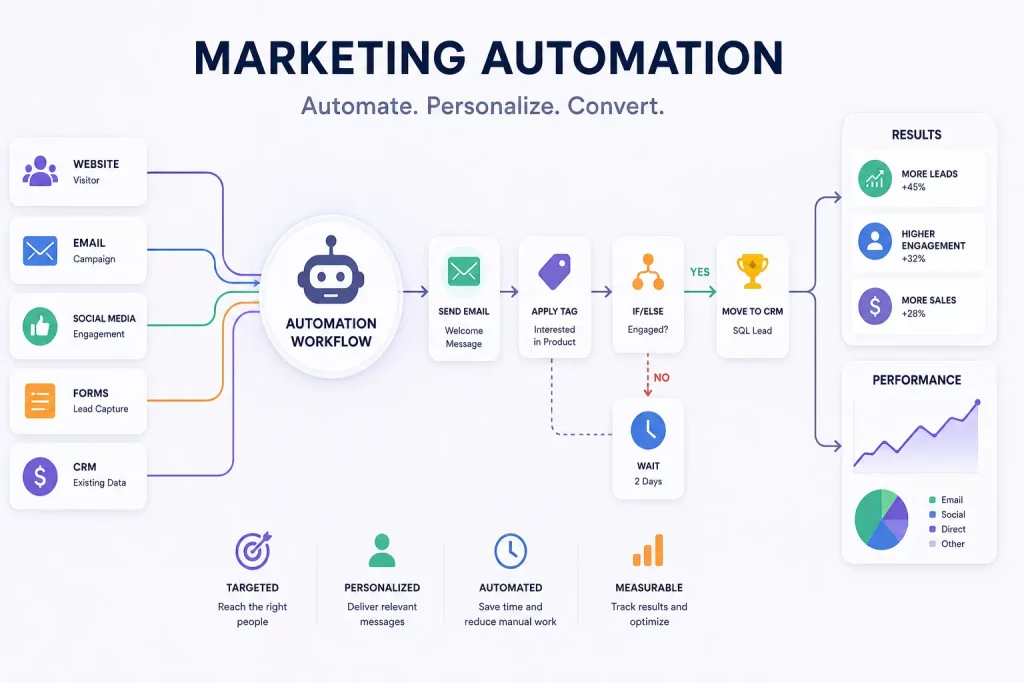
Marketing automation: the numbers
What is marketing automation?
Marketing automation is the set of technologies and processes that make it possible to automatically execute marketing actions such as sending emails, segmenting audiences, activating campaigns and updating CRM records, based on predefined conditions or behaviors detected in real time.
It is not simply “sending emails automatically”. It is a system that observes user behaviors (a page visited, a product viewed, a form filled in, a completed purchase, an opened email) and responds with the most relevant action for that person at that moment.
The difference between marketing automation and simple email marketing lies in conditional logic: you do not send the same message to everyone, but different messages to different people at different moments, based on behavioral and demographic criteria.
This is why automations systematically convert better than broadcast campaigns.
“Marketing automation works when you stop thinking
about what you want to communicate and start thinking about what your customer is looking for at every stage of their journey. Automation is the tool — relevance is the result.”
How marketing automation works: triggers, conditions and actions
Every marketing automation flow is built on three fundamental elements that combine into logical sequences of increasing complexity.
The trigger: what starts the flow
The trigger is the event that starts the automation. It can be:
- A user action: subscribing to a list, purchase, abandoned cart, clicking a link
- A demographic data point: birthday, anniversary, contract expiry
- A time-based condition: X days after subscription, Y days before expiry
- An external event: update of a CRM record, integration with another system
Conditions: who receives what
Conditions filter the audience and personalize the path.
They make it possible to show different messages to different segments within the same flow, without creating separate automations for each case.
- Has already purchased? Yes → show complementary products. No → show the bestseller
- Opened the previous email? Yes → send the next step. No → resend the same message with a different subject line
- Is a VIP customer? Yes → exclusive offer. No → standard offer
Actions: what happens
Actions are what the system executes when triggers and conditions are met.
The most common actions in marketing automation are:
- Sending emails or SMS
- Updating a tag, segment or field in the CRM
- Activating a push notification or WhatsApp message
- Adding to or removing from an advertising list (Google Ads, Meta Ads)
- Assigning a lead to a salesperson
- Creating a task in the CRM or sales project
The power of marketing automation lies in combining these three elements into multi-step flows that accompany the user along the funnel, from the first visit to purchase, from loyalty to recovery after abandonment.
This approach is directly connected to understanding the Messy Middle in purchasing behavior, the chaotic phase between stimulus and decision where automation can make the difference.
The most important marketing automation flows for ecommerce
For an ecommerce business, marketing automation mainly works on conversion and loyalty. The following flows cover the critical stages of the funnel and are those with the most measurable and highest ROI.
1. Welcome flow
The moment a user subscribes to the newsletter or creates an account is the moment of greatest attention and availability. A well-built welcome flow introduces the brand, sets expectations and pushes toward the first purchase.
Recommended structure: email 1 (welcome + brand story) → wait 2 days → email 2 (bestseller or most relevant category) → wait 3 days → email 3 (first-purchase incentive if they have not bought yet).
2. Abandoned cart recovery
On average, 70% of carts are abandoned before checkout.
An automated recovery sequence, triggered within 1 hour of abandonment, is the flow with the highest ROAS of all for an ecommerce business.
Recommended structure: email 1 after 1 hour (neutral reminder with products in the cart) → email 2 after 24 hours (brand benefits, reviews, guarantees) → email 3 after 48 hours (limited-time incentive).
Do not always start with a discount in the first abandoned cart recovery email.
Many users have simply forgotten — a simple reminder converts and preserves margin. The discount should be used as the last lever, not the first response.
3. Post-purchase flow
The moment after purchase is the most neglected by companies and the most valuable for building loyalty. A well-structured post-purchase flow increases Customer Lifetime Value, reduces returns and generates organic reviews.
Recommended structure: email 1 (order confirmation + delivery expectations) → email 2 after delivery (how to use the product, tutorials, tips) → email 3 after 7-14 days (review request) → email 4 after 30 days (complementary products, cross-sell).
This flow is directly connected to the strategy of maximizing Customer Lifetime Value, one of the most important KPIs for an ecommerce business that wants to grow sustainably.
4. Win-back flow
Customers who have not purchased for 90-180 days are at risk of permanent abandonment.
An automated win-back flow tries to recover them before they leave the purchase cycle permanently.
Recommended structure: email 1 (we miss you — brand news) → wait 7 days → email 2 (personalized incentive) → wait 7 days → email 3 (last chance or request for updated preferences).
If no email is opened after the sequence, remove them from the active list to keep deliverability high.
“For an ecommerce business, the four fundamental flows (welcome, abandoned cart, post-purchase and win-back) cover the entire customer lifecycle. Before building advanced automations, these four must work perfectly.”
The most important marketing automation flows for B2B
In B2B, buying cycles are longer, the number of decision makers is higher and the average contract value is higher. Marketing automation in this context mainly works on nurturing — keeping the lead warm until they are ready to speak with a salesperson.
1. Lead nurturing
A lead who downloads a whitepaper or fills in a form is not ready to buy.
They are in the evaluation phase — they are gathering information, comparing solutions, building an opinion. Nurturing is used to guide them along this path with progressively more specific and relevant content.
Recommended structure: email 1 (downloaded resource + thank you) → email 2 after 3 days (related content, the problem addressed by the resource) → email 3 after 5 days (case study or social proof) → email 4 after 7 days (soft commercial CTA — demo, free consultation, audit).
This approach is directly linked to understanding
lead generation as a structured process, not as an occasional activity.
2. Automated lead scoring
Lead scoring assigns a score to each lead based on behaviors (emails opened, pages visited, resources downloaded, forms filled in) and demographic characteristics: industry, company size, role. When the score exceeds a threshold, the lead is automatically passed to the sales team.
This eliminates the problem of manual and arbitrary handoff between marketing and sales, one of the most common bottlenecks in B2B companies.
3. B2B customer onboarding
After contract signing, the B2B customer needs to be guided toward the first result as quickly as possible. An automated onboarding flow reduces churn in the first 90 days, the period with the highest churn rate, and increases the probability of renewal and upsell.
How to choose the right marketing automation tool
The market for marketing automation tools is crowded and the differences between platforms are not always obvious. Choosing the wrong tool is expensive, not only in terms of license cost, but also in implementation hours, data migration and team training.
The criteria to evaluate are not the features on paper — almost all leading platforms offer similar triggers, conditions and actions — but compatibility with the company’s specific context.
Selection criteria by company type
| Criterion | Ecommerce | B2B / SaaS | Generalist SME |
|---|---|---|---|
| Native integration with platform | Essential — must connect with Shopify, Magento, WooCommerce | Important — native CRM or integration with Salesforce, HubSpot | Medium — a connection via API or Zapier is often enough |
| Behavioral segmentation | Critical — based on products viewed, purchased, cart | Important — based on pages visited, resources downloaded, lead score | Useful — even simple segmentation by tag or list |
| Email deliverability | Critical — high volumes, sender reputation is fundamental | High — transactional and commercial emails mixed | Medium — lower volumes, less critical |
| SMS and additional channels | Very useful — SMS for abandoned cart and promotions | Less relevant — email and CRM cover most cases | Depends on the sector |
| Reporting and attribution | High — ROAS per flow, revenue per automation | Fundamental — generated pipeline, deals won by source | Basic — opens, clicks, conversions |
| Implementation complexity | Medium-high — requires integration with feed and product data | High — requires a well-configured CRM and clean data | Low-medium — simple flows with guided configuration |
Platforms best suited for ecommerce
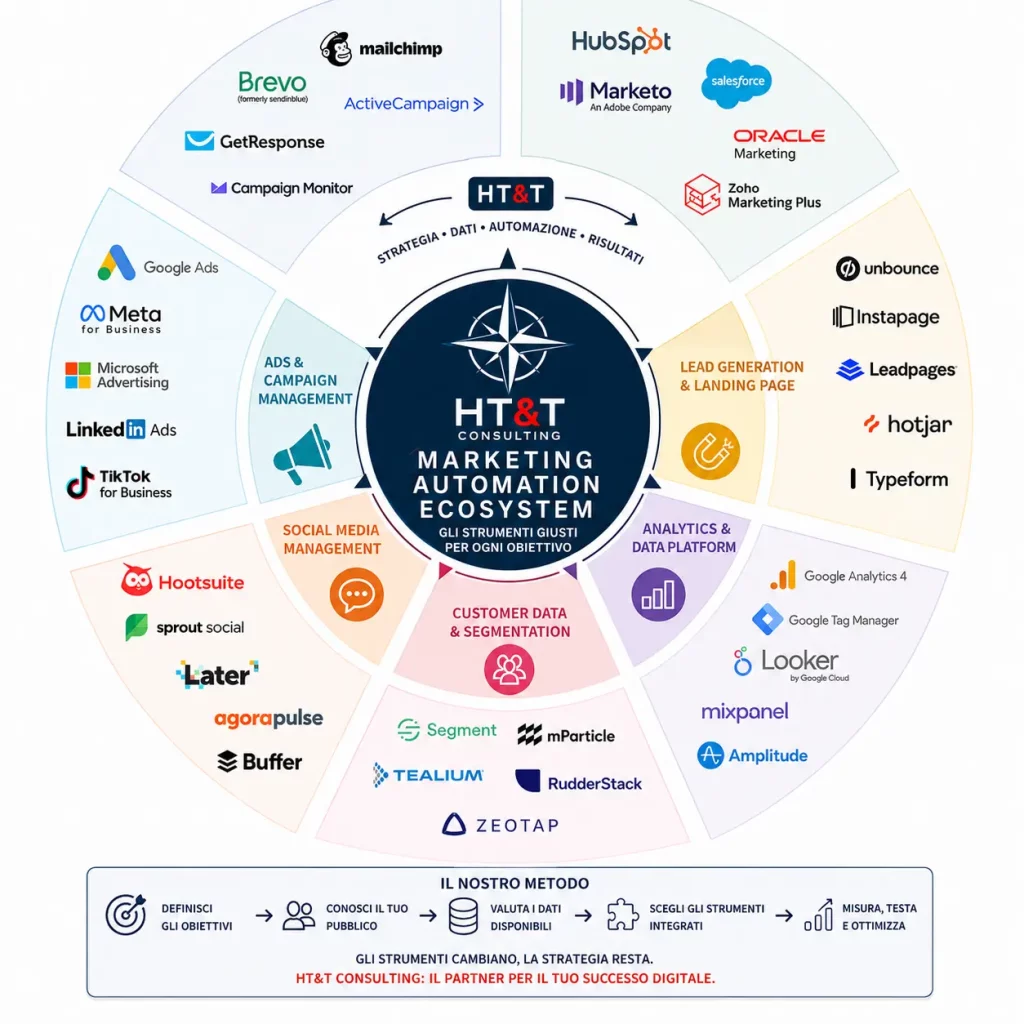
For an ecommerce business, the choice of tool depends mainly on the quality of the integration with the sales platform, and on how catalog, orders, customers, segments and behavioral data are managed.
You do not necessarily need the most complex platform: you need the one that allows you to activate reliable flows without creating too much manual work.
In ecommerce contexts, platforms such as Klaviyo, ActiveCampaign, Mailchimp, Brevo, MailUp and Blendee are often evaluated, as well as solutions integrated into the CRMs already present in the company. Klaviyo can be interesting when the focus is on Shopify, ecommerce segmentation, post-purchase flows and abandoned cart recovery. ActiveCampaign can be suitable when you need to combine automation, a lightweight CRM and more relational paths. Mailchimp and Brevo can make sense in simpler contexts, where the main objective is to structure newsletters, lists and first automated flows. MailUp is a very present solution in the Italian market, especially for companies working on structured email marketing, database management and recurring sends. Blendee can be evaluated when the project requires personalization, customer data platform, advanced segmentation and omnichannel activation.
The practical evaluation should start from a few questions: does the platform correctly receive purchase events? Can it segment by product, category, customer value and purchase frequency? Does it allow you to exclude those who have already entered other flows? Does it clearly measure the revenue generated by each automation?
When advanced automation and orchestration are needed
In some cases, classic marketing automation is not enough, because the process involves multiple systems: ecommerce, CRM, ERP, customer care, advertising platforms, internal databases or project management tools. In these scenarios, it can be useful to introduce an orchestration layer.
Tools such as n8n, Make or custom API-based solutions can be useful when you need to connect different systems, synchronize data, create alerts, update CRM records, send internal notifications or activate processes that do not fit into the standard flows of an email platform.
In this article, we explored how to structure flows between different systems using tools such as n8n and Supermetrics for data automation
, with practical examples of integration between analytics, CRM and marketing platforms.
A concrete example: if an ecommerce business wants to notify the team when a flow generates a sudden drop in conversions, when a VIP segment exceeds a certain spending threshold, or when a B2B request must be automatically assigned to a salesperson, orchestration can become more useful than simple email automation.
Marketing automation and AI: what has changed?
The integration between marketing automation and artificial intelligence has accelerated significantly over the last two years. These are no longer experimental features but the new baseline of leading platforms.
The areas where AI has concretely changed the way marketing automation is done are three:
1. Predictive personalization
The most advanced platforms no longer limit themselves to segmenting based on past behaviors but predict future behaviors. Which products is a user likely to buy?
When are they likely to churn? What is the best time to send them an email?
AI answers these questions in real time, for each user.
2. Content generation and optimization
AI systems integrated into automation platforms suggest email subject lines, automatically test copy variants and optimize messages based on historical performance. This reduces content production time and increases message relevance.
3. Omnichannel orchestration
AI manages the sequence and the optimal channel for each communication, deciding in real time whether an email, an SMS, a push notification
or a remarketing ad is better, based on the user’s recent behavior and probability of response on each channel.
This development is consistent with the broader trend toward AI systems that work autonomously on complex processes, as explored in the article on business process automation with n8n and in the reflection on how AI works with our brain to make faster and more precise decisions.
“AI has not made marketing automation obsolete, it has made it more powerful. But it has also raised the bar: you need the right, clean and connected data so that AI has material to work with.”
Common mistakes in marketing automation
Mistake 1 – Automating without a strategy
Activating flows just because “you need to have them” without defining objectives, segments and messages produces automations that work technically but do not produce results.
Before touching the tool, you need to answer: who receives this flow?
What do we want them to do? How do we measure success?
Mistake 2 – Dirty data in the CRM
Marketing automation is only as accurate as the data it is based on.
Duplicate contacts, incomplete fields, poorly built segments: every data issue is amplified in automation, producing messages sent to the wrong people or not sent at all.
Before implementing any advanced flow, perform a database audit: deduplication, field normalization, verification of active email addresses.
Mistake 3 – Too many active flows at the same time
A user who simultaneously receives a welcome flow, a win-back flow and a manual promotional campaign does not have a coherent experience, they have a chaotic experience. Flow overlap is one of the most underestimated and most damaging mistakes for deliverability and brand perception.
Mistake 4 – Not measuring flows individually
Looking only at aggregate email marketing metrics hides what works and what does not. Each flow must have its own reference metrics: open rate, click rate, conversion rate, generated revenue and must be optimized individually.
Mistake 5 – Not updating flows over time
A flow configured 18 months ago with offers, products and messages from that period is probably obsolete. Marketing automation is not a system to configure and forget: it requires periodic reviews, systematic A/B testing and content updates.
Schedule a quarterly review of all active flows.
Check KPIs, update content and test at least one variant per flow every quarter.
Not managing automation directly? What to monitor
If you have a team or an agency managing marketing automation, you do not need to know how to build every single flow, but you do need to know what to ask to understand whether the work is being done properly.
The right questions to ask every quarter
- How many active contacts are there in the database? How many have been cleaned recently?
- What is the average open rate of automated flows compared to manual campaigns?
- How much revenue is attributed to automation flows every month?
- Which flows have been optimized or tested in the last quarter?
- Is there overlap between automated flows and manual campaigns?
Signs that something is wrong
- Increasing unsubscribe rate — messages too frequent or not relevant enough
- Declining deliverability — technical issues or unclean database
- Flat automation revenue — obsolete or not optimized flows
- No active A/B tests — lack of systematic optimization
Well-implemented marketing automation produces clear and measurable data.
If you cannot answer “how much is each flow worth in terms of revenue“, there is a measurement problem, not an automation problem.
On this topic, our guide to data visualization to simplify data and speed up decision-making is also useful.
Frequently asked questions about marketing automation
What is marketing automation in simple words?
Marketing automation is a system that automatically sends
personalized communications to users based on their behaviors and characteristics.
Instead of sending the same message to everyone, it sends the right message
to the right person at the right time — without manual intervention.
What is the difference between marketing automation and email marketing?
Traditional email marketing sends broadcast campaigns — the same message
to the whole list or to a static segment. Marketing automation sends messages
triggered by specific behaviors, in logical sequences, with different paths
for different segments. Email marketing is a tool; marketing automation
is a system.
Does marketing automation also work for SMEs?
Yes. Many platforms offer accessible plans for companies of every size.
Even with a database of just a few thousand contacts, welcome flows, abandoned cart recovery and post-purchase flows produce measurable results.
The starting point is not the size of the company — it is having clear data
and clear objectives.
How long does it take to implement marketing automation?
It depends on complexity. Basic flows — welcome, abandoned cart, post-purchase — can be operational in 2-4 weeks with integration on standard platforms such as Shopify or WooCommerce. More complex implementations with CRM, lead scoring and custom integrations require 2-3 months.
How do you measure the ROI of marketing automation?
The main metrics are revenue attributed to flows, conversion rate per automation, churn reduction, CLV increase and customer acquisition cost reduction. Most platforms offer native reports for these KPIs; it is important to configure them correctly from the beginning.
Marketing automation and GDPR: what do you need to know?
Marketing automation collects and processes personal data, therefore it is subject to GDPR. The critical points are: explicit and documented consent for each type of communication, easy and immediate unsubscribe options, a clear data retention policy, and data security within the system.
Most enterprise platforms handle these aspects
natively, but responsibility for policies remains with the company.
What is the difference between marketing automation and CRM?
CRM is the system that stores contact data and manages business relationships. Marketing automation is the system that uses that data to communicate automatically and in a personalized way. They are often integrated or included in the same platform — but they can also be separate systems that communicate via API.
Can marketing automation replace the marketing team?
No. Marketing automation executes repetitive and scalable processes, but it requires strategy, content, optimization and human supervision.
It frees the team from repetitive manual activities so they can focus on high-value activities — strategy, creativity, analysis, customer relationships.
Checklist: what to verify before activating flows
Before considering a marketing automation system ready, verify these points:
- Clean database — no duplicates, mandatory fields completed, valid emails
- Documented GDPR consent for each type of communication
- Tested and working integration with ecommerce or CRM
- Welcome flow active and tested on all major email clients
- Abandoned cart flow configured with at least 3 steps
- Post-purchase flow with review request active
- Win-back flow configured for contacts inactive for 90+ days
- Active exclusions — contacts do not receive multiple flows at the same time
- Maximum sending frequency set to avoid overlaps
- KPIs for each flow defined and monitored
- A/B test planned for at least one element per flow
- Quarterly flow review scheduled in the calendar
Marketing automation is not a project that ends, but a system that must be maintained, optimized and updated over time.
The difference between automation that produces results and automation that runs out of steam after a few months lies in the care with which it is managed after launch.
And in a context where user behaviors change rapidly (influenced by AI, zero-click search and new discovery channels) the ability to adapt flows to change is the real competitive advantage.
On this topic, the article on how the role of content is changing in the AI era is also useful.
Bibliography and useful sources
HubSpot – Marketing Automation
Introductory guide on marketing automation, workflows, CRM, lead nurturing and sales automations.
Salesforce – Marketing Automation
Insights on marketing automation platforms, CRM, customer journey and personalization.
MailUp – Statistical Observatory
Italian benchmarks on email marketing, sends, opens, clicks, industries and user behavior.
Klaviyo – Ecommerce Benchmarks
Ecommerce benchmarks on email, SMS, automations, revenue per recipient and performance by industry.
Omnisend – Ecommerce Marketing Report
Report on ecommerce automation, welcome emails, abandoned cart recovery, SMS and customer journey.
Gartner – Marketing Automation
Market analysis on platforms, customer journey orchestration, data and marketing automation.
HT&T Magazine – n8n and Supermetrics
Insights on marketing data automation, integration between sources, CRM, analytics and reporting.
HT&T Magazine – GA4 ecommerce
Technical guide on ecommerce events, conversions, dataLayer, tracking and data quality.
Continua a leggere
11 minutes of reading

18 minutes of reading

8 minutes of reading

And it consumes less energy.
To return to the page you were visiting, simply click or scroll.