Amazon Ads: Complete Guide to Sponsored Products, ACOS and ROAS

Ecommerce & Performance Marketing
(also known as Amazon Advertising,
Amazon Sponsored Ads or Amazon PPC)
Amazon Ads: The Complete Guide to Sponsored Products, ACOS and Strategies to Sell on Amazon
More than 60% of product searches now begin directly on Amazon rather than Google.
Brands that sell online and fail to invest in Amazon advertising are giving visibility
to competitors that do. This guide explains how Amazon Ads formats work, how much they
cost, and how to interpret ACOS, ROAS and TACOS without confusion.

At a Glance
Amazon Ads is Amazon’s advertising platform that allows brands to
promote products directly within search results and product detail pages across the
marketplace. The main ad formats are Sponsored Products, Sponsored Brands,
Sponsored Display and Amazon DSP, each serving a different role throughout the
customer journey, from discovery to conversion.
The average CPC for Sponsored Products across Italy and Europe ranges between
€0.80 and €1.20, representing an increase of approximately 8–12%
compared to 2025. Average global ACOS typically ranges between 28% and 30%,
while top-performing advertisers consistently remain below 25%.
The most important metric for Amazon sellers is often not campaign ROAS but
TACOS (Total Advertising Cost of Sales). TACOS measures how organic
sales grow over time thanks to the combined impact of advertising and ranking
improvements, rather than focusing exclusively on short-term advertising efficiency.
Updated June 2026. This guide includes ACOS, ROAS and CPC benchmarks
for 2025–2026, updates regarding Amazon’s “shopping-signal enhanced” attribution model
introduced in January 2026, Ads Agent and Prime Video Insights announcements presented
at unBoxed Milan 2026, and a comparison between Amazon Ads and other ecommerce
advertising channels.
Amazon Ads by the Numbers
Why Invest in Amazon Ads?
More than 60% of online product searches now start directly on Amazon rather than Google.
For companies selling physical products, Amazon is no longer just a sales channel;
it has become one of the world’s largest search engines for purchase intent.
Brands that fail to advertise on Amazon leave visibility—and revenue—to competitors that do.
Amazon’s advertising business generated $47.4 billion in global revenue in 2024,
growing 24% year-over-year. Sponsored Products alone accounted for approximately 65%
of all advertising spend on the platform, clearly indicating where serious Amazon
sellers allocate their budgets.
“Amazon Ads was recognized by Forrester as the Leader in The Forrester Wave:
Omnichannel Advertising Platforms, Q1 2026.”
In Italy, Amazon Ads further expanded its offering for advertisers during
unBoxed Milan 2026, where Amazon announced the launch of
Ads Agent, an AI-powered campaign planning assistant, and
Prime Video Insights within Amazon Marketing Cloud.
These developments reinforce Amazon’s vision of a fully integrated advertising
ecosystem that connects streaming, search and ecommerce.
For ecommerce brands operating across multiple channels, Amazon strategy should be
aligned with Google Shopping and other acquisition channels. Managing product data
consistently across marketplaces and advertising platforms is increasingly critical
to maintaining efficiency and scalability.
Amazon Ads Formats: Sponsored Products, Brands, Display and DSP
Amazon Ads consists of four primary advertising solutions, each designed for a
specific objective and stage of the customer journey.
Amazon Ads Formats: Operational Comparison
| Format | Where It Appears | Primary Objective | Attribution Window |
|---|---|---|---|
| Sponsored Products | Search results and product detail pages | Direct conversions and visibility on targeted keywords | 7 days (click-based) |
| Sponsored Brands | Top of search results with logo and featured products | Brand awareness and consideration, showcasing up to three products | 14 days (click-based) |
| Sponsored Display | Product detail pages (on Amazon only in Italy) | Retargeting and competitor/category targeting | 14 days (click-based) |
| Amazon DSP | Amazon inventory and third-party websites, including off-Amazon placements | Large-scale awareness campaigns, available even to brands not selling on Amazon | CPM-based model rather than CPC |
Sponsored Brands offers a significant advantage for established
brands because it does not require access to Amazon DSP and is therefore available
to advertisers of virtually any size. The ad format includes a brand logo, a
customizable headline with a call-to-action, and up to three featured products
complete with images, pricing and reviews. This makes it particularly effective
for increasing brand recognition while driving traffic to a product portfolio.
Sponsored Display, in the Italian market, appears exclusively on
Amazon product detail pages, often near the product description or below the Buy Box.
Since it does not appear within search results, keyword targeting is unavailable.
Instead, advertisers target products, audiences or categories, making Sponsored
Display highly effective for reaching shoppers actively evaluating competing products.
ACOS, ROAS and TACOS: Understanding the Metrics That Matter
Amazon advertisers frequently encounter three metrics that are often confused with
one another. Understanding the differences between them is essential not only for
optimizing campaigns, but for optimizing the business itself.
ACOS (Advertising Cost of Sales)
ACOS represents the percentage of attributed revenue spent on
advertising and is calculated as:
ACOS = Advertising Spend ÷ Attributed Sales × 100
An ACOS of 25% means that for every €100 generated through advertising,
€25 was spent on ads.
ACOS and ROAS are simply two ways of expressing the same relationship.
For example:
- 20% ACOS = 5x ROAS
- 25% ACOS = 4x ROAS
- 33% ACOS = 3x ROAS
They are not alternative metrics; they communicate the same information from
opposite perspectives.
Break-even ACOS
The break-even ACOS is the maximum ACOS threshold at which a
campaign remains profitable. It is calculated as:
      Break-even ACOS =

      (Selling Price − All Non-Advertising Costs)

      ÷ Selling Price × 100
In practice, break-even ACOS corresponds to the product’s profit margin before
advertising expenses are considered. Every percentage point above this threshold
represents a loss; every percentage point below it represents profit.
TACOS: The Metric That Measures Business Health, Not Just Campaign Performance
TACOS (Total Advertising Cost of Sales) measures advertising
spend against total revenue, including both organic and advertising-driven sales.
Unlike ACOS, which evaluates only attributed advertising revenue, TACOS helps
determine whether advertising is contributing to sustainable organic growth.
A declining TACOS over time, even with a stable ACOS, indicates that advertising
campaigns are helping generate real organic growth. Rankings improve, visibility
expands, and the business becomes progressively less dependent on paid advertising
to generate sales.
A practical recommendation is to monitor ACOS daily for campaign
optimization decisions and review TACOS weekly to understand
whether advertising is building a stronger business or merely creating dependence
on ad spend.
For advertisers interested in moving beyond surface-level performance metrics,
it is important to understand that optimizing exclusively for ROAS can often
lead to short-term decisions that damage long-term profitability and growth.
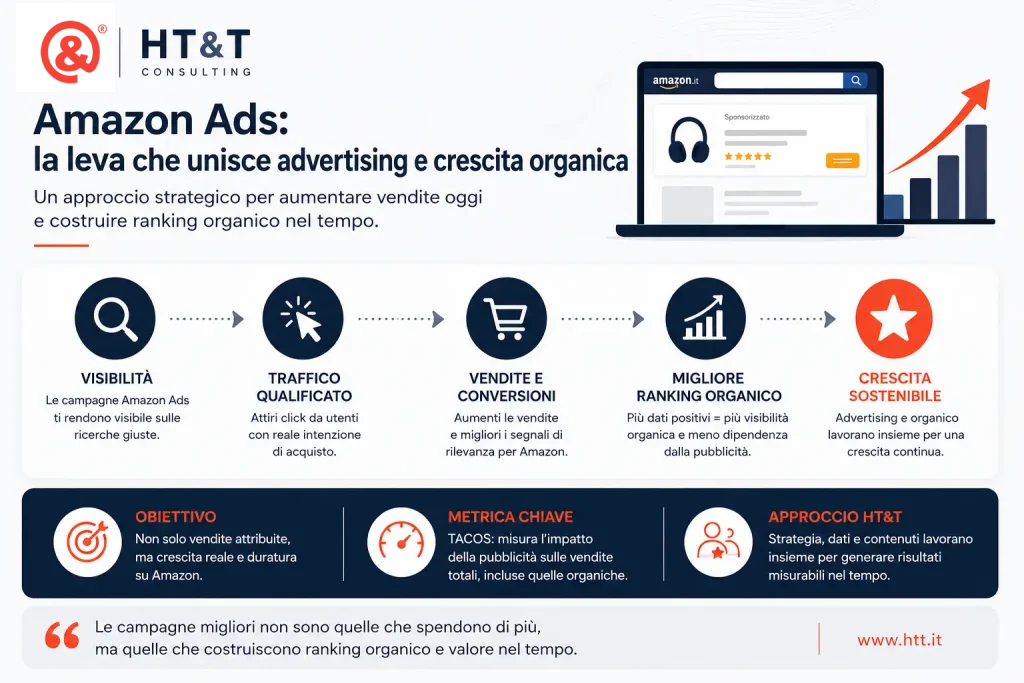
How Amazon Ads Influences Organic Ranking
Amazon Ads does not directly improve organic ranking simply because more money
is invested into advertising. The impact is indirect, but highly significant.
Advertising campaigns increase visibility, qualified traffic, sales velocity,
conversion history and customer engagement. These signals help Amazon’s algorithm
determine whether a product is relevant for specific search queries.
When a Sponsored Products campaign generates sales for a specific keyword,
Amazon collects positive behavioral signals. Shoppers search, click, purchase
and potentially leave reviews. As these signals accumulate over time, the product
may improve its organic position for the same keyword and related search terms.
From Sponsored Click to Organic Ranking
| Signal Generated by Amazon Ads | Impact on the Product | Potential Effect on Organic Ranking |
|---|---|---|
| More Impressions | The product is exposed to a larger audience for relevant searches. | Increases opportunities to collect useful keyword and demand signals. |
| More Qualified Clicks | Amazon measures shopper interest and search relevance. | Can strengthen the association between the product and targeted queries. |
| More Attributed Sales | Sales velocity increases. | Helps demonstrate commercial relevance to Amazon’s algorithm. |
| Higher Conversion Rate | The listing converts traffic more efficiently. | Positive signal regarding listing quality and relevance. |
| More Reviews Over Time | Stronger social proof. | Improves click-through rate, conversion rate and organic competitiveness. |
This is why TACOS is often more strategic than campaign-level ACOS.
If TACOS decreases while total sales continue growing, advertising is helping
drive organic growth. If TACOS remains high and organic sales fail to improve,
advertising may simply be purchasing sales without building long-term ranking strength.
Amazon Ads is not just a tool for buying traffic. It is a tool for generating
the signals Amazon uses to determine which products deserve greater visibility.
The best campaigns are the ones that build organic ranking, not just attributed sales.
Sandro Caneschi, CTO, HT&T Consulting
The objective should not be limited to generating sales through advertising.
The goal is to create a virtuous cycle:
More visibility → More sales → More data → Better ranking →
More organic sales → Lower dependency on advertising spend.
How Much Does Amazon Advertising Cost?
The average CPC for Sponsored Products across Italy and Europe ranges between
€0.80 and €1.20, representing an increase of approximately
8–12% compared to 2025.
However, average CPC figures can be misleading because competition varies
dramatically between product categories. The cost per click for premium
supplements is not comparable to that of handcrafted products or hobby items.
Differences of five to ten times are common.
Average Amazon Ads CPC by Category (Europe, 2025–2026)
| Category | Average CPC | Notes |
|---|---|---|
| Consumer Electronics | €1.80–€3.50+ | Highly competitive category with some of the strongest ROAS performance (~3.98x). |
| Health & Supplements | €1.80–€3.50+ | Strong competition but margins often support higher CPCs. |
| Premium Beauty | €1.85–€2.47 | Among the fastest-growing CPC categories year-over-year. |
| High-Margin Pet Products | €1.80–€3.50+ | High customer loyalty often justifies more aggressive bidding. |
| Premium Toys | €1.80–€3.50+ | Strong seasonality, particularly during Q4. |
| Crafts & Hobbies | Below €0.50 | Lower competition and excellent visibility-to-cost ratio. |
Sponsored Display recorded the most significant CPC increase
among Amazon advertising formats, rising approximately 49% year-over-year.
This growth is largely attributed to Amazon’s expansion into off-Amazon
inventory, including streaming services and third-party applications.
Amazon DSP operates on a CPM (cost per thousand impressions)
model rather than CPC. It is generally not recommended for brands with fewer
than 50 ASINs or limited purchase history.
For effective DSP usage, a minimum monthly budget of approximately
€10,000 is typically recommended.
Attribution and Conversion Windows
Amazon’s click-based attribution windows remain unchanged.
Sponsored Products uses a
7-day attribution window,
while Sponsored Brands and
Sponsored Display use a
14-day attribution window.
What changed in January 2026 was Amazon’s attribution methodology for
view-through conversions. Amazon introduced a new
“shopping-signal enhanced” model that incorporates richer
purchase-intent signals when evaluating conversions not directly tied to clicks.
One frequently overlooked consequence is that campaign performance should
never be evaluated too early.
For Sponsored Products, advertisers should generally wait at least
8 days before drawing conclusions.
For Sponsored Brands, a minimum of
15 days is recommended.
Pausing campaigns or adjusting bids after only 48–72 hours remains one of
the most common—and costly—mistakes in Amazon advertising management.
Attribution challenges are not unique to Amazon. Every advertising platform
depends on data quality and measurement architecture.
The more accurately data is collected and interpreted, the more reliable
optimization decisions become.
How to Structure Amazon Ads Campaigns by Category and Objective
Campaign structure has a greater impact on advertising efficiency than
individual bid adjustments.
The foundations of an effective Amazon Ads structure include:
-
Separate campaigns by match type:
Broad Match, Phrase Match and Exact Match should be isolated to maintain
budget control and prevent internal competition. -
Build negative keyword lists systematically:
Identify irrelevant search queries through search term reports and exclude
them to reduce wasted spend. -
Use a silo-based campaign architecture:
Separate campaigns by product category, launch strategy, growth objectives,
profitability goals or defensive branding initiatives. -
Adjust ACOS targets according to product lifecycle stage:
New product launches can support higher ACOS targets than mature,
established products. -
Test video advertising formats:
Video ads often generate two to three times more engagement than static
creatives and can improve ROAS by 20–40% when used effectively.
A practical optimization workflow is to analyze the previous 90 days of
performance data, including ACOS, ROAS, CPC and conversion rate metrics.
Any campaign with ACOS above 30% or ROAS below 3x should be flagged for
review. In many cases, improving campaign architecture delivers stronger
results than simply adjusting bids.
The principles behind Amazon Ads campaign organization are remarkably similar
to those used in Google Ads ecommerce campaigns: segmentation, budget control,
search intent alignment and performance-based optimization.
Common Amazon Ads Mistakes
Common Mistakes and How to Fix Them
| Mistake | Symptom | Solution |
|---|---|---|
| Evaluating campaigns too early | Decisions based on incomplete data | Wait at least 8 days for Sponsored Products and 15 days for Sponsored Brands |
| Confusing ACOS with break-even ACOS | Profitable campaigns incorrectly considered unprofitable | Calculate break-even ACOS for each product before judging performance |
| Optimizing only for ROAS | Organic growth stagnates and advertising dependency increases | Monitor TACOS weekly to evaluate overall business health |
| Poor-quality listings | Higher CPCs than necessary | Improve titles, images, bullet points and A+ Content before increasing bids |
| No negative keywords | Budget wasted on irrelevant searches | Review search term reports regularly and add negatives systematically |
| Using DSP without sufficient data | High spend and inconsistent performance | Reserve DSP for catalogs with 50+ ASINs and significant purchase history |
Amazon Ads vs Google Shopping vs Meta Ads: Which Channel Should Ecommerce Brands Choose?
For most ecommerce brands, this is not an either-or decision.
Each platform plays a different role within the customer journey.
Amazon Ads vs Google Shopping vs Meta Ads
| Channel | Primary Strength | Ideal Funnel Stage | Main Limitation |
|---|---|---|---|
| Amazon Ads | Extremely high purchase intent and built-in social proof through reviews | Product discovery and direct conversion | Marketplace fees and advertising costs can reduce margins |
| Google Shopping | Full ownership of customer data and the ecommerce experience | Conversion through owned channels | Requires brands to generate their own traffic |
| Meta Ads | Powerful audience targeting and relatively low impression costs | Awareness, discovery and retargeting | Lower purchase intent compared to search-driven channels |
Many mature brands use Amazon as a high-intent conversion channel while
Google and Meta generate awareness and demand. Together, these channels
create a more balanced and resilient acquisition strategy.
When Amazon Ads Makes Sense (and When It Doesn’t)
| Scenario | Amazon Ads Suitability | Reason |
|---|---|---|
| Products with many reviews | ★★★★★ | Strong social proof improves conversion rates. |
| Highly comparable commodity products | ★★★★★ | Shoppers often search directly on Amazon. |
| New brands without reviews | ★★☆☆☆ | Awareness and review generation may be required first. |
| Low-margin products | ★★☆☆☆ | Marketplace fees and advertising costs may erode profitability. |
| Premium or innovative products | ★★★★☆ | Performs well when supported by strong branding and A+ Content. |
The most common mistake is optimizing campaigns while ignoring the catalog.
On Amazon, real competitive advantage emerges when advertising, content,
reviews and pricing work together.
Massimiliano Baldocchi, CEO, HT&T Consulting
Conclusion: Amazon Ads Is a Ranking Growth Engine
Many businesses evaluate Amazon Ads exclusively through campaign ACOS or ROAS.
While understandable, this approach is incomplete.
Amazon advertising does far more than generate immediate sales. It influences
visibility, sales velocity, review volume and organic ranking performance.
A seemingly high ACOS may be entirely sustainable during a product launch,
while a low ACOS may conceal stagnant growth.
This is why TACOS, break-even ACOS and the proportion of organic sales should
always be analyzed together.
If you want to understand the growth potential of your Amazon Advertising account,
the first step is a comprehensive audit covering campaigns, listings, catalog
structure and business metrics.
Only then is it possible to determine whether the limitation lies in the budget,
the strategy or simply in the way performance data is being interpreted.
Frequently Asked Questions About Amazon Ads
What is considered a good ACOS on Amazon Ads?
There is no universally “good” ACOS. It depends on profit margins and the
product’s lifecycle stage. The most important benchmark is your break-even ACOS.
What is the difference between ACOS, ROAS and TACOS?
ACOS and ROAS measure advertising efficiency from opposite perspectives,
while TACOS evaluates advertising spend against total business revenue,
including organic sales.
How much does Amazon advertising cost?
Average CPC typically ranges from €0.80 to €1.20, although costs vary
significantly depending on category competitiveness.
How long should I wait before evaluating campaign performance?
At least 8 days for Sponsored Products and 15 days for Sponsored Brands,
allowing attribution windows to close properly.
What is the difference between Sponsored Ads and Amazon DSP?
Sponsored Ads are self-service CPC-based formats, while Amazon DSP is a
CPM-based programmatic platform designed for larger budgets and broader audiences.
Should I invest in Amazon Ads or Google Shopping?
They are complementary channels. Amazon excels at converting high-intent
shoppers, while Google Shopping drives traffic to your owned ecommerce store.
Is Amazon Ads suitable for small and medium-sized businesses?
Yes. Sponsored Products, Sponsored Brands and Sponsored Display have no
mandatory minimum budget requirements, making them accessible to SMEs.
Can Amazon Ads work without FBA?
Yes. Both FBA and FBM sellers can advertise. However, FBA products often
benefit from higher conversion rates thanks to Prime eligibility.
How much budget is needed to start with Amazon Ads?
Many businesses begin with budgets between €300 and €1,000 per month,
depending on category competitiveness.
Does Amazon Ads work for new brands?
Yes. Amazon Ads can help generate initial sales, collect reviews and build
organic ranking. Higher ACOS levels are often expected during launch phases.
What is listing quality score and how does it affect advertising costs?
Listing quality is influenced by titles, images, bullet points and A+ Content.
Better listings typically achieve lower CPCs and stronger conversion rates.
Amazon Ads Audit Checklist
- Break-even ACOS calculated for every key product in the catalog
- Campaigns separated by match type (Broad, Phrase and Exact)
- Negative keywords regularly updated using recent search term reports
-
ACOS targets differentiated according to the product lifecycle stage
(launch, growth or profit phase) - TACOS monitored weekly, not just campaign-level ACOS
-
Listings fully optimized (title, bullet points, A+ Content and images)
before increasing bids -
No performance evaluation before 8 days for Sponsored Products or
15 days for Sponsored Brands -
At least one video advertising format tested for products with
sufficient margin - Monthly review of campaigns with ACOS above 30% or ROAS below 3x
-
DSP budget allocated only to catalogs with 50+ ASINs and a
meaningful purchase history
Sources & References
Amazon Advertising – Resource Library
Official guides, case studies and product updates directly from Amazon Ads.
Feedvisor – Amazon ACOS Benchmark 2026
Analysis of ACOS, CPC and attribution benchmarks updated for 2026.
Get-Ryze.ai – Amazon Ads Benchmarks by Category 2026
Analysis of more than 850 Amazon accounts, including ACOS, ROAS
and CPC benchmarks across multiple product categories.
Epinium – Amazon Ads Costs and CPC Benchmarks 2026
Market data focused on Italy and Europe, including CPC comparisons
by product category.
HT&T Magazine – Feed Management & Product Feeds
How to manage product data across marketplaces, advertising channels
and ecommerce platforms.
Continua a leggere
5 minutes of reading

28 minutes of reading


And it consumes less energy.
To return to the page you were visiting, simply click or scroll.