Answer Engine Optimization: How to get chosen by AI before you’re even searched.

AEO & GEO
AEO – Answer Engine Optimization: how to be chosen by AI before users even search for you
AEO (Answer Engine Optimization) is the set of strategies that help a brand be selected by artificial intelligence systems as an authoritative source in answers generated by Google, ChatGPT, Gemini and Perplexity.
Search engines have stopped showing results. They show answers.
From search to answers
Until a few years ago, the path was simple: the user typed a query, Google returned ten blue links, and the SEO’s job was to bring their website as high as possible in that list. Today, that model has structurally changed.
Generative AI systems (ChatGPT, Perplexity, Gemini, Claude) do not show links: they show answers. And Google itself, with AI Overviews, has integrated generative logic directly into the traditional SERP, synthesizing content from multiple sources and presenting a direct answer before the user can click on any organic result.
The result is that a growing share of searches ends without a click, not because the user has not found what they were looking for, but because they found it directly in the answer, without ever visiting a website. This phenomenon has a name: zero-click search, and it is reshaping the rules of organic traffic.
Zero-click rate by search type
Sources: Semrush 2025 · Digital Bloom IQ 2025 · Bain & Company 2025 · Search Engine Journal 2026
In this scenario, AEO – Answer Engine Optimization emerges. It is not a replacement for SEO, but its natural evolution toward an ecosystem where value is not measured only by ranking, but by the ability to become the source that engines choose to build their answers.
What is AEO and how does it differ from traditional SEO?
Answer Engine Optimization is the set of techniques and strategies designed to ensure that your content is selected by answer engines, the systems that generate direct answers instead of lists of links, as an authoritative and reliable source.
Traditional SEO focuses on positioning within search result pages; AEO focuses on something more ambitious: being the answer, not just one result among many.
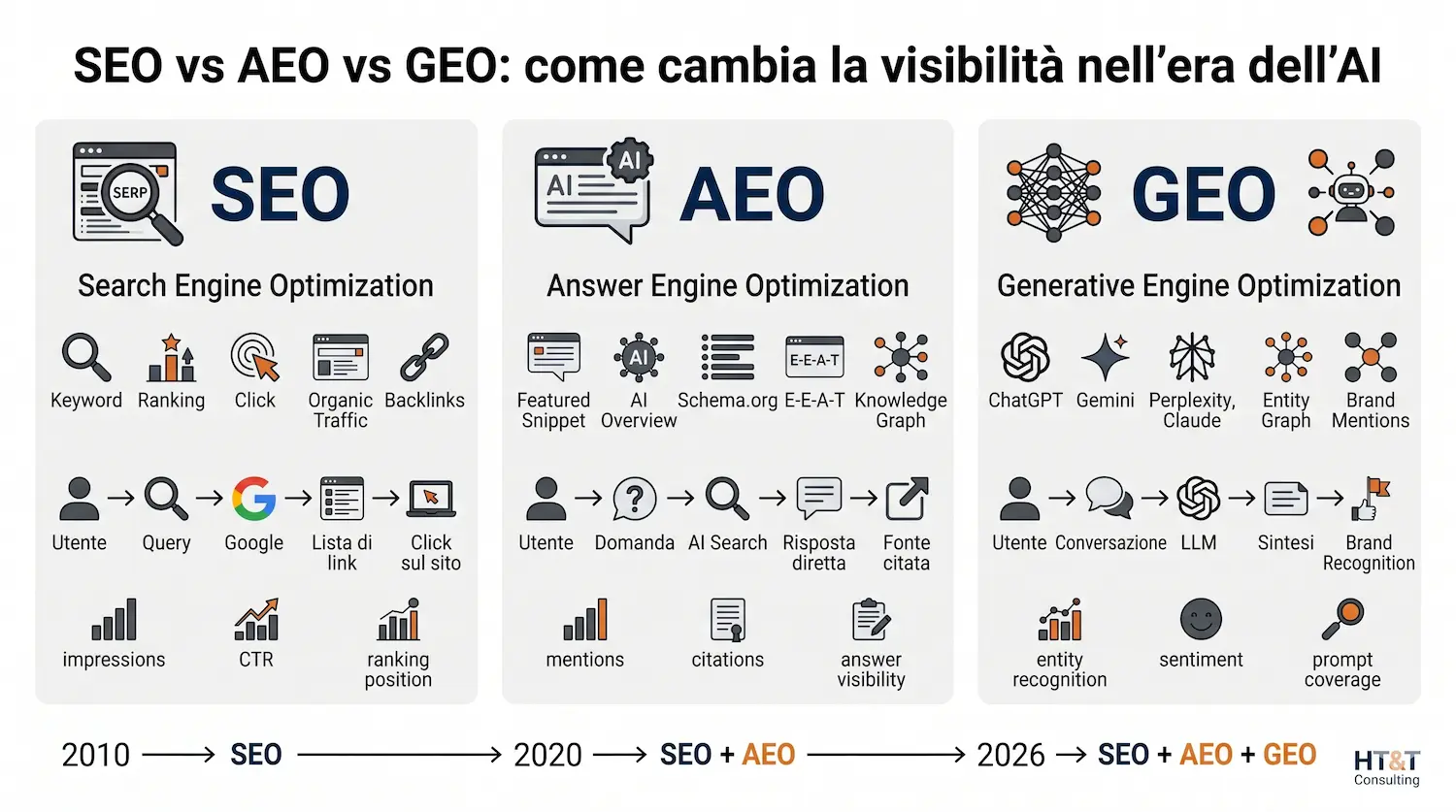
SEO works to gain visibility in results. AEO works to become a source that artificial intelligence systems can select, cite and synthesize.
For this reason, AEO should be understood as a natural extension of SEO consulting: it does not replace organic positioning work, but makes it more suitable for an ecosystem dominated by generated answers, snippets and AI summaries.
The main answer engines to monitor
The main answer engines that currently influence a brand’s visibility are:
- Google AI Overview: the generative summary integrated into Google’s SERP.
- Google Featured Snippet: the highlighted answer displayed above organic results.
- Google Knowledge Panel: the information panel about brands and entities.
- People Also Ask: related questions with expandable answers.
- Perplexity AI: a generative AI-based search engine that cites sources.
- ChatGPT with Browse: answers with references to real-time web sources.
- Gemini: Google’s AI integrated into Search and Workspace.
Each of these systems has its own selection logic, but they all share one fundamental principle: they prefer clear, structured, authoritative and verifiable content.
Why has AEO become so important?
The decline in organic traffic is a measurable reality. Data shows that websites that relied exclusively on traditional SEO positioning are experiencing significant drops in sessions from Google, alongside the expansion of AI Overviews in Italian and international SERPs.
Google’s evolution toward generated answers and increasingly conversational queries is also connected to Google AI Max for Shopping and Travel, where AI automation affects not only organic visibility, but also the creation and distribution of advertising campaigns.
The issue is not that Google is penalizing those sites, but that AI intercepts the question before the user reaches the link. If your content is not cited as a source by AI, it simply does not exist within that answer.
For companies, especially B2B businesses, businesses with complex products or those operating in highly competitive information-driven sectors, the question is no longer how to rank on the first page, but how to make AI cite me when answering my target audience’s questions.
It is no longer enough to be relevant for Google: you need to be recognizable to AI.
The 7 operational levers of AEO
Optimizing for answer engines does not require rewriting everything from scratch. It requires better structuring what already exists and adding the signals that AI systems use to assess the reliability of a source.
1. Structured data and Schema.org
Schema.org markup is the language used to speak directly to machines. Correctly implementing types such as FAQPage, Article, Organization, Product, HowTo and Review allows engines to understand not only the content of the page, but also its context, purpose and reliability. It is the mandatory starting point for any AEO strategy.
In this sense, structured data is no longer just SEO support: it becomes a true semantic infrastructure that helps search engines and AI interpret content, entities and relationships correctly.
2. Question-based content
Answer engines look for content that answers specific questions directly and comprehensively. Structuring articles with explicit questions as H2 or H3 headings, followed by concise answers in the first two paragraphs, significantly increases the likelihood of being selected as a source for featured snippets and AI Overviews.
The rule is simple: if a question is worth answering, the answer must come immediately, not after three introductory paragraphs.
3. E-E-A-T: Experience, Expertise, Authoritativeness, Trustworthiness
Google and AI models evaluate the credibility of a source before citing it. E-E-A-T is not a single factor but a set of signals: authors with verifiable bios and links to LinkedIn profiles, citations from authoritative external sources, original data, transparent methodologies and visible update dates. For B2B brands, the author page is often the most overlooked and most impactful signal.
4. Topical authority
A website that covers a topic in depth, with related articles, guides, glossaries and case studies, is perceived as a vertical authority on that subject. AI systems tend to cite sources that demonstrate systematic coverage of a topic, not those with a single isolated article. Building content clusters around your areas of expertise is the most effective editorial strategy for AEO.
The same principle makes it strategic to build editorial content that is connected over time, as happens in pathways dedicated to the law of acceleration in marketing: it is not enough to cover a single topic; you need continuity, depth and recognizability.
5. Strategic internal linking
Connecting articles to each other in a semantically coherent way helps both human and AI crawlers understand the hierarchy of content and the depth of each page. A key article that is well linked from ten satellite articles has a better chance of being selected as a source than an isolated article, even if the content quality is equivalent.
This is why internal linking should not be treated as a secondary activity, but as part of an AEO and GEO strategy: it helps machines read the website as a coherent system, not as a collection of isolated pages.
6. Speed and Core Web Vitals
A slow or unstable page is penalized both by Google and by models that use real-time browsing. Core Web Vitals (LCP, INP, CLS) remain a fundamental technical prerequisite. Excellent content on a slow page is content that risks never being reached.
7. Knowledge Graph and structured data about the brand entity
Google’s Knowledge Graph is the system through which the engine maps relationships between entities: brands, people, places and concepts. Being correctly represented in the Knowledge Graph, with Organization schema, sameAs links to Wikipedia or Wikidata, verified social profiles and consistent citations across the web, is essential to ensure that AI knows exactly who you are and does not confuse you with someone else.
How to measure AEO visibility: from rank to BRMA
One of the concrete challenges of AEO is measurement. Traditional SEO has established metrics — rank, clicks, impressions — which Google Search Console makes available in a structured way. Visibility in generative AI is much harder to track, because there is no native dashboard saying “your brand was cited X times by ChatGPT this week”, although Bing Search Console has experimented with an AI performance page for Copilot and related services.
At HT&T, we developed BRMA – Brand Recognition & Mention Analysis, a proprietary tool that systematically measures how the main AI models (GPT, Gemini, Perplexity) cite, describe and position a brand in their answers, across a structured set of prompts relevant to the sector.
This approach is part of the AEO and GEO optimization work that HT&T Consulting applies to measure, correct and strengthen brand presence in generative environments.
BRMA analyzes three key dimensions: the frequency with which the brand is mentioned, the sentiment and context in which it appears, and the consistency of the information compared with what the brand wants to communicate. The results feed into the vertical AI Observatories (Pharma, Automotive, Finance, Luxury) that we periodically publish as industry benchmarks.
What consistently emerges from our analyses is that visibility in AI is not random. Brands that invest in data structure, editorial authority and consistency of online information are cited significantly more often, and more accurately, than those that do not manage these signals.
A real case: from a confused brand to a recognized brand
One of the most emblematic cases we have managed involved an internationally recognized brand that, in the responses generated by major AI models, was systematically associated with the wrong corporate ownership; a confusion that generated misleading information for users searching for news about the company.
The issue was not the website content, which was accurate and up to date, but the structured signals that models used to build the brand representation: an incomplete knowledge graph, missing or inconsistent sameAs references, and conflicting information across multiple sources that the model was synthesizing incorrectly.
The intervention involved the systematic correction of the knowledge graph through Organization schema, corporate ownership markup, alignment of citations across Wikipedia, Wikidata and authoritative industry sources, integrated with a targeted editorial plan designed to strengthen the correct associations in the sources that AI models prioritize.
The result was clear: within sixty days, correct brand mentions in the responses of major AI models moved from partial and often inaccurate visibility to 100% accurate coverage across all queries monitored by BRMA.
This case demonstrates something important: AEO is not just content optimization. It is the active management of the representation that AI builds around your brand, a representation that exists independently of your website and is fueled by everything that exists online.
“In the past, the best place to hide a body was page two of Google. Today, it is not being seen by answer engines.”
AEO and GEO: two sides of the same strategy
AEO and GEO — Generative Engine Optimization — are often mentioned together, and for good reason. AEO mainly focuses on direct-answer systems integrated into traditional search engines (featured snippets, AI Overviews, knowledge panels). GEO extends this logic to pure generative models such as ChatGPT, Gemini, Claude and Perplexity, which are increasingly becoming a primary access point to information for a growing number of users, and are finding their place not only on mobile devices but also in environments such as automotive infotainment systems.
The operational levers largely overlap: data structure, editorial authority, E-E-A-T, and information consistency. The main difference lies in the type of query and the context of use: AEO covers informational intent in search, while GEO covers conversation and decision-making processes within AI models.
For companies that want to build sustainable visibility in 2026 and beyond, the answer is not choosing between AEO and GEO, but integrating them into a single coherent approach that optimizes presence wherever their audience’s questions may find an answer.
Frequently asked questions about AEO
What is AEO in simple terms?
Answer Engine Optimization is the set of techniques designed to ensure that your content is selected by answer engines — Google AI Overview, featured snippets, ChatGPT, Perplexity — as a source for direct answers shown to users.
What is the difference between AEO and SEO?
SEO aims to rank within search results. AEO aims to become the direct answer, not simply one result among many. The two approaches complement each other — without a strong SEO foundation, AEO is difficult to implement.
What is the difference between AEO and GEO?
AEO optimizes for direct-answer systems integrated into traditional search engines such as Google. GEO optimizes for pure generative AI models such as ChatGPT, Perplexity and Gemini. In practice, the operational levers largely overlap.
What do you need to start with AEO?
The starting point is an audit of three elements: existing Schema.org structured data, the quality of the brand’s knowledge graph, and the content format. With this data, it becomes possible to identify optimization priorities.
How do you measure visibility in AI?
There is currently no native dashboard equivalent to Google Search Console for generative AI. Measurement requires dedicated tools that systematically query models using industry-relevant prompts and analyze frequency, sentiment and accuracy of brand mentions.
How long does it take to see AEO results?
It depends on the starting point. Knowledge graph and structured data interventions may produce effects in 4–8 weeks. Building topical authority through content typically requires a 3–6 month horizon.
Is AEO only relevant for large brands?
No. SMEs that strongly own a specific vertical topic often achieve greater visibility in AI systems than larger generalist brands that have not properly structured their content. Specialization is a major advantage in AEO.
Bibliography and useful sources
Google Search Central
Official documentation on structured data, rich results, crawling, indexing and content quality.
Schema.org
The official vocabulary for describing content, entities, products, organizations, FAQs and semantic relationships.
Google Search Quality Rater Guidelines
Guidelines to better understand content quality, trust, authority and E-E-A-T.
Google AI Features and Your Website
Official Google documentation explaining how AI search features interact with websites, links and organic visibility.
Perplexity AI
A generative answer engine based on synthesized answers, cited sources and conversational search.
Wikidata
A collaborative knowledge base useful for understanding entities, relationships and structured data in knowledge graphs.
Continua a leggere
15 minutes of reading

35 minutes of reading

27 minutes of reading

And it consumes less energy.
To return to the page you were visiting, simply click or scroll.