Meta Ads for B2B: Lead Generation on Facebook and Instagram
Performance Marketing & Lead Generation
Meta Ads B2B: how to generate leads on Facebook and Instagram
Facebook and Instagram are not just B2C channels. For B2B companies that know how to use them, Meta generates qualified leads at a significantly lower cost per lead than Google Search, but it requires a completely different strategy from consumer campaigns.

Meta Ads B2B: the short answer
Yes, Meta Ads works for B2B, especially for
lead generation, retargeting and lead nurturing, when the sales cycle is longer than 30 days and the prospect needs multiple touchpoints before speaking with the sales team.
Compared with Google Search and LinkedIn Ads, Meta often makes it possible to achieve higher volumes and more competitive cost per lead, but it requires a different structure: TOFU–MOFU–BOFU funnel, educational content, custom audiences, CRM integration and fast follow-up.
Meta Ads tends to perform better in B2B when it is used to educate, build trust and qualify the prospect, not when the goal is to obtain an immediate commercial conversion from cold audiences.
- Ideal for awareness, nurturing and retargeting
- CPL often lower than other paid channels
- Works best with CRM, marketing automation and valuable content
- Ineffective without a funnel, follow-up or advanced tracking
Meta Ads B2B: the numbers
−42% CPL achieved for a client in the industrial automation sector after moving from Direct-to-Form campaigns to an educational content funnel (Whitepaper + Case Study).
HT&T Internal Benchmark, 2026
Does Meta Ads work for B2B?
The short answer is yes, but with one fundamental premise: Meta does not work for B2B when it is used as LinkedIn with a lower budget, but when it is used for what it is: a platform where people spend their free time, even when they are managers, entrepreneurs or purchasing managers.
The most common misconception about B2B on Meta is that decision makers are not there.
The data says the opposite: almost half of B2B decision makers use Facebook for business-related research. Not because they are looking for suppliers on Facebook, but because they are on Facebook like everyone else, and if an ad intercepts a real problem at the right moment, they click.
The difference between a B2B Meta campaign that works and one that wastes budget is not the channel, but the understanding of the B2B buying cycle.
A decision maker does not buy management software or strategic consulting after seeing an ad on Facebook. But they can begin an evaluation journey, download a piece of content, sign up for a demo, and that is exactly what B2B lead generation on Meta must do.
“The problem is that most B2B campaigns on Meta are built like B2C campaigns with a professional tone, and they do not work for either.
B2B on Meta requires a funnel strategy, not a campaign.”
B2B targeting on Meta: how to reach decision makers?
Targeting on Meta for B2B is not as precise as LinkedIn. In fact, you cannot directly select “CFOs of manufacturing companies with 50-200 employees”.
But there are targeting combinations that approximate these profiles very well, often with much lower costs.
Targeting by work-related demographic data
Meta allows targeting by work sector, job title, company size and seniority. This data comes from what users declare in their profile: less precise than LinkedIn, but sufficient to build qualified B2B audiences.
- Job title: “Marketing Manager”, “CEO”, “Purchasing Manager”
- Sector: Manufacturing, Technology, Professional Services, Retail
- Company size: available as an estimate, not always precise
- Business behaviours: small business owners, IT decision makers, financial managers
Targeting by interest and behaviour
Often more effective than demographic targeting for B2B.
Business-related interests (management software, professional training, industry magazines, B2B events) identify people actively interested in the world of work and business.
Custom Audiences and Lookalikes: the most effective audiences
Custom audiences are Meta’s strong point for advanced B2B.
They allow you to reach people who have already had contact with the company, and to find new prospects with characteristics similar to existing customers.
- Customer list: upload the database of current customers to exclude them or create lookalikes
- Website Custom Audience: retargeting of users who visited specific website pages
- Lead form engagement: users who interacted with previous lead forms
- Video views: users who watched at least 50% of a company video
- Lookalike 1-3%: the most effective targeting for scaling. Meta finds users similar to your best customers
Meta Ads formats for B2B lead generation
Not all Meta formats work in the same way for B2B.
The choice of format depends on the funnel stage (awareness, consideration, conversion) and on the type of offer you want to promote.
Meta Ads formats and optimal B2B use
| Format | Funnel | Optimal B2B use | Key considerations |
|---|---|---|---|
| Lead Ads | Conversion | Content downloads, demo requests, webinar sign-ups. Native form without leaving Meta | Cheaper leads but less qualified, add qualification questions |
| Video Ads | Awareness / Consideration | Explaining a complex problem, customer testimonials, animated case studies | The first 3 seconds are decisive, start immediately with the problem, not with the brand |
| Carousel | Consideration | Showing multiple services, steps in a process, different benefits for different roles | Each card must have an autonomous message, do not fragment a single idea |
| Single Image | All funnel stages | The most versatile format, works for every objective if the copy is precise | Avoid generic stock images, use real photos of the team or customers |
| Instant Experience | Consideration | Native mobile-first landing page for complex product or service presentations | Requires more production, use only for high-value offers |
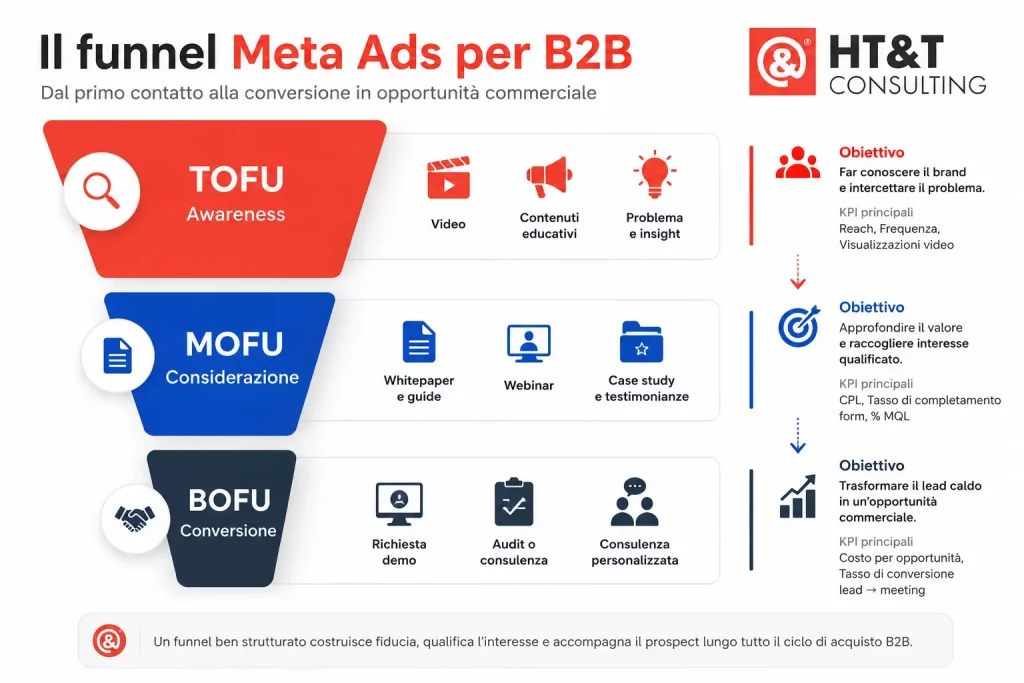
The Meta Ads funnel for B2B: TOFU, MOFU, BOFU
The B2B buying cycle rarely ends at the first contact with an ad.
A decision maker who does not know your brand will not fill out a commercial contact form after seeing an ad for the first time.
The funnel is used to build trust progressively, before asking.
Top of Funnel – Awareness
Goal: make the brand known and intercept the problem.
Do not sell, educate. The content that works best at this stage includes short videos describing a recognizable problem, blog articles on industry topics, research or original data.
KPI: cost per video view, reach, frequency. Do not optimize for leads at this stage, you are building warm audiences for the next phases.
Middle of Funnel — Consideration
Goal: deepen value and collect an initial signal of interest.
At this stage, whitepapers, practical guides, webinars, case studies and content requiring a small commitment (filling out a form) in exchange for concrete value work well.
KPI: CPL (cost per lead), form completion rate, lead quality (percentage that becomes MQL). This is the main stage for B2B lead generation on Meta.
This approach is directly connected to the logic of the Messy Middle, the evaluation phase in which the decision maker gathers information and builds an opinion before making a decision.
Bottom of Funnel – Conversion
Goal: turn the warm lead into a commercial opportunity.
At this stage, demo requests, free consultations, audits and time-limited offers for users who have already interacted with the brand work well.
The audience is narrower, only those who have already shown interest, but it has a much higher conversion rate.
KPI: cost per opportunity, lead-to-meeting conversion rate, commercial quality of contacts.
“In B2B, the Meta funnel is not an option, it is a requirement.
Those who try to generate qualified B2B leads with a single cold conversion campaign are optimizing for cost per lead, not for cost per acquired customer.
They are two completely different things.”
Creatives and copy for B2B on Meta
Creativity is the factor that most differentiates an effective B2B Meta campaign from one that does not work. Meta is an entertainment platform, and ads compete with posts from friends, cat videos and sports news.
To stop a manager from scrolling at the wrong moment, the message must immediately be recognizable as relevant.
The logic is the same as that which guides a good digital strategy: start from the real behaviour of the target, not from the channel.
The copy that works for B2B
- Start from the problem, not the solution: “Are you losing leads because your CRM does not talk to your website?” works better than “Our automation software is market-leading”
- Use concrete numbers: “40% reduction in lead qualification time” is more credible than “Save precious time”
- Speak to a specific role: “For marketing managers in B2B companies” filters the audience and increases perceived relevance
- Social proof carries a lot of weight: case studies, customer logos, testimonials from people with the same role as the target
- Clear, low-friction CTA: “Download the guide”, “View the case study”, “Book 30 minutes” convert better than “Contact us”
What works visually
Generic professional stock images (men in suits shaking hands, empty modern offices) do not stop the scroll. What works better:
- Real photos of the team or customers: authenticity beats perfection
- Screenshots of tools, dashboards, results: tangible value
- 15-30 second videos with subtitles: 85% of videos on Meta are watched without sound
- Charts or visualized data: data captures a manager’s attention more than any headline
Meta Lead Ads: setup and qualification of B2B leads
Meta Lead Ads allow the user to fill out a form without leaving the platform, which reduces friction and lowers CPL.
For B2B, this is both an advantage and a disadvantage: more leads, but often less qualified than those who land on a landing page.
How to configure the form to qualify leads
The key is to add qualification questions that discourage irrelevant leads without increasing friction too much for qualified ones.
- Company size: filter out those outside the target (e.g. only companies with 10+ employees)
- Role: identify the decision maker compared with the generic user
- Main challenge: qualifies intent and provides useful information to the sales team
- Timing : “Are you evaluating a solution in the next 3 months?” separates the warm lead from the exploratory one
Do not add more than 3-4 qualification questions. Each additional question reduces the completion rate. Find the balance between quality and volume based on the value of the lead for your business.
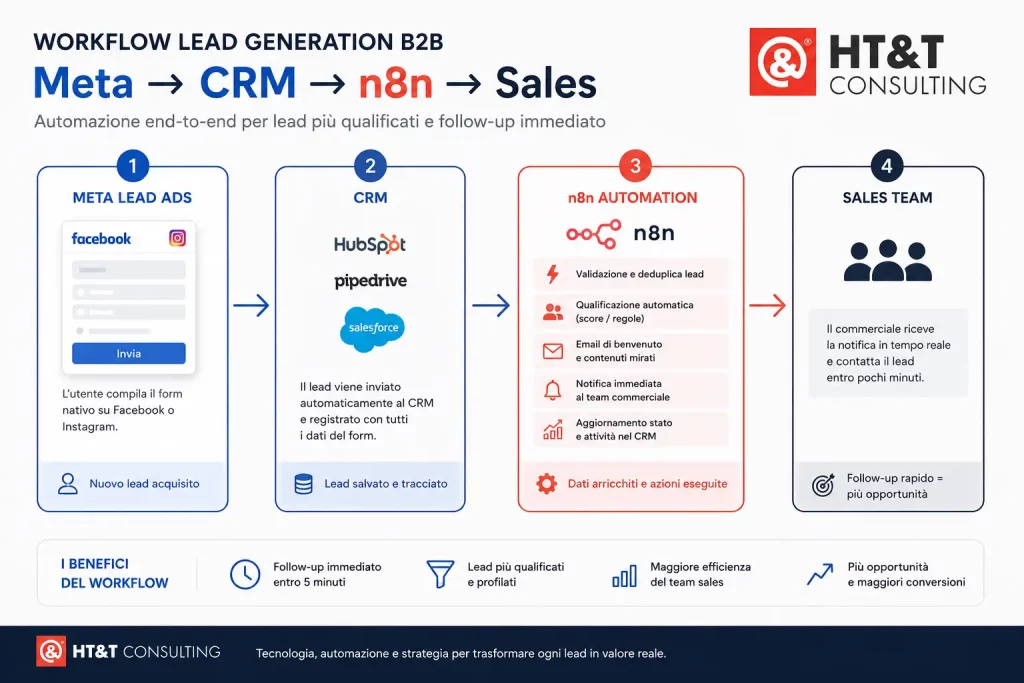
CRM integration and immediate follow-up
A B2B lead generated on Meta has a very short attention window.
B2B studies show that the probability of conversion from lead to meeting drops dramatically if follow-up takes place more than 5 minutes after contact.
The direct integration between Meta Lead Ads and the CRM, through native APIs or connectors such as Zapier or n8n, makes it possible to notify the sales team in real time and automatically start email nurturing sequences.
To improve data quality and reduce the loss of browser-side conversions, Meta tracking should also be integrated with a server-side tracking logic.
On this topic, our guide to business process automation with n8n is also useful, as it shows how to connect Meta Lead Ads to CRM, email and notifications without manual intervention.
B2B retargeting: staying present throughout the buying cycle
The B2B buying cycle is measured in weeks or months.
A decision maker who visited the website, downloaded content or watched a video is not yet ready to buy, but is in the evaluation phase.
Retargeting is used to stay present throughout this period, with messages that become progressively more specific and conversion-oriented.
The recommended B2B retargeting sequence
- 0-14 days – maximum intent. Direct offer: demo, consultation, free audit. Audience: visitors of key pages (services, pricing, case studies)
- 15-30 days – medium intent. In-depth content: sector-specific case study, practical guide, customer testimonial
- 31-60 days – latent intent. Educational content: webinar, industry research, relevant blog article
- Over 60 days – evaluate whether to continue or exclude from the audience to avoid wasting budget
The logic of B2B retargeting is directly connected to the principle of the mere exposure effect: familiarity built through repeated exposures increases preference and trust, critical elements in the B2B buying process.
How to measure B2B Meta campaign performance
The wrong metric leads to the wrong decisions. For B2B on Meta, CPL (cost per lead) is only the starting point, not the destination.
A €5 lead that never becomes a customer is worth less than a €50 lead that closes a €10,000 contract.
B2B metrics by funnel stage
| Metric | Stage | B2B Benchmark 2026 | Why it matters |
|---|---|---|---|
| CPM | Awareness | €8–15 by B2B sector | Reach efficiency on the target audience |
| CTR | All stages | 0.5–1.5% for B2B | Message relevance for the audience |
| CPL | Conversion | €15–80 depending on the sector | Acquisition efficiency — but not enough on its own |
| Lead → MQL rate | Post-conversion | 20–40% for qualified campaigns | Real quality of generated leads |
| Cost per opportunity | Post-conversion | Depends on the sector and ticket size | The metric closest to real business value |
| Pipeline ROAS | Business | Minimum target 3-5x | Revenue generated vs advertising budget — the final metric |
To connect Meta data to real business metrics, the CRM and GA4 must be properly integrated with campaign tracking.
Without this integration, you can see CPL, but not cost per acquired customer.
Measurement quality also depends on the ability to read data in clear, operational dashboards: this is why it is useful to connect campaigns to a data visualization system that displays CPL, MQL, opportunities and revenue.
On this topic, our guide to GA4 and conversion tracking is also useful.
Common mistakes in B2B Meta campaigns
Mistake 1 – Cold conversion campaign without a funnel
Sending cold traffic directly to a “Contact us” or “Request a demo” page without building awareness and trust is the most common mistake.
CPL will be high, lead quality low, and the campaign will be considered “not working” when in reality the problem is the structure, not the channel.
Mistake 2 – Audience too narrow
Targeting an audience of 50,000 people with too many overlapping filters blocks Meta’s algorithm, which needs sufficient volume to optimize.
For B2B on Meta, audiences between 300,000 and 2 million people often perform better than ultra-segmented ones.
Let Meta find the most relevant subset within a broad audience. Advantage+ Audience does exactly this, often delivering better results than rigid manual targeting.
Mistake 3 – Generic copy not focused on the problem
“We are the leading agency in sector X with 20 years of experience” does not stop any manager from scrolling. B2B copy that works on Meta talks about the customer’s problem, not the company’s achievements.
Mistake 4 — No CRM integration for follow-up
Collecting leads on Meta and manually downloading them once a week means losing the best follow-up moment.
Every hour of delay significantly reduces the probability of conversion in B2B.
Mistake 5 — Optimizing only for CPL without measuring quality
A low CPL with low-quality leads is worse than a high CPL with qualified leads.
If the sales team says that Meta leads do not convert, the problem is not Meta: it is the targeting or the qualification form.
Do you not manage campaigns directly?
If you have a team or an agency managing your B2B Meta campaigns, these are the questions you should ask to understand whether the work is being done properly.
The right questions every month
- What is the CPL for each funnel stage (TOFU, MOFU, BOFU), not just the average CPL?
- How many leads became MQLs (Marketing Qualified Leads), and how many received a sales follow-up?
- Is the Meta Pixel installed correctly and tracking website conversions?
- Are retargeting audiences updated and excluding active customers?
- How many creative tests have been carried out in the last month?
Signs that something is wrong
- CPL continuously increasing without quality improvement: creative fatigue or audience saturation
- High lead volume but zero sales conversions: qualification or targeting problem
- No A/B testing on creatives: lack of systematic optimization
- No funnel structure: only one cold conversion campaign
B2B lead generation on Meta naturally integrates with a broader lead generation and content strategy, including SEO, content marketing and marketing automation.
Channels perform better when they work together.
When Meta Ads does not work for B2B
Meta Ads is not the right channel when the company is only looking for immediate commercial leads from cold audiences, does not have valuable content to offer, does not integrate leads with the CRM, or measures performance only through cost per lead.
In these cases, the problem is not Meta, but the absence of a funnel, qualification and follow-up strategy.
Do you want to generate qualified B2B leads with Meta Ads?
HT&T Consulting is a Meta Business Partner with experience in B2B lead generation campaigns in manufacturing, technology, professional and industrial sectors.
We design complete Meta funnels, from strategy to creatives, from targeting to CRM integration.
Meta Ads can become part of an integrated web marketing, marketing automation and CRM strategy.
Frequently asked questions about B2B Meta Ads
Does Meta Ads work for B2B?
Yes, with the right strategy. Meta is not LinkedIn, so targeting by role and company is less precise, but volumes are huge and cost per lead is often significantly lower. Meta works best for B2B when you use a structured funnel rather than direct conversion campaigns on cold audiences.
What is the difference between Meta Ads and LinkedIn Ads for B2B?
LinkedIn offers more precise targeting by role, industry and company size, making it ideal for reaching specific decision makers with professional messaging. Meta offers much higher volumes, generally lower CPL and more advanced retargeting tools. The two channels are complementary: LinkedIn for high-value B2B awareness, Meta for volume and nurturing.
How much does B2B lead generation on Meta cost?
Average CPL on Meta for B2B ranges from €15 to €80 depending on the sector, the type of offer and targeting quality. Lead Ads usually have lower CPL (€10-30) but less qualified leads compared with campaigns driving traffic to external landing pages (€30-80 with higher average quality).
How do you qualify B2B leads generated on Meta?
Qualification happens in two stages: in the form (with questions about role, company size, main challenge and timing) and during the sales follow-up. CRM integration makes it possible to automatically qualify leads based on responses and assign them to the right sales representative.
Which B2B sectors perform best on Meta?
The sectors that usually achieve the best results on B2B Meta include professional services, consulting, training, HR, technology, SaaS software, manufacturing with a focus on productivity and efficiency, logistics and B2B financial services. Sectors with very long buying cycles and very high ticket sizes tend to perform better in awareness and nurturing than in direct conversion.
What is the minimum budget for effective B2B Meta campaigns?
For a three-stage B2B funnel (awareness, consideration, conversion), the recommended minimum budget is €1,500-2,000 per month, distributed across the three phases with a stronger focus on conversion. With lower budgets, it becomes difficult to collect enough data to optimize the algorithm effectively.
How do you measure ROI on B2B Meta campaigns?
Real ROI is measured by connecting leads generated on Meta to opportunities and closed deals inside the CRM. Metrics to track include CPL by stage, lead → MQL rate, MQL → SQL rate, cost per opportunity and pipeline ROAS. Without CRM integration, you only see CPL, which is not enough to evaluate B2B campaign effectiveness.
Is it better to use Meta Lead Ads or external landing pages for B2B?
It depends on the objective. Lead Ads have lower CPL and are ideal for simple offers such as downloads or webinar registrations. External landing pages generate more qualified leads, because users willing to leave the platform usually show stronger intent, and they provide more control over copy, design and tracking. For high-ticket B2B, external landing pages often produce higher-quality leads despite the higher CPL.
Checklist: before launching your B2B Meta campaigns
Check these points before considering a B2B Meta campaign ready to go live:
- Meta Pixel installed and verified on all key website pages
- Conversions API configured for server-side tracking
- Custom audiences created: website visitors, customers, existing leads
- Lookalike audiences built from high-quality seed data (active customers, not all contacts)
- Funnel structure in place, at least two stages (awareness + conversion)
- Different creatives for each funnel stage — not the same ad everywhere
- Qualification form with 2-4 relevant questions
- CRM integration active for immediate sales notifications
- Exclusions active: existing customers excluded from acquisition campaigns
- Budget distributed by funnel stage — not equally split between awareness and conversion
- KPIs defined for each stage, not just total average CPL
- At least 2-3 creative variations per ad set for A/B testing
- Frequency monitored: above 3-4 in 7 days on cold audiences may indicate saturation
A well-structured B2B Meta campaign is not just an acquisition tool, but a system that accompanies the prospect throughout the evaluation journey, builds trust in the brand and qualifies interest before the commercial contact.
When integrated with marketing automation and a properly configured CRM, it becomes one of the B2B channels with the best balance between cost and lead quality for companies that know how to use it correctly. Of course, Google Ads should not be abandoned, as it remains a critical component of any marketing strategy.
Bibliography and sources
Meta for Business — B2B success stories
Official Meta case studies on B2B campaigns, lead generation, measurement and advertising performance.
Meta Business Help Center — Lead Ads and CRM
Official documentation on integrating leads generated by Meta campaigns with CRM systems.
Meta for Business — Conversions API
Official Meta resources on using Conversions API to improve tracking, attribution and data quality.
Content Marketing Institute — B2B Content Marketing Benchmarks 2025
Annual report on investments, content strategies, channels and priorities of B2B marketers.
Think with Google — The changing face of B2B marketing
Google research on B2B buyer behaviour, the role of digital channels and evaluation journeys before purchase.
HT&T Consulting — Internal Attribution Benchmark 2025–2026
Internal HT&T analysis on B2B Meta Ads campaigns, CPL, qualified leads, multi-channel touchpoints and CRM integration.
Proprietary internal source
Continua a leggere
24 minutes of reading

19 minutes of reading

23 minutes of reading

And it consumes less energy.
To return to the page you were visiting, simply click or scroll.