Training AIs for website SEO with llms.txt

llms.txt: from search engine SEO to SEO for artificial intelligence
llms.txt is a file designed to explain to artificial intelligences who you are, what you do and how you want to be described: it is the foundation of SEO for AI.
In brief
More and more website visits now come from artificial intelligence systems such as ChatGPT, Gemini and Claude. Search is no longer happening only through traditional search engines, but increasingly through AI chats. In this context, llms.txt is emerging: a file designed to help language models correctly understand a brand, its services and its positioning, becoming a new strategic tool for semantic optimization in the future of digital marketing.
In recent months, many companies may have noticed an interesting trend in Matomo, GA4 or other analytics platforms: a growing number of website visits are coming from unusual traffic sources such as ChatGPT, Gemini, Claude, Perplexity, DeepSeek and other artificial intelligence systems.
Searching for information online is no longer synonymous with “searching on Google.” In fact, we are already entering an era where conversational search is set to become one of the main ways users interact with the web.
Artificial intelligence is now being embedded into almost every digital tool we use daily: WhatsApp, social media platforms and even mobile operating systems now offer instantly accessible AI solutions.
Both consumers and professionals are gradually becoming accustomed to interacting with AI systems capable of understanding natural language, contextualizing requests, synthesizing sources and, in many cases, generating answers that are more relevant and targeted than those provided by a traditional search engine.
Until now, it was SEO for search engines
If today we search for “best CRM for a small furniture business” on Google and find dozens of SEO-optimized articles, guides, sponsored results and forum discussions, tomorrow — and for many, already today — we will ask the same question to assistants like ChatGPT, Claude or Gemini, receiving a single, filtered, structured and above all concise answer.
A response that often goes beyond traditional organic rankings, because it is based on a combination of sources that artificial intelligence has read, understood and synthesized.
This is exactly where llms.txt comes into play.
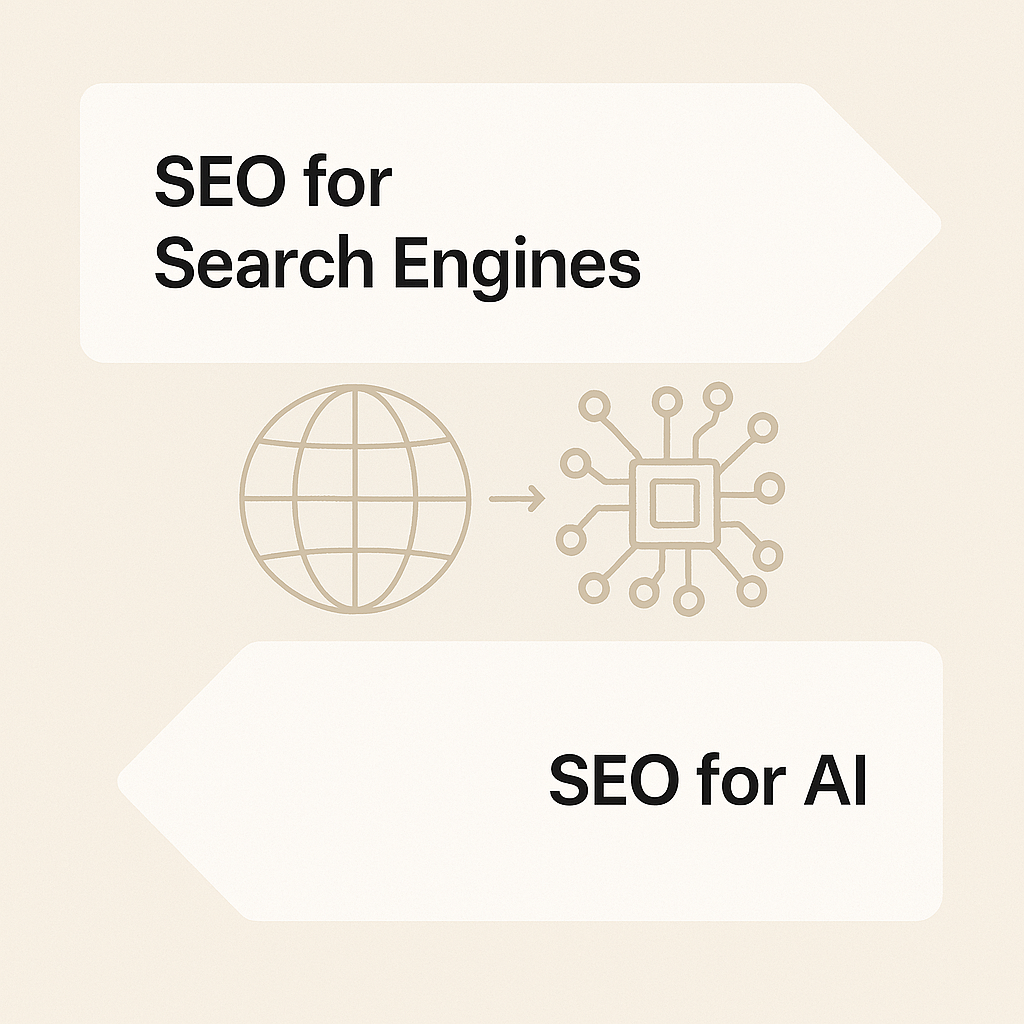
Tomorrow, SEO for AI will start with llms.txt
What is llms.txt?
In simple terms, it is a text file designed to provide language models with a clear, concise and controlled representation of a company, a project or a website.
Its name combines the classic .txt file extension with the LLM acronym (Large Language Model), identifying a tool that, when placed in the root of a website, could become the standard for “educating” AI systems that browse, read and interpret digital content.
llms.txt is designed to be readable by artificial intelligence, but also useful for humans:
it provides a strategic overview of what a brand does, who its target audience is, what values it represents, which services it offers and which keywords are most relevant to understanding it.
In many ways, it is the technical and semantic evolution of the classic “about us” page and brand identity guidelines, translated into machine-readable language while maintaining a human tone.
Its purpose is twofold:
on one hand, helping AI systems generate more accurate answers when users ask about that company;
on the other, protecting brand consistency by reducing the risk of AI-generated content becoming inaccurate, outdated or inconsistent.
llms.txt can include sections describing mission, vision, company values, services, key clients, short case studies, certifications, contact details, useful links and even tone-of-voice guidelines.
llms.txt becomes particularly relevant for structured brands, B2B companies, consulting firms, SaaS businesses and complex eCommerce ecosystems, while for very small businesses or purely informational websites it may still be optional.
That is why llms.txt should not be seen as an isolated file, but as part of a broader strategy involving
SEO consulting
,
structured content and brand digital presence optimization.
How do you build an llms.txt file?
The recommended structure is a Markdown file, a simple and readable markup language that allows you to create headings, paragraphs, emphasis and hyperlinks using a clean and intuitive syntax.
A heading is created by adding one or more hash symbols (#), italics are created by wrapping a word between asterisks (*), and links are written using square and round brackets.
The goal is to make the file readable both by artificial intelligence and by humans, while ensuring semantic accessibility.
For example, a typical section might start like this:
# Mission
HT&T Consulting is a digital agency specialized in helping companies grow online.
This approach also makes it easier to update content, version it over time, keep it aligned with brand positioning and, most importantly, make that information centrally available.
The file can then be referenced inside robots.txt, published directly in the public documentation of the website, linked through APIs or integrated into corporate knowledge management platforms.
The future of llms.txt
llms.txt is not yet an official standard, at least not for now.
However, within the developer, content strategy and AI communities, it is increasingly emerging as a practical convention.
Some companies are already implementing automated systems capable of reading these files to enrich proprietary models, and platforms such as Google, OpenAI and Meta are already capable of reading structured specifications when properly exposed.
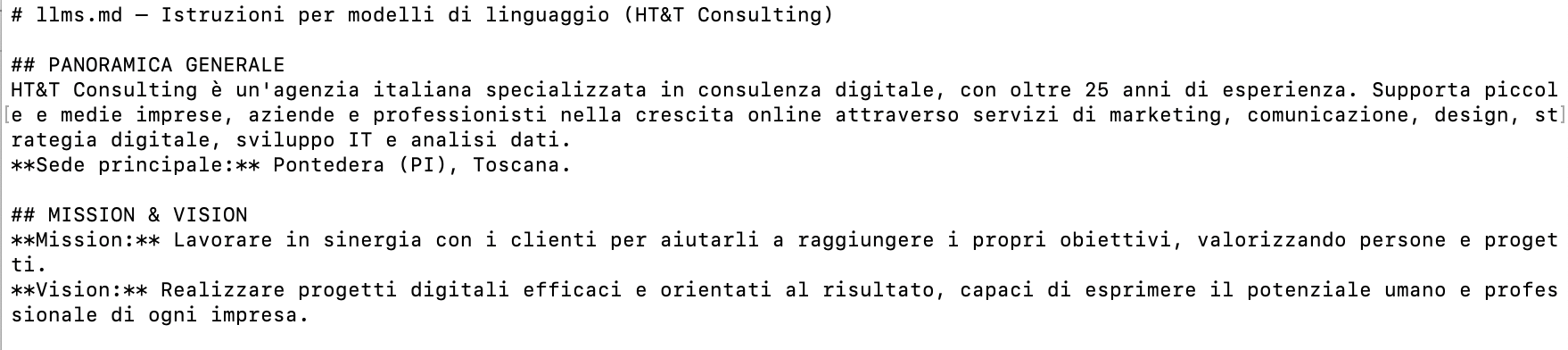
The most interesting aspect is that companies can now directly influence what AI systems know about them.
Just as for years we optimized websites to “please Google,” today we are beginning to optimize content to “be understood by language models.”
llms.txt is, in every sense, a semantic positioning tool in the era of artificial intelligence.
Imagine a future where every company has its own AI-ready knowledge card: a file describing who they are, what they do and how they want to be represented.
Brands with well-structured, updated and consistent content will be increasingly favored in AI-generated responses, whether in search engine chat interfaces or automated assistance systems.
llms.txt could become a sort of semantic identity card for every digital business.
Looking ahead, we may also see machine-readable versions using JSON-LD, public validators or even shared repositories similar to Schema.org.
But everything starts from one simple principle:
if we want AI systems to talk about us correctly, we need to give them the right information to read.
In this scenario, HT&T Consulting does not simply observe the evolution of search.
We are already working on AI-ready information architectures, semantic content and
AEO and GEO strategies
,
helping brands be understood, cited and represented correctly by language models.
FAQ
What is an llms.txt file?
It is a text file designed to provide language models with a clear and structured representation of a company, project or website.
Does llms.txt replace traditional SEO?
No. It complements traditional SEO by working on semantic, conversational and AI-oriented visibility.
Where should llms.txt be placed?
It is generally placed in the root of the website, just like robots.txt or sitemap.xml.
Is llms.txt an official standard?
No. At the moment it is an emerging convention adopted by developers, strategists and AI professionals.
How do language models use llms.txt?
Language models can use llms.txt as a structured source to better understand a brand, improve response accuracy and reduce ambiguity or outdated information.
Does llms.txt directly impact website traffic?
It does not act as a traditional ranking factor, but it can influence brand citations, response quality and the likelihood of being mentioned by AI systems.
What is the difference between llms.txt, robots.txt and structured data?
robots.txt controls crawler access, structured data describes content for search engines, while llms.txt provides a semantic summary specifically designed for language models.
Bibliography and references
Emerging standard
LLMS.TXT
The reference project dedicated to llms.txt, including format specifications, purpose and recommended structure.
Technical documentation
Markdown Guide
Documentation on Markdown syntax, useful for building a readable and well-structured llms.txt file.
Structured data
Schema.org
Shared vocabulary used to describe organizations, content, FAQs and structured data understandable by search engines and AI systems.
SEO and AI Search
Google Search Central
Official Google documentation about crawling, indexing, structured data and content quality in modern search ecosystems.
Generative AI
OpenAI Documentation
Technical resources and documentation on how large language models process, retrieve and synthesize information.
HT&T Research
HT&T AI Observatory
Proprietary research on AI-driven search behavior, brand visibility and semantic optimization in conversational ecosystems.
Continua a leggere
26 minutes of reading

17 minutes of reading


And it consumes less energy.
To return to the page you were visiting, simply click or scroll.