
SEO · AEO · GEO
Google’s AI Optimization Guide: what it confirms, what it debunks and what it does not say
On May 15, 2026 Google published its first official guide on how to optimize websites for AI features in Search. It is an important document, but it should be read critically, not treated as a step-by-step manual.
In brief
On May 15, 2026 Google published an official guide titled “Optimizing your website for generative AI features on Google Search”.
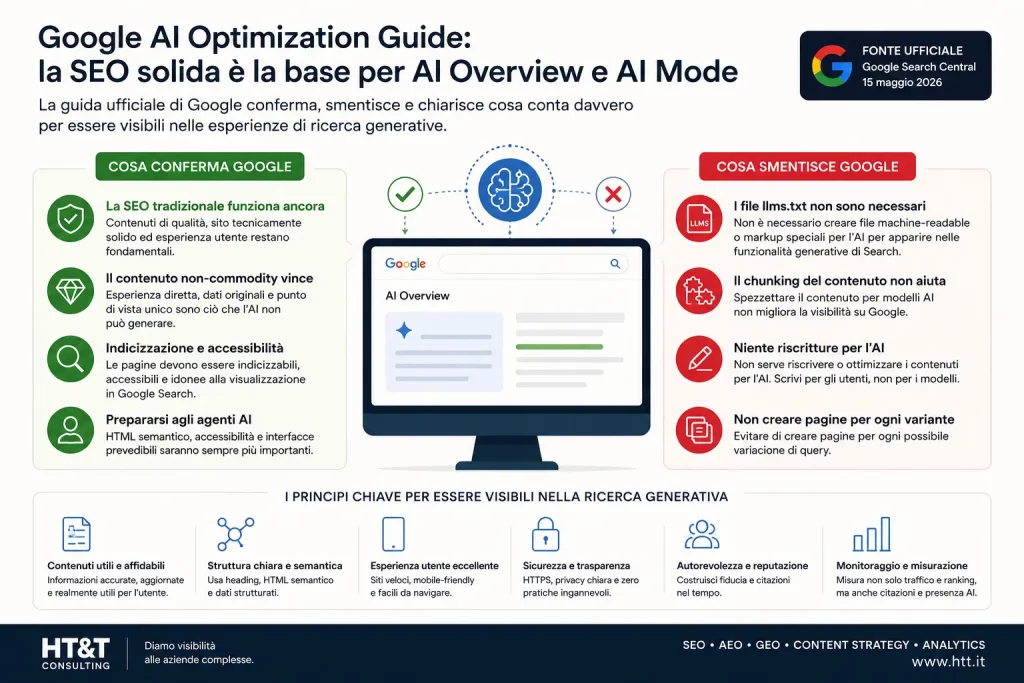
Short answer: according to Google, optimizing for AI Overview and AI Mode still means doing solid SEO: original content, crawlable and indexable websites, proper technical structure, a clear user experience and no AI-specific hacks.
The document confirms that traditional SEO remains the foundation for AI Overview and AI Mode, debunks some “hype” practices such as llms.txt files and artificial content chunking, and introduces a key concept: non-commodity content, meaning content with unique perspectives, original data and direct experience, as a differentiating factor in the era of generative search.
What the guide does not say, however, is just as interesting as what it does say.

Why this guide matters
This is not the first time Google has published guidelines for webmasters. But it is the first time it has done so explicitly about how optimization works for AI-powered Search features — AI Overview, AI Mode and the emerging agentic experiences.
The document was published in the official Google Search Central section under “SEO fundamentals” and released on May 15, 2026.
This is not a blog post and not a tweet: it is official documentation.
That gives it a completely different weight compared to previous statements.
The reason I read it critically rather than treating it as gospel is that Google has historically published guidelines reflecting how it wants the web to work, not necessarily how it actually works in practice. The gap between those two realities can be significant.
Keeping this in mind while reading is essential.
“When Google publishes an official guide on AI optimization, there are two possible readings: the perspective of those who follow it literally, and the perspective of those who use it to understand what Google wants you to do — and ask why. The second one is always more interesting.”
What it confirms: traditional SEO is not dead
The first thing Google says — very clearly in the second section of the document — is that traditional SEO best practices still apply to generative search experiences.
The technical reason is precise: Google AI features such as AI Overview and AI Mode use retrieval-augmented generation (RAG), a system that retrieves content from Google’s normal search index in order to generate responses.
This means that if a page is not indexed, it cannot be considered for AI-generated answers. If it has technical issues, if it is slow or contains duplicate content, the same limitations and penalties that affect traditional organic rankings will also affect visibility inside AI-generated responses.
✓ Confirmed by the guide
Technical SEO work such as proper indexing, clean redirects, canonicals, mobile performance, Core Web Vitals and semantic markup remains the foundation for appearing in AI responses. It is not separate work: it is the same work.
This is important for anyone who assumed that “AI changed everything” and that classic SEO had become obsolete. That is not the case. SEO is still necessary — just no longer sufficient.
Google also confirms that Schema.org structured data remains useful, not because it directly impacts AI answers, but because rich results still matter within the broader search ecosystem. The work we described in our article about
semantic structure and JSON-LD
is therefore validated, although expectations should remain realistic.
What Google adds beyond traditional SEO
The guide does not simply say that SEO still matters. It adds two important concepts for understanding how generative Search experiences work: retrieval-augmented generation and query fan-out.
The first means that AI Overview and AI Mode retrieve information from Google’s index in order to generate more reliable and updated responses. The second means that Google can expand a user’s search into multiple related queries in order to better satisfy the underlying informational intent.
What it debunks: myths to abandon
The most direct and courageous part of the guide is the “Mythbusting” section.
Google explicitly lists practices circulating as “AI optimization” and defines them as ineffective or irrelevant for Google Search.
✗ Myth debunked
llms.txt files and special AI markup: Google explicitly says there is no need to create machine-readable AI files, AI-specific text files or special markdown formats in order to appear in generative search experiences. The llms.txt file has no impact on how Google handles a website.
✗ Myth debunked
Content chunking: there is no requirement to artificially fragment content into small pieces to help AI understand it.
Google states that its systems are capable of understanding multiple topics on the same page and surfacing the relevant part to users.
✗ Myth debunked
Rewriting content “for AI”: there is no need to write in a specific style for generative systems. AI systems understand synonyms and general meanings. There is no need to obsess over every long-tail variation or keyword permutation.
✗ Myth debunked
Artificially generating “mentions”: trying to create brand mentions across blogs, forums and third-party websites in order to increase visibility inside AI responses does not work. Google’s anti-spam systems also apply to generative features.
✗ Myth debunked
Creating pages for every query variation: doing so mainly to manipulate rankings violates Google’s scaled content abuse policies.
It is not an effective long-term strategy.
In practice: appearing in AI Overview and AI Mode does not require llms.txt files, AI-specific markup, artificial content chunking or pages created for every query variation. What matters is a technically solid, crawlable and genuinely useful website.
Reading these myths, it is easy to recognize that many of the debunked practices became popular simply because nobody truly knew how AI search worked. Google has now established a clear position — at least for its own platform.
The key concept: non-commodity content
The most interesting part of the guide — and the one I focused on the most — is the introduction of the concept of non-commodity content.
Google explicitly distinguishes between two types of content:
Commodity content is based on common knowledge, could be written by anyone and adds little unique value. Google’s own example is “7 tips for first-time home buyers”: generic content that exists everywhere.
Non-commodity content is based on direct experience, original data, unique perspectives and verifiable expertise. Google’s example is “Why we skipped the inspection and saved money: a sewer line analysis” — content that only someone who actually lived through that experience could write.
For marketers and digital communication professionals, this means the real question is no longer “Is this article optimized for the right keywords?” but rather “Does this article bring something that does not already exist elsewhere?”.
Real case studies, proprietary data and analyses based on direct client experience are the signals Google values inside AI-generated responses.
This is the same principle behind the E-E-A-T framework (Experience, Expertise, Authoritativeness, Trustworthiness) introduced by Google in its content quality guidelines. The AI optimization guide now explicitly extends it to generative search experiences.
“Non-commodity content is not a new concept. In journalism it is called a scoop, in academia it is called original research, in marketing it is called a case study. Google has simply given a technical name to something good editors already understood.”
Commodity vs non-commodity content: the practical difference
| Commodity content | Non-commodity content |
|---|---|
| Repeats information already available online. | Adds direct experience, original data or a proprietary point of view. |
| Could be written by anyone. | Can only be written by someone with expertise or access to specific information. |
| Answers the keyword. | Answers the real problem behind the search. |
| Can easily be replicated by competitors or AI tools. | Is difficult to copy because it comes from real cases, data, methodologies and observations. |
What the guide does not say: Google’s strategic silences
An official Google guide should also be read for what it does not say.
There are several areas where the document is deliberately vague or silent, and those absences are just as informative as the statements themselves.
◌ Significant silence
How sources are selected for AI Overview and AI Mode: the guide explains that generative systems use RAG and retrieve content from the index, but it never explains the specific criteria determining why one source gets cited in an AI response instead of another. This remains a black box.
◌ Significant silence
The decline of organic traffic: the guide talks about “new opportunities” for websites appearing inside AI responses, but avoids discussing
zero-click search
and the loss of traffic affecting websites that are not cited.
This is an uncomfortable topic for Google, which has every reason to present AI as an opportunity rather than a threat to the publisher ecosystem.
◌ Significant silence
The monetization of AI responses: the guide says nothing about how advertising will work inside generative answers, nor how publishers may eventually benefit economically from being cited by AI systems. This remains an unresolved issue.
◌ Significant silence
The knowledge graph and entity representation: one of the most important aspects influencing how AI systems describe brands is not mentioned at all. The guide does not discuss how organizations should manage their representation inside Google’s knowledge graph, despite it being a critical factor for generative visibility.
The silence around the knowledge graph is especially relevant for us.
The work we do through
BRMA — Brand Recognition & Mention Analysis,
consistently shows that the quality of a brand’s representation inside the knowledge graph directly influences the frequency and accuracy of AI citations.
Google does not talk about it, but that does not mean it is irrelevant — it probably means the area is not yet standardized enough for official documentation.
AEO and GEO according to Google: a redefinition
The guide directly addresses the concepts of AEO (Answer Engine Optimization) and GEO (Generative Engine Optimization), and does so in a particularly interesting way. Google states:
“From Google Search’s perspective, optimizing for generative AI search is optimizing for the search experience, and thus still SEO.”
In other words: according to Google, AEO and GEO are not separate disciplines from SEO, but rather SEO applied to generative environments. There are no special techniques and no parallel optimization model. There is simply good SEO that also creates visibility inside AI-powered experiences.
This position is technically correct — and it is also something we explain in our
AEO guide.
The operational levers — semantic structure, E-E-A-T, high-quality content and structured data — are fundamentally the same as traditional SEO, applied with a deeper awareness of the ecosystem they now operate within.
That said, reducing AEO and GEO to “just SEO” is also a convenient way for Google to avoid acknowledging that generative search introduces new layers of complexity not fully covered by traditional SEO, such as knowledge graph management, entity optimization and AI citation analysis.
These aspects do not disappear simply because Google chooses not to mention them.
“Saying that AEO and GEO are ‘just SEO’ is like saying that content marketing is ‘just writing well’. Technically true, practically incomplete. The complexity lies in the operational details that a three-page guide cannot possibly cover.”
Google says “it is still SEO”. HT&T adds: yes, but it must be measured differently
Google’s position is technically correct: AEO and GEO do not replace SEO. But in practice they introduce new metrics and new operational questions.
| Topic | Google’s position | HT&T’s interpretation |
|---|---|---|
| AEO and GEO | They are still SEO. | They are SEO applied to an ecosystem where citations, synthesis and brand representation also matter. |
| llms.txt | Not necessary for Google Search. | Not useful for Google specifically, but potentially relevant within broader AI ecosystem strategies. |
| Content | Content should be useful, original and non-commodity. | The strongest content includes case studies, proprietary data, benchmarks and analyses grounded in direct experience. |
| Measurement | The guide does not address it in detail. | It becomes necessary to measure not only rankings and traffic, but also AI visibility, citation frequency and citation quality. |
AI agents
The final section of the guide is the one I spent the most time on — and the one where Google is the most cautious in making precise predictions.
It is titled “Explore agentic experiences”.
Google describes AI agents as autonomous systems capable of performing tasks on behalf of users such as booking, comparing and purchasing.
It also explains that these agents access websites by analyzing visual rendering, DOM structure and accessibility trees.
This represents a major shift in how optimization will need to work.
Until now, search optimization mainly meant optimizing for how crawlers read text. With AI agents, optimization increasingly means optimizing for how autonomous systems interact with websites: clicking, navigating, interpreting interfaces and executing actions.
Google references the
UCP (Universal Commerce Protocol)
as an emerging standard that will allow agents to do more.
This is a signal worth monitoring carefully, especially for ecommerce businesses and websites with transactional functionality.
The connection with what we are already analyzing around
agentic ecommerce
is direct: websites that already have clean semantic structures, proper accessibility and predictable interfaces will have a structural advantage once AI agents become a mainstream way for users to interact with digital services.
Practical implications for marketers
After reading and analyzing the guide, these are the concrete implications I consider most relevant for anyone managing a website, a brand or a digital communication strategy.
Stop optimizing for AI as if it were a separate channel
There is no “SEO for AI” separated from SEO itself. There is website quality — technical, editorial and experiential quality — that creates visibility across every context, including generative search experiences.
Anyone planning parallel strategies can simplify considerably.
Invest in non-commodity content
This is the clearest editorial priority emerging from the guide.
Original data, proprietary research, verifiable case studies and analyses based on direct experience are the types of content Google values most inside generative responses.
They are also the hardest types of content to produce and the hardest for competitors to replicate.
Ignore AI “hacks”
llms.txt files, chunking, AI rewrites and generative keyword stuffing are officially useless for Google Search.
The time saved by avoiding these tactics can be reinvested into real content and technical quality.
Prepare for AI agents
Accessibility, semantic HTML and predictable interfaces are no longer just best practices.
They are becoming the technical prerequisite for being accessible to the AI agents that will increasingly interact with websites on behalf of users.
Continue working on the knowledge graph
The guide does not mention it, but that does not mean it is irrelevant.
Managing brand representation across Google entities, Wikipedia, Wikidata, sameAs markup and authoritative industry sources remains one of the key drivers of visibility inside AI-generated responses.
This is an area Google has not yet standardized enough to include in public documentation, but in practice it already makes a measurable difference.
Want to understand how to position your brand inside AI-generated responses?
HT&T Consulting analyzes brand visibility across major AI models such as GPT, Gemini and Perplexity, building strategies designed to improve the quality and frequency of citations inside generative responses.
Frequently asked questions
Did Google officially publish a guide about AI optimization?
Yes. On May 15, 2026 Google published the document “Optimizing your website for generative AI features on Google Search” inside Google Search Central.
The guide explains how AI Overview, AI Mode and future agentic experiences interact with websites.
Does traditional SEO still matter for AI Overview and AI Mode?
Yes. Google explicitly confirms that traditional SEO best practices remain the foundation for visibility inside generative search experiences because AI systems retrieve information from the normal search index.
Does Google recommend using llms.txt files?
No. Google clearly states that llms.txt files and special AI-oriented text files are not required for appearing in AI Overview or AI Mode.
Is content chunking necessary for AI search optimization?
No. According to Google, its systems are capable of understanding long pages and extracting relevant sections without the need to artificially split content into small fragments.
What is non-commodity content?
Google defines non-commodity content as content based on direct experience, proprietary data, unique perspectives and real expertise. It is content that cannot easily be replicated by competitors or AI-generated summaries.
What is the difference between SEO, AEO and GEO?
SEO focuses on visibility inside traditional search results. AEO focuses on being selected inside direct answers and AI-generated summaries. GEO focuses on how brands are represented and cited inside generative engines such as Gemini, GPT and Perplexity.
Does structured data still matter for AI Search?
Yes. Google confirms that structured data and semantic markup still help Search understand website content and remain important for rich results and contextual understanding.
Why does Google mention AI agents?
Google describes AI agents as autonomous systems capable of interacting with websites, navigating interfaces and completing actions on behalf of users. This makes accessibility, semantic HTML and interface predictability increasingly important.
Does Google explain how sources are selected inside AI Overview?
No. The guide confirms that AI systems retrieve information from Google’s index, but it does not explain the exact criteria determining why some sources are cited while others are not.
Is AI optimization becoming a completely separate discipline from SEO?
According to Google, no. Google’s position is that optimizing for generative AI search experiences is still SEO. However, in practice, AI visibility also introduces new topics such as entity optimization, citation analysis and knowledge graph management.
Bibliography
Google Search Central — Optimizing your website for generative AI features on Google Search
Official documentation published by Google on May 15, 2026 explaining how AI Overview, AI Mode and agentic experiences interact with SEO and website optimization.
Google Search Central — SEO Starter Guide
Google’s official documentation on technical SEO fundamentals including indexing, crawlability, structured data and website quality.
Google Search Quality Evaluator Guidelines
Official Google document introducing E-E-A-T concepts such as Experience, Expertise, Authoritativeness and Trustworthiness for evaluating content quality.
Google Developers — Retrieval-Augmented Generation (RAG)
Technical documentation explaining retrieval-augmented generation systems and how AI models retrieve information from external sources.
W3C — Web Content Accessibility Guidelines (WCAG)
International accessibility standards referenced by Google in relation to AI agents, semantic navigation and accessible interfaces.
HT&T Consulting — JSON-LD, AEO and GEO
HT&T analysis on semantic structure, structured data and optimization strategies for generative engines and answer engines.
Continua a leggere
20 minutes of reading

10 minutes of reading

5 minutes of reading

And it consumes less energy.
To return to the page you were visiting, simply click or scroll.