Business automation with n8n and AI: how to reduce operations and increase strategy
Beyond automation: from task execution to decision-making autonomy. How to combine the execution power of n8n with the intelligence of AI agents to optimize business process automation, software integration and workflow automation.
In short
Companies are overwhelmed by manual operations, but they can drastically reduce them by combining n8n (a low-code visual workflow automation platform) with AI agents and the Model Context Protocol (MCP).
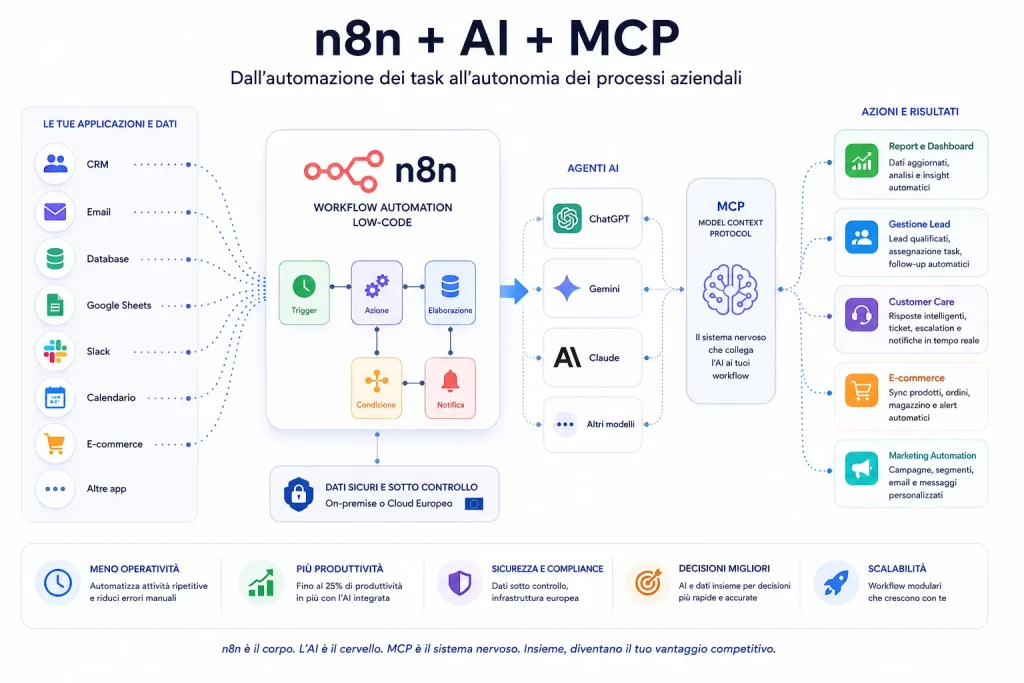
n8n is the “body” with thousands of ready-to-use integrations, AI agents (ChatGPT, Gemini, Claude) are the brain that makes decisions, and MCP is the nervous system that connects them.
At HT&T Consulting, we use this combination to automate processes such as lead management, reporting, and customer care for Italian and European companies—freeing up time for strategy, growth, and customer relationships.
If you want to explore the topic from a more technical and operational perspective, we’ve created a dedicated guide on
marketing data automation with n8n and Supermetrics, where we explain how to connect advertising sources, analytics, CRM systems, and reporting into a low-code data pipeline.
More strategy, less operations with n8n
In our daily work at HT&T Consulting, we support dozens of companies that tell us every day:
“We are overwhelmed by operations, but can AI help us? Can you train us?”
Manual data handling, transferring information between different tools, building reports—these are all activities that consume the most valuable resource we have: time.
Time that could be invested in strategy, growth, customer care, and continuous improvement of business processes.
We also discuss this more broadly in our article
Marketing Trends 2026: AI, data and strategic vision, where we analyze how artificial intelligence is transforming business planning.
This article is the foundation of a series of content pieces where we will explain concrete use cases of AI-driven automation, focusing on a solution that is already transforming how some of our clients work: n8n.
Specifically, we focus on how to combine a visual no-code workflow automation platform like n8n with next-generation AI agents, to create operational flows that do not simply execute repetitive tasks but actively support decision-making and end-to-end process management.
At HT&T Consulting, we work daily with Italian and European companies to design and implement business process automation systems that improve efficiency, scalability, and data control—while ensuring localization, compliance, and alignment with specific market requirements.
Why has AI automation become a priority?
In recent years, the adoption of artificial intelligence in business processes has accelerated significantly.
According to McKinsey – The State of AI in 2025, AI is now widely embedded across many business functions.
However, the real challenge is no longer “using AI”: it is integrating it into processes in a scalable, governed, and measurable way.
At the same time, the concept of hyperautomation, defined by Gartner, highlights how companies are moving from simple task automation to the intelligent orchestration of entire processes.
“Hyperautomation combines automation tools, artificial intelligence, and orchestration to identify, evaluate, and automate as many business processes as possible.”
Gartner – IT Glossary, Hyperautomation
This leads to a very practical conclusion:
companies that automate isolated tasks fall behind those that build an integrated decision infrastructure.
Automation is not about doing more things. It is about freeing people to focus on what truly matters.
A new digital colleague
Forget the idea of automation as something rigid or complex. Think of n8n as a universal translator for all the software tools you already use. It is a no-code visual automation platform that allows your applications to talk to each other and exchange tasks, without you having to act as the intermediary.
In Italy, we often pronounce it “enne-otto-nenne”, but in English it is read as “n-eight-n”. Its core is a visual interface where we build workflows as if we were using Lego bricks. Each brick is an action: one brick for your CRM, one for your ERP, one for Google Sheets, one for Slack.
In terms of software integration, n8n becomes the backbone of your digital ecosystem: it connects applications, databases, marketing tools, and ecommerce platforms into a single orchestrated flow, reducing manual errors and shortening operational times.
But what does all this mean in practice for your company?

The GLANT workflow: optimization and monitoring
Let’s take the workflow created for GLANT as an example. GLANT is one of our clients and a sector leader in the design, production, and sale of luxury Made in Italy glamping tents for hospitality businesses. Automation with n8n is not limited to scheduling responses to events that have already happened: it is used for proactive actions, continuous monitoring, and business intelligence.
With an n8n workflow we implemented, the moment a potential client (holiday village or campsite) clicks “Submit” on a request for information, the platform activates. Within seconds, the data is automatically created in their CRM — in their case, HubSpot — a task is assigned to the local sales representative, and a personalized email is sent to thank the customer. At the same time, the team receives a Slack notification: “New qualified lead!”. All of this happens automatically, 24 hours a day.
From lead management to active market monitoring
But efficiency does not end with inbound leads. A second fundamental pillar of the automated strategy is proactive monitoring of Glant mentions across the web and LLMs. Leveraging the versatility of n8n, we built a workflow that regularly queries various LLMs, including ChatGPT, Gemini, Claude, Perplexity, and other specific platforms. This automation runs on a targeted list of search prompts that potential customers might use during the supplier scouting phase, intercepting not only direct brand mentions but also conversations that could lead to new business opportunities.
The results are filtered and aggregated so they can be contextualized and correctly attributed. This allows the GEO positioning strategy to be adjusted based on concrete data, not perceptions.
To better understand how positioning works in generative systems, we explore the topic in our dedicated guide to
llms.txt and SEO for artificial intelligence.
These workflows, for GLANT, will be one of the pillars of the new website, scheduled for 2027.
Business Intelligence automation
This principle applies to all Business Intelligence activities. How many hours every month are spent extracting data from Google Ads, Meta Ads, Google Analytics, and your ecommerce platform to assemble a report? We can configure n8n to handle this part for you.
On the first day of each month, n8n will connect to all these sources, collect the key data, consolidate them into a single spreadsheet or business intelligence dashboard, and send you a summary by email. Your team arrives at the office and finds the analysis already prepared, without having to spend the day building it.
The real strength of n8n, and the reason why we at HT&T have chosen it for many projects, is that it gives us full control over data. Unlike other platforms, we can install it on your private infrastructure, on-premise or on a controlled cloud environment. This means that your sensitive data — customers, invoices, strategies — never leaves your servers, ensuring the highest level of security and regulatory compliance in Italy and Europe.
For this reason, monitoring responses generated by LLMs should be considered together with
GEO and AEO: publishing content is not enough; you need to build consistent signals that generative systems can understand, cite, and reuse correctly.

Automation meets intelligence
All of this is excellent for automating defined processes. But today the conversation has shifted to Artificial Intelligence. And this is where many of our clients rightly raise a question:
“Wait a minute. With ChatGPT and Gemini agents now able to do things, isn’t all this already outdated? What’s the difference?”
It is a crucial question, and the answer clarifies the future of business process automation. The difference can be summarized with a simple analogy: brain versus hands.
ChatGPT agents (OpenAI) and Gemini agents (Google) are extremely powerful brains. They are incredible reasoning platforms enclosed within proprietary ecosystems. Their limitation is that they are born with very few hands. If you want your ChatGPT agent to control your Salesforce CRM, you must build that hand yourself: write the code, manage the APIs, and handle authentication. They are brains for which you need to build a custom body, piece by piece, with a significant development effort.
When AI truly enters workflows, it also becomes important to understand which model is behind it and how much control it offers over data, infrastructure, and customization. For this reason, alongside automation, it can also be useful to explore
Gemma 4 and the value of open-weight models for companies, especially in cases where privacy, local execution, and adaptability become concrete project priorities.
n8n, on the other hand, is a powerful body with thousands of ready-made hands. It is an execution platform that already knows how to talk to Salesforce, Google Sheets, Slack, your SQL database, and hundreds of other systems. With n8n, you simply connect the brain you prefer, in the specific step where you need it.
Seen from this perspective, n8n is not a competitor to AI agents, but their natural partner. It is the ideal body, already prepared, to which we can connect one or more intelligent brains.
What is the real impact of AI on productivity?
Early empirical evidence shows a significant increase in individual productivity when AI is integrated into operational workflows.
“Workers using generative AI tools can complete tasks up to 25% faster and with higher quality.”
McKinsey Global Institute – Productivity & Generative AI
The difference does not lie in using a chatbot, but in integrating AI into the company’s operating systems. This is where n8n becomes the execution layer.
The Model Context Protocol (MCP)
This is where the Model Context Protocol (MCP) comes in. If AI is the brain and n8n is the body with hands, MCP is the central nervous system.
It is an open standard that allows the brain — an AI model such as Anthropic’s Claude, for example — to speak to and give commands to the hands — your n8n workflows — in a way they can understand instantly. MCP defines how to expose tools and functions to artificial intelligence and how to allow AI to orchestrate multiple actions in sequence.
Without MCP, brain and hands do not communicate. With MCP, n8n can tell AI: “I am a body capable of executing these 100 complex tasks.” And AI can respond: “Perfect. Now execute tasks 7, 12, and 45 in this sequence.”
This completes our strategic vision. We are moving from simple automation, which executes tasks defined by us, to autonomy, where an intelligent agent makes decisions and uses tools to act based on context.
This shift is particularly important because n8n is evolving from a simple automation engine into an operational layer for AI agents. MCP access makes it possible to expose selected workflows, manage authentication centrally, and make automations callable by compatible AI tools.
In practice, an AI agent can not only interpret a request, but also activate already governed business workflows: create a ticket, update a CRM, query a database, send a notification, or generate a report.
Ideal n8n + AI architecture
An effective implementation combines three layers:
- Operational layer: n8n deployed on controlled infrastructure (on-premise or EU cloud) with secure credential management.
- Decision layer: an AI agent configured for analysis, classification, summarization, and decision-making.
- Orchestration layer: Model Context Protocol (MCP) or structured APIs that allow the AI to trigger workflows in sequence.
This architecture enables a shift from simple automation to controlled autonomy, while maintaining governance, auditability, and data control.
Why n8n is different from Zapier or Make in an AI architecture
In an agentic automation architecture, the difference between tools is not only functional but structural.
Here is what really changes when the goal is not just to automate tasks, but to orchestrate AI-driven decisions.
Infrastructure control
n8n can be installed on-premise or on a controlled cloud.
Zapier and Make primarily operate in SaaS mode.
In European contexts with compliance and governance requirements, this difference is critical.
Custom APIs and nodes
n8n allows the creation of custom nodes, advanced conditional logic, and direct API handling.
In an AI architecture, this enables agents to trigger complex workflows, not just linear automations.
Real agentic orchestration
Integrated with MCP or tool-based APIs, n8n can become the operational layer of an AI agent.
The AI decides, and n8n executes. This is a step beyond sequential automation.
Enterprise scalability and governance
Workflow versioning, auditability, credential control, and structured logging make n8n
more suitable for enterprise contexts compared to tools designed for quick SMB automations.
Zapier and Make are excellent tools for operational automation.
n8n, in an AI architecture, becomes an agentic execution layer integrated with intelligent models, governance, and infrastructure control.
When automation meets marketing data, n8n can become the operational engine of a broader pipeline: we explored this in depth in our article on
n8n and Supermetrics for marketing data automation.
Which companies benefit most from n8n + AI?
Not all organizations have the same need for advanced automation.
The impact is greater in contexts where:
- multiple software systems are not integrated;
- marketing or sales teams produce manual reports;
- lead management requires repetitive human intervention;
- compliance requires strict data control and European infrastructure.
In these cases, the integration of workflow automation and AI agents can reduce manual operations by up to 30–50% in repetitive tasks, according to internal analyses and industry benchmarks.
From automation to autonomy
Let’s go back to the previous example, but in a more complex scenario.
Imagine receiving a support email from an important client, written in a frustrated tone.
In the traditional scenario, an operator reads the email, understands the urgency, looks up the client in the CRM, sees that it is a high-value customer, and opens a high-priority ticket.
In the new scenario, the AI (the brain) reads the email. Thanks to its language models, it understands tone, language, and urgency. Using MCP (the nervous system), the AI does not simply reply—it communicates with your systems through n8n (the hands). It can autonomously decide:
“This is an important and frustrated customer. Execute the ‘High Priority Escalation’ workflow.”
n8n instantly checks the customer in the CRM, creates a high-priority ticket in your helpdesk system, and sends a WhatsApp Business or Telegram alert to the department manager.
What trends are redefining business automation?
Today we observe three clear evolutions:
- Agentic workflows: flows where AI decides and automation executes.
- Infrastructure control: increasing demand for self-hosted solutions in Europe.
- Compliance-by-design: governance and auditing built into the architecture.
The competitive difference will not be between those who use AI and those who do not,
but between those who integrate it superficially and those who turn it into a company operating system.
What is the average ROI of an n8n + AI automation project?
When we talk about intelligent automation, the key question is not technical but economic:
what is the return on investment?
Industry analyses show that workflow automation projects integrated with AI typically generate:
- 30–60% reduction in time spent on repetitive manual tasks
- 20–40% reduction in operational costs in administrative and marketing processes
- Up to 25% increase in individual productivity when AI supports analysis and decision-making
“Organizations that adopt hyperautomation solutions observe significant improvements in operational efficiency and cost reduction within the first year.”
Gartner – Hyperautomation Research
In practical terms, this means that a marketing team currently spending 40 hours per month on manual reporting can reduce it to 10–15 hours, freeing up over 300 hours per year to reinvest in strategy and growth.
In our projects, the break-even point for an n8n + AI implementation is often reached within 3–6 months, depending on workflow complexity.
Can we help you implement automation?
This is not a distant future—it is already happening.
At HT&T Consulting, our role is not only to help you manage the present, but to equip you with the tools to lead the future.
Freeing your team from operational work means allowing them to focus on what no software can replace: strategy, intuition, and human relationships.
For this reason, we will continue to create videos and articles on real-world implementations of n8n with MCP and AI agents, showcasing practical use cases of business automation applied to marketing, sales, and customer care.
If you are considering an automation project or want to understand how to integrate AI and workflows into your infrastructure, explore our approach to
digital strategy and our
digital automation consulting services.
Are you ready to stop managing individual tasks and start orchestrating your business? Let’s talk.
When AI makes decisions and n8n executes them, the company stops reacting to events and starts orchestrating its own operating system.
Frequently asked questions about n8n, AI, and MCP
What is n8n and how is it used in companies?
n8n is a low-code workflow automation platform that connects applications, databases, and cloud services.
It is used in companies to automate repetitive processes, reduce manual work, integrate tools, and create reliable workflows that run in the background 24/7.
What is the difference between n8n and other automation platforms?
Compared to platforms like Zapier or Make, n8n offers greater technical flexibility, on-premise deployment, and full data control.
It is ideal for companies that require advanced integrations, security, and deep customization.
How does n8n integrate with AI agents like ChatGPT, Gemini, or Claude?
n8n integrates with AI agents by exposing functions as tools that AI can use.
Through the Model Context Protocol (MCP), an AI model can orchestrate n8n workflows as operational “hands”, while keeping logic and decision-making within the AI agent.
Can n8n be used while keeping data in Italy or Europe?
Yes. n8n can be installed on internal servers or European cloud infrastructure, ensuring that sensitive data does not leave your environment and supporting regulatory compliance.
Where should you start with business process automation?
Start with a simple but high-impact process: lead management, reporting, or data synchronization.
Build an initial n8n workflow, integrate AI where useful, measure the time saved, and then scale iteratively.
Technical references and sources
n8n Documentation
Official n8n documentation: workflow automation, self-hosting, API integrations, and security.
Go to documentation →
n8n Security & Self-Hosting
Official guidelines on on-premise installation, credential management, and data control in enterprise environments.
Learn more →
Model Context Protocol (MCP)
Open standard for orchestrating AI models and external tools. Foundation for interoperable agentic systems.
Official website →
OpenAI – Function Calling & Tools
Documentation on how GPT models interact with external tools and orchestrate actions.
Technical documentation →
Anthropic – Tool Use & Agentic Workflows
Claude’s approach to external tool usage and reasoning models for intelligent automation.
Documentation →
Google Gemini – Function Calling
Google’s implementation for integrating AI with external systems and orchestrating complex tasks.
Gemini Developer Docs →
Gartner – Hyperautomation
Research on hyperautomation: integration of RPA, AI, and workflow orchestration in business processes.
Official definition →
McKinsey – The State of AI
Analysis of AI adoption in enterprises and its impact on productivity and operational efficiency.
Report →