Shopify Plus vs Magento 2 (Adobe Commerce)

Decision Memo • HT&T Consulting
Article updated on May 2, 2026 with the latest updates on Shopify Plus, Adobe Commerce as a Cloud Service, Checkout Extensibility, and Agentic Commerce.
Shopify Plus vs Magento 2 (Adobe Commerce): decision memo with TCO matrix and Agentic Commerce
At a glance (TL;DR)
If your goal is a fast time-to-market, predictable TCO
ⓘ and lean governance across multiple markets, Shopify Plus provides a managed SaaS core (scalability, security, performance), an extensive ecosystem of extensions, integrated B2Bⓘ, high-converting checkout experiences, and today, already operational agentic capabilities (Shopify Magic and Sidekick) that reduce operational costs and increase execution speed.
Magento 2 / Adobe Commerce becomes the preferred choice when businesses require deep customization (catalog, processes, pricing), advanced B2B workflows (RFQ, roles/permissions, multi-price lists), and full application/infrastructure control. It creates long-term strategic value, at the cost of higher ongoing operational effort (DevOpsⓘ, SecOpsⓘ, patching).
The most effective decision starts with a TCO matrix over 12–24 months including licenses/fees, hosting, development, extensions/apps, security, integrations, payment & checkout, people costs, and roadmap considerations.
Adobe Commerce as a Cloud Service (SaaS), recently launched and introduced to the market, still requires real-world evaluation to fully understand its long-term TCO.
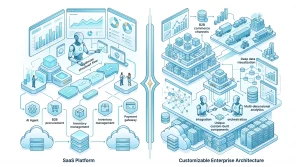
Executive summary: common scenarios and strategic guidelines
Let’s start with the typical CMO / IT Director context: a defined budget, a short launch window, multiple countries to orchestrate, legacy systems to integrate, and a backlog that cannot spiral out of control.
In this context, Plus allows organizations to shift resources from run to change (fewer servers, patches, and incidents; more design, content, and growth initiatives).
On the other hand, when competitive differentiation depends on highly specific business processes (pricing engines, product configurators, multi-level approval workflows, industry-specific compliance), Magento’s complete flexibility becomes a strategic investment—provided the organization accepts a more variable
TCOⓘ and a more disciplined release cycle.
Let’s look at three common scenarios.
Scenario A: Growing multi-country D2C business
Choose Shopify Plus if your team is marketing-driven and your roadmap includes rapid expansion across languages, currencies, payment methods, marketplaces, social commerce, and retail media.
The SaaSⓘ model reduces technical friction and accelerates market testing.
Scenario B: Enterprise B2B with tailored workflows
Choose Magento / Adobe Commerce when you need to model Roles & Permissions, RFQⓘ, credit lines, multi-tier pricing, and complex approval workflows—with granular control over APIⓘ, environments, and security.
Scenario C: Technical products with mission-critical integrations
It depends on the required level of customization.
If workflows can align with platform standards (with limited extensions), Plus typically delivers faster execution.
If your business depends on hard proprietary services and non-negotiable server-side logic, Magento usually performs better over the long term.
For growing D2C brands, marketplace and social integrations are often faster with Shopify.
For advanced B2Bⓘ operations involving RFQ, PO, and advanced user roles, architectural freedom becomes more valuable.
Adobe Commerce: SaaS, PaaS, and Open Source are not the same choice
It is essential to clearly distinguish Adobe’s three operating models, because they have very different impacts on
TCO, technical governance, roadmap, security, and customization.
-
Adobe Commerce as a Cloud Service (SaaS):
a fully managed, “versionless” model with upgrades and patches handled by Adobe.
It significantly reduces operational overhead, while introducing stricter guardrails compared to traditional Magento. -
Adobe Commerce on cloud infrastructure (PaaS):
infrastructure is managed by Adobe, but application code, patches, QA, module compatibility, and releases remain largely under the merchant’s or technical partner’s responsibility. -
Magento Open Source:
no enterprise license fees, maximum architectural freedom, but full responsibility for hosting, security, performance, updates, compliance, and maintenance.
This is why, when discussing “Magento” generically, the real question is no longer simply:
Magento or Shopify?
but rather:
Which operating model are we prepared to sustain over the next 24–36 months?
Agentic Commerce: what it means and what Shopify already offers
By Agentic Commerce, we mean experiences where
AI
ⓘ
agents work with data, catalogs, and payment/logistics services to autonomously handle parts of the funnel: from discovery to cart composition, all the way to post-purchase support.
The user shifts from “browser” to “delegator”, while the merchant gains operational efficiency and new conversion surfaces: conversational assistants, semantic search, auto-merchandising, and autonomous actions across marketing and catalog management.
Why this matters in a decision memo
In your
TCOⓘ matrix, you are not measuring only licenses and hosting. You are also measuring human hours saved or reallocated thanks to agentic features: content, merchandising, merchant support, and insights.
Even more importantly, you are considering new demand surfaces:
LLMⓘ, assistants, and conversational searches where the cart may be built outside the website and land directly in checkout in a single step.
What is already available in Shopify today
- Shopify Magic: AI generation for product descriptions, emails, FAQs, and other content, natively integrated into the admin, with contextual prompts and brand voice adaptation.
- Shopify Sidekick: an agentic assistant for merchants, supporting analysis, setup, operational automations, form completion, and natural-language navigation across the admin.
- “Agent-ready” infrastructure: APIs and services that allow external agents to query catalogs, compose carts, and initiate checkout, with integration cases already rolling out across the AI ecosystem.
What this means operationally for an eCommerce business
Preparing for agentic commerce does not simply mean “adding AI”. It means making the catalog understandable, queryable, and actionable by external systems: clear product titles, complete attributes, updated availability, explicit policies, structured data, reliable feeds, secure checkout, and tracking for new demand sources.
In this logic, Shopify Plus has an advantage for merchants looking for fast adoption and lower technical complexity. Adobe Commerce remains strong when competitive advantage depends on proprietary processes, complex catalogs, and deep integrations with enterprise systems.
Practical implication: with Plus, you immediately gain operational leverage (content & automation) and readiness for adoption of external agentic channels (assistants, LLMs) that can bring highly intentional traffic directly to checkout.
Decision perimeter: SaaS vs PaaS / Open Source
| Aspect | Shopify Plus (SaaS) | Adobe Commerce as a Cloud Service (SaaS) | Adobe Commerce (PaaS) / Magento Open Source |
|---|---|---|---|
| Hosting & Ops | Managed: scaling, CDN, WAF, TLS. | Managed: cloud-native, versionless. | Your responsibility: application, patches, hardening. |
| Upgrades & patches | Managed by Shopify. | Managed by Adobe in the SaaS model. | Handled by team/partner, with variable costs and timelines. |
| Customization | High, via extensions, apps, and APIs. | High, through composable architecture and SaaS services. | Maximum: core, modules, database. |
| B2B | Native on Plus, with lean governance. | Enterprise-level, within the Adobe suite. | Enterprise-level, with full feature and architectural control. |
| Owner cost & TCO | Predictable: subscription and platform fees. | Predictable: subscription and consumption-based SaaS costs. | Variable: hosting, development, QA, security. |
TCO Matrix (12 months): cost items, risks, and opportunities
The following table summarizes the impact of the main cost items and related trade-offs. The assessments are indicative and depend on volumes, countries, integrations, and team maturity.
Shopify Plus (SaaS),
Adobe Commerce as a Cloud Service (SaaS), and
Adobe Commerce (PaaS) / Magento Open Source (self-hosted).
Figures and considerations vary depending on volumes, countries, integrations, and contracts.
| Item | Shopify Plus (SaaS) | Adobe Commerce as a Cloud Service (SaaS) | Adobe Commerce (PaaS) / Magento Open Source (self-hosted) |
|---|---|---|---|
| Platform license / fees | Predictable enterprise subscription; B2B included. | Enterprise subscription with cloud-native services; enterprise B2B. | Commerce: license based on tier / GMV; Open Source: €0 license, with costs elsewhere. |
| Hosting & infrastructure | Managed: CDN, WAF, TLS, scaling. | Managed, cloud-native and “versionless”; resilience handled by Adobe. | Adobe PaaS or own IaaS: environments and SRE responsibilities remain on your side. |
| Core upgrades & patches | Managed by Shopify; themes and apps must remain compatible. | Managed by Adobe in the “versionless” SaaS model. | Your responsibility: core + modules, patch calendar, and regression testing. |
| Security & compliance | Platform-level protections are managed. | Enterprise controls managed in SaaS. | Hardening, WAF, penetration testing, and incident response are your responsibility. |
| Development & customization | Themes, apps, functions; no core editing. | Extensions and APIs within SaaS guardrails. | Total freedom: core, modules, database; higher development effort and QA. |
| Extensions / Apps / Modules | Rich app store; predictable fees; performance guidelines. | Adobe Marketplace and managed services. | Large marketplace; compatibility and upgrades must be handled at every release. |
| Checkout & payments | Checkout Extensibility: blocks, extensions, pixels; integrated PSPs. | Managed enterprise checkout; Adobe/partner PSP integrations. | Fully custom checkout; free PSP choice; performance and compliance are your responsibility. |
| B2B & multistore | Native B2B on Plus; lean governance across markets and languages. | Enterprise B2B suite in the cloud. | Deep enterprise B2B: RFQ, roles, multi-price lists, and advanced multistore. |
| ERP / PIM / DAM integrations | APIs + webhooks; event-driven patterns through apps. | Adobe APIs and services; Experience Cloud integration. | Full freedom: APIs, queues, database; resilience and security must be designed. |
| Headless & composable | Storefront API / Hydrogen. | Composable SaaS with cloud-native services. | Total headless freedom with maximum architectural control. |
| Agentic Commerce | Available: Shopify Magic & Sidekick; “agent-ready” ecosystem. | Possible with Adobe AI services / suite. | Possible through custom or partner solutions. |
| Observability & performance | Platform telemetry; infrastructure tuning limited by design. | Managed observability in SaaS; tuning within guardrails. | APM, logging, alerting, and capacity planning are your responsibility. |
| People cost | Lean team: less DevOps / SecOps. | Medium team: product and integrations, helped by SaaS offloading. | Extended team: full-stack + DevOps + SecOps. |
| Time-to-market | Fast: weeks to a few months. | Medium-fast: months, with enterprise capabilities. | Medium-high: months, including hardening and UAT. |
| Cost predictability / TCO | High: known subscription and platform fees. | High: SaaS subscription / consumption costs. | Variable: hosting, development, QA, security. |
Terminology note: “Adobe Commerce as a Cloud Service” = fully managed, “versionless” SaaS. “Adobe Commerce (PaaS)” = Adobe Commerce on cloud infrastructure, with infrastructure managed by Adobe while code, patches, and QA remain your responsibility. “Magento Open Source” = self-hosted.
Operational reading: Plus reduces operating costs and shortens the distance between idea and release; Magento creates value when process specificity and full control generate sustainable competitive advantage.
Decision criteria (go/no-go) with examples
-
Advanced
B2Bⓘ complexity:
multi-level RFQ, credit lines, POⓘ, granular roles/permissions → Magento tends to win. Lean B2B or B2B evolving from a D2C base → Plus. -
Checkout customization:
official blocks/extensions and pixel-side tracking → Plus. Strongly server-side flows and atypical UX → Magento. -
Internal capabilities:
marketing-driven team (Plus) vs IT / DevOpsⓘ / SecOpsⓘ team. -
Speed & certainty:
tight deadlines, multiple markets, limited developers → Plus. -
Regulatory requirements & IT policies:
governance and infrastructure/data control → Magento; managed compliance → Plus. -
Agentic readiness:
if you want to immediately leverage agents for content, merchant assistance, and conversational demand surfaces → Plus.
Risks & mitigation strategies
Checkout Extensibility: Shopify Plus migration can no longer be postponed
The question is no longer when to migrate, but verifying what has actually been migrated.
For Shopify Plus, the August 28, 2025 deadline for Thank You and Order Status pages has already passed, and automatic upgrades of legacy customizations started in January 2026.
Mitigation plan: immediate audit of checkout.liquid, additional scripts, legacy apps, pixels, marketing tracking, GA4 events, Conversion API, thank you page, order status page, and post-purchase flows.
The goal is to avoid data loss, broken automations, and discontinuity in conversion measurement.
Continuous security and patching (Magento)
In PaaSⓘ / on-prem environments, the operational burden is significant: you must manage core and extension patches, hardening, compatibility testing, and incident response, while also monitoring new CVEⓘ.
Mitigation: upgrade calendar, WAFⓘ / CDNⓘ, periodic penetration testing, rigorous CI/CD, blue-green deployments, and emergency runbooks.
Over-engineering risk
Total freedom can lead to solutions that are too complex compared to the actual value they generate.
Countermeasure: a decision memo for every customization, including cost, risk, conversion impact, and maintainability; 70/20/10 rule: 70% standard, 20% adapted, 10% custom.
Integrations & data stack (ERP, PIM, DAM, Ads, Analytics, LLM)
- On Plus, prioritize certified connectors and event-driven patterns. On Magento, you can push much further with proprietary APIs, queues, and business logic—along with the related architectural responsibility.
-
Analytics & micro-CDP: GA4ⓘ + warehouse for cohorts, LTV, incrementality, and audience activation toward advertising platforms / CDPⓘ.
-
LLMs & external agents: prepare your catalog, policies, and endpoints so third-party agents can safely build carts and initiate checkout, while maintaining full control over stock, pricing, and fulfillment.
HT&T insights to support platform selection
Choosing between Shopify Plus and Adobe Commerce should never be isolated from the broader digital ecosystem.
To build a more complete evaluation, we recommend connecting this memo with several strategic areas: integrations, UX/CRO, modern SEO, AI, and custom development.
-
eCommerce, ERP, PIM, and DAM integrations: useful for understanding how much your project depends on data flows, synchronization, business systems, and operational automation.
-
Conversion Design & CRO: critical if your expected value depends on UX, checkout optimization, funnel performance, and conversion rate improvement.
-
SEO, AEO & GEO: essential for making catalogs, categories, and content understandable both by Google and AI-driven answer engines.
-
AI & Automation: useful for preparing processes, data, and workflows for agentic commerce and AI assistants.
-
Backend & frontend development: relevant when the platform must integrate with custom business logic, proprietary services, or headless architectures.
-
Magento as a Service: what changes with Adobe’s new model: useful context for Adobe Commerce as a Cloud Service.
-
Instant Checkout & Shopify Agentic Commerce: a deeper look into new AI-driven purchasing surfaces and conversational commerce.
Implementation roadmap (90→180 days)
Phase 0: Discovery & TCO (2–3 weeks)
-
Requirements gathering (D2C / B2Bⓘ), integration inventory, process mapping, and KPI definition.
-
Calculation of TCOⓘ across 12–24 month scenarios; definition of the “must-have” backlog.
Phase 1:
MVPⓘ (6–10 weeks on Plus; 10–16 on Magento)
- Environment setup, themes/UX, catalog, payments, shipping, taxation.
-
Core integrations (ERP, PSPⓘ, email, analytics), QA ⓘ and UATⓘ .
Phase 2: B2B / expansion (4–8 weeks)
- B2B enablement, pricing lists, payment terms, operational automations, extra-EU localization.
- Performance optimization, governance, and ongoing security.
Phase 3: Agentic enablement (continuous)
- Enable Shopify Magic / Sidekick for content generation and internal operations.
- Test external agents (LLMs / assistants) for discovery and cart → checkout flows.
- Measure the impact on cost-to-serve, conversion, and new demand channels.
Conclusion
In short, choosing between Shopify Plus,
Adobe Commerce as a Cloud Service,
Adobe Commerce on cloud infrastructure, and
Magento Open Source depends on three factors:
how much you value speed and cost predictability, how much business value comes from deep customization, and how ready you are for Agentic Commerce.
The right way to decide is through a
12–24 month TCO matrix, followed by an MVP → scale-up roadmap that aligns platform, integrations, governance, and KPIs.
About HT&T Consulting
For over 25 years, we have been designing, developing, and managing eCommerce ecosystems.
We work across both Shopify / Shopify Plus and Magento 2 / Adobe Commerce, managing integrations (ERP/PIM/DAM), performance, UX/CRO, and privacy-safe measurement (we are
Google Marketing Platform Certified).
If you need to select the right platform or scale your eCommerce business, we can support you across multiple strategic areas to achieve your business goals.
We have several proven “from zero to hero” success stories, where brands and SMEs evolved from prototypes into scalable commerce ecosystems across Italy and Europe.
Next step
Would you like a customized TCO matrix (12–24 months) and a migration plan with Agentic enablement?
Book a Decision Workshop with our specialists: in 90 minutes, we deliver a clear go/no-go recommendation and an executable roadmap.
Back to top
Continua a leggere
7 minutes of reading

5 minutes of reading


And it consumes less energy.
To return to the page you were visiting, simply click or scroll.