Data Warehouse for SMEs: The Power of Data.

Data Warehouses for SMEs: Turning Data into Competitive Advantages
In the digital age, data is the new oil. But only companies that know how to transform it into concrete strategies grow. This guide shows how Italian small and medium-sized businesses can implement a data warehouse and achieve ROI of up to 91% without enterprise-level budgets.
In Brief
A centralized data warehouse enables companies to collect, organize and analyze data from all business sources (sales, production, marketing) within a single platform. The result: faster decision-making, a 30% reduction in costs, and documented ROI ranging from 91% to 236%. With Google’s cloud tools (BigQuery, Data Studio, Dataflow), SMEs can now access technologies that were once reserved exclusively for large enterprises.

What Is a Data Warehouse?
A Data Warehouse is a centralized repository designed to collect, organize and analyze data from multiple business sources. Unlike operational systems such as ERP, CRM or ecommerce platforms, which manage day-to-day activities, a Data Warehouse is built to support analytics, reporting and strategic decision-making.
In practice, it brings together information from sales, marketing, finance, production, customer service and other business applications into a single environment, creating one reliable version of the truth across the organization.
A Practical Example
An ecommerce business may have data spread across Shopify, Google Analytics 4, Google Ads, Meta Ads, Mailchimp and its accounting software. A Data Warehouse integrates all these sources and enables businesses to answer questions such as:
- Which campaigns generate the highest margins?
- Which customers deliver the highest lifetime value?
- Which products generate the best return on investment?
- Which channels acquire the most profitable customers?
Data Warehouse vs Data Lake vs Data Lakehouse: Which One Should You Choose?
These terms may sound similar, but they represent fundamentally different architectures designed for different use cases. Choosing the wrong one means wasting both time and money.
Before Comparing Them: What Are Data Lakes and Data Lakehouses?
Many people use these terms interchangeably, but they represent distinct approaches to data management.
Data Warehouse
A structured repository designed for reporting, KPIs and Business Intelligence. Data is organized and validated before being used.
Data Lake
A repository that stores large volumes of raw data, including unstructured content such as documents, images, videos, application logs and IoT data.
Data Lakehouse
A modern architecture that combines the flexibility of a Data Lake with the analytical capabilities of a Data Warehouse.
“Many SMEs start with a Data Lake because it seems more flexible. They then discover that unstructured data is unusable without a semantic layer. A Data Warehouse is the correct starting point for organizations seeking insights rather than storage.”
Google Cloud Architecture Team, 2025
Key Differences
| Data Warehouse | Data Lake | Data Lakehouse | |
|---|---|---|---|
| Data Type | Structured (tables, schemas) | Everything (structured, semi-structured, unstructured) | Both, unified |
| Schema | Schema-on-write (defined beforehand) | Schema-on-read (flexible) | Flexible schema with governance |
| Query Performance | ⚡ Very high (optimized) | 🐢 Low (raw data) | ⚡ High (optimized layer) |
| Data Quality | ✅ High (clean, validated) | ⚠️ Variable (raw) | ✅ High with governance layer |
| Initial SME Cost | Medium, proportional to usage | Low for storage, higher to make data analyzable | Higher due to greater architectural complexity |
| Best For | BI, reporting, analytics, business KPIs | Data science, machine learning, raw data storage | Mature organizations with data teams and advanced use cases |
| Examples | BigQuery, Snowflake, Redshift | Google Cloud Storage, AWS S3 | Databricks, BigLake |
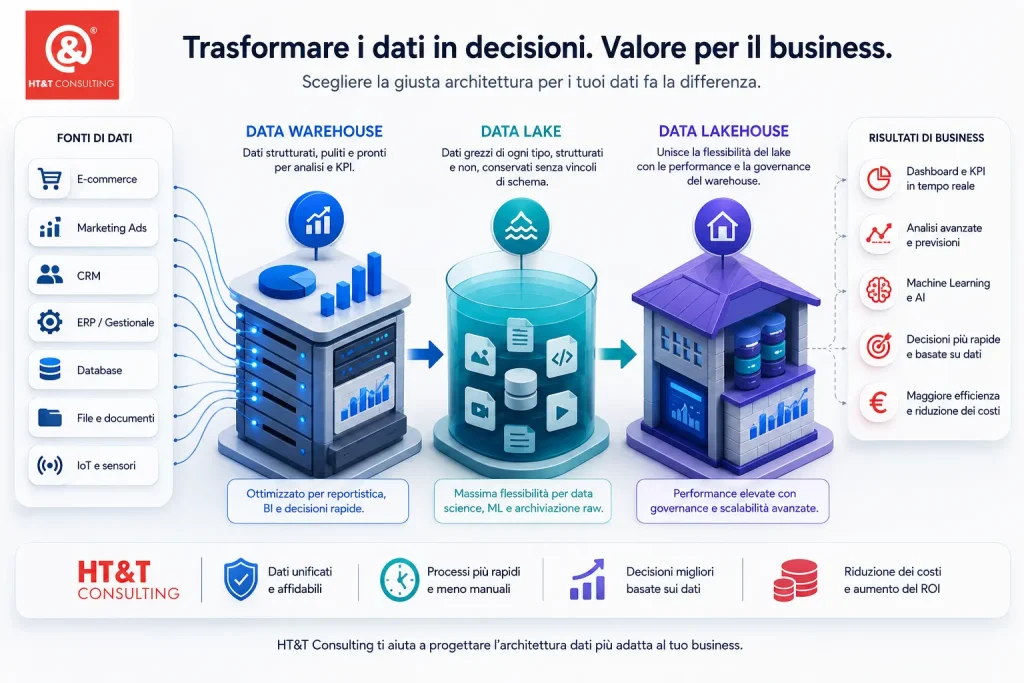
Which One Should Your Company Choose?
Data Warehouse (recommended): If your goal is to improve business decisions, build dashboards, monitor KPIs and create reporting systems, a Data Warehouse is the right choice. Clean data, fast queries and immediate BI capabilities. Google’s BigQuery is serverless, has no fixed costs and charges only for the data processed.
Data Lake: Suitable only if you manage massive volumes of unstructured data (videos, audio files, machine logs) and have a technical team capable of working with it. For most SMEs, it quickly becomes a “data swamp” filled with unusable information.
Data Lakehouse: The architecture of the future, but one that requires a dedicated data team. Consider it after 2–3 years of maturity with a Data Warehouse.
A Practical Example
A machinery manufacturer collecting videos, images, IoT data and sensor logs may require a Data Lake.
An ecommerce company that wants visibility into sales, margins and advertising ROI almost always needs a Data Warehouse.
An international group with hundreds of data sources and a dedicated Data Science team may consider a Data Lakehouse.
What Is a Data Warehouse and Why Do SMEs Need One?
A data warehouse is not simply a database. It is a structured and centralized repository that collects data from multiple business sources (sales, production, marketing, supply chain, CRM) and transforms it into consistent, analyzable information.
Imagine a supermarket of data: without a data warehouse, each department (sales, finance, marketing) has its own disorganized storage area. Excel files are scattered, databases are not synchronized, and reports are created manually. It’s chaos. A data warehouse acts as the architect that brings order, standardizing data, cleaning duplicates and inconsistencies, and preparing it for analysis.
“Poor-quality data costs organizations an average of $12.9 million per year in rework and inefficiencies.”
Polimi Big Data & BI Study, 2026
Unlike transactional systems (ERP, CRM) designed for daily operations, a data warehouse is optimized for analytics. Data stored within it remains immutable, ensuring historical integrity: you know exactly what happened every month, quarter and year.
The Data Warehouse Market
Over the last few years, Data Warehousing has evolved from a technology reserved for large multinational corporations into a tool accessible to small and medium-sized businesses. The growth of cloud computing, pay-as-you-go pricing models and serverless platforms has dramatically reduced entry costs, making it possible to implement advanced Business Intelligence solutions without significant infrastructure investments.
At the same time, the volume of data generated by ecommerce platforms, CRM systems, ERP software, marketing tools and business applications has increased exponentially. As a result, organizations face a growing need to centralize information. Companies capable of transforming data into operational knowledge gain stronger forecasting capabilities, reduced inefficiencies and a deeper understanding of their customers.
It is therefore no surprise that the global Data Warehouse market continues to grow rapidly. More and more organizations are investing in advanced analytics, automation and artificial intelligence, creating an ecosystem where data has become one of the most valuable assets for maintaining competitiveness.
The message for businesses is clear: investing in data management is no longer optional, and it must be done in a sustainable, progressive way. Modern technologies make it possible to start with focused projects and scale over time without facing the infrastructure investments typically associated with large enterprises.
Why Should a Company Implement a Data Warehouse?
Many Italian SMEs already possess vast amounts of data but struggle to turn it into a competitive advantage. Ecommerce orders, quotations, invoices, marketing campaigns, production data and CRM information are often managed in separate systems that do not communicate with each other. As a result, each department works with different numbers, reports take time to produce, and decisions are often based more on intuition than evidence.
A Data Warehouse is designed specifically to solve this problem. By centralizing all business information within a single environment, it provides a complete and up-to-date view of the business. Instead of consulting dozens of Excel files or accessing multiple software platforms, managers and business owners can analyze KPIs, profitability, sales performance and operational metrics from a single trusted source.
For any organization, the value lies not in the technology itself, but in the ability to make faster and more accurate decisions. Knowing which customers generate the highest profits, which products have the best margins or which activities are slowing growth enables businesses to act before competitors do and allocate resources more effectively.
In an increasingly competitive economic environment, a Data Warehouse represents the transition from a company that merely collects data to a truly data-driven organization, capable of using information as a strategic lever to increase efficiency, profitability and forecasting capabilities.
Artificial Intelligence Enhances the Data Warehouse
A Data Warehouse collects, organizes and makes business data reliable. Artificial Intelligence adds an additional layer of value: the ability to interpret that data, identify hidden correlations and automatically generate operational recommendations. In other words, the Data Warehouse represents the company’s memory, while AI becomes its decision-making engine.
In recent years, the rise of generative models and machine learning tools has made a completely new approach to data analysis possible. It is no longer necessary to know SQL or manually build complex reports: managers, sales teams and department heads can query data using natural language and receive immediate answers supported by visualizations and advanced analytics.
This transformation is democratizing access to business information. Activities that once required days of work from analysts and consultants can now be completed in minutes, enabling SMEs to make faster decisions based on evidence rather than intuition or incomplete information.
To produce reliable results, however, AI requires structured, up-to-date and consistent data. This is precisely where the Data Warehouse becomes essential: without a solid data foundation, even the most advanced AI model risks generating inaccurate analyses, unreliable forecasts and misleading recommendations.
A Data Warehouse is powerful. Add AI, and it becomes intelligent.
“By 2027, 45% of analytics queries will be generated through search, natural language or voice interfaces. Data democratization has arrived.”
Gartner, 2025
What AI Can Do on Top of a Data Warehouse
- Automated Analytics: Identify anomalies, hidden trends and correlations that humans might overlook.
- Forecasting: Predict product demand, costs and customer churn with accuracy rates of up to 93%.
- Intelligent Recommendations: “This customer has an 82% probability of purchasing product X again. Contact them now.”
- Natural Language Processing: Ask questions in plain language: “Who is our most profitable customer?”
The AI Paradox for SMEs
Seventy percent of organizations report that they are not realizing the full potential of their AI investments, despite achieving positive ROI. The reason? Weak foundations: poor data quality, lack of governance and organizational silos.
A Data Warehouse solves this problem by providing clean, centralized and well-governed data. Only then can AI truly deliver its value.
What AI Can Do Today with a Data Warehouse
- Automatically generate dashboards
- Answer business questions in natural language
- Detect anomalies in sales performance
- Forecast future demand
- Identify customers at risk of churn
- Recommend commercial actions
Real Use Cases: How Italian Companies Can Leverage a Data Warehouse
1️⃣ Ecommerce
The Problem: Sales data in Shopify, marketing data in Mailchimp, traffic data in Google Analytics, accounting data in TeamSystem. None of the systems communicate. You have no idea which email campaign actually generates profit.
With a Data Warehouse:
- Analyze the customer journey: where customers come from, which products they purchase and what their average value is.
- Identify products with the highest margins and those approaching stock-out situations.
- Automate promotions: customer has not visited in 30 days? Send a personalized discount for the product they are most likely to purchase.
- Demand forecasting: “In May we expect a sales spike for summer products; increase inventory by 50%.”
2️⃣ Manufacturing Company
The Problem: Production data stored in Excel spreadsheets, order data stored in SAP, with no synchronization. You do not know where bottlenecks are, how long production cycles take or which machine fails most often.
With a Data Warehouse:
- Identify bottlenecks: “Press X takes 40% longer than average. Predictive maintenance is urgently required.”
- Optimize production cycles: reducing lead times by 20% increases throughput without additional investments.
- Improve quality control: identify defects before products leave the factory rather than afterward.
- Plan production based on demand forecasts: no excess inventory, no stock-outs.
3️⃣ Financial Services Company
The Problem: Customer data is scattered across CRM systems, risk management platforms and email tools. You cannot accurately calculate customer lifetime value or determine which cross-selling opportunities are most relevant.
With a Data Warehouse:
- Credit risk assessment: AI can predict default probability with up to 93% accuracy.
- Intelligent cross-selling: “Customer X has a checking account and has a 78% probability of being interested in a loan. Notify the sales team.”
- Fraud detection: pattern recognition identifies anomalous transactions in real time.
- Customer segmentation: premium, standard and at-risk customers, each with dedicated engagement strategies.
Google Cloud Tools for SME Data Warehouses
Once the data strategy has been defined, selecting the right technology platform becomes one of the most important aspects of the project. Today the market offers numerous cloud solutions that enable organizations to build scalable Data Warehouses without investing in proprietary infrastructure, reducing both implementation times and management costs.
The ideal platform should be easy to use, integrate seamlessly with existing business systems, remain economically sustainable and scale over time. In this context, Google Cloud represents one of the most compelling options thanks to its serverless architecture and native integration with tools that companies already use every day.
For us, Google Cloud is the natural choice because it is serverless (nothing to administer), pay-as-you-go (you pay only for what you use), integrated (everything communicates seamlessly) and scalable (from SMEs to multinational enterprises).
BigQuery: The Heart of the Data Warehouse
BigQuery is a cloud Data Warehouse that does not require database administrators. Load your data, ask questions and obtain answers in seconds—even across billions of rows. Cost? Data warehousing services are generally charged per terabyte of data processed rather than per server, which typically translates into a starting cost of approximately €50–200 per month.
Dataflow: Automated ETL
Connects BigQuery to your data sources (Shopify, Google Analytics, CRM, ERP). Data is extracted, cleaned and loaded automatically. No coding required—just configuration.
Data Studio: Business Intelligence Made Easy
Data Studio transforms data into interactive dashboards that anyone can explore. The CEO sees daily KPIs, sales representatives monitor their pipelines, and CFOs track cash flows—all in real time and fully synchronized.
Common Challenges and How to Solve Them
Implementing a Data Warehouse delivers tangible benefits, but it is not without challenges. The difficulties that emerge during the journey are rarely technological in nature. Modern technology is more accessible and easier to use than ever before. Instead, the real challenges involve data organization, business processes and ensuring that people across the organization embrace and use information in their daily work.
Many SMEs encounter similar issues: data distributed across multiple systems, incomplete or inconsistent information, a lack of specialized skills and uncertainty regarding project costs. The good news is that these challenges are common and, in most cases, can be overcome through a gradual approach and proper planning.
Let’s look at the most common obstacles organizations face when building a Data Warehouse and how to address them pragmatically.
Challenge 1: “Where Do We Get the Data?”
Solution: Start with the three most important sources for your business. An ecommerce company typically begins with Shopify (orders), Google Analytics (traffic) and Mailchimp (email marketing). Everything else comes later. A good CRM already centralizes many valuable sources.
Challenge 2: “Our Data Is Messy and Inconsistent”
Solution: This is exactly what ETL/ELT processes are designed for. BigQuery includes built-in data cleaning functions, while Dataflow handles more complex transformations. If one system stores “Milan” and another stores “MI,” the platform automatically standardizes the information.
Challenge 3: “We Don’t Have an Internal Data Analyst”
Solution: Data Studio provides self-service BI. Your CEO can create dashboards without writing SQL. For advanced AI and analytics initiatives, collaborating with partners such as HT&T that have expertise in analytics and data science is often the smartest investment.
Challenge 4: “How Much Does a Data Warehouse Cost?”
Solution: Google Cloud offers transparent and scalable pricing. SMEs pay based on actual data volumes processed. During the first month, projects can start at around €50–100. As your business grows, costs increase, but so does ROI.
The Implementation Roadmap: From Zero to Data-Driven in 6 Months
One of the most common questions we receive from SMEs concerns the time required to implement a Data Warehouse. The answer depends on the complexity of the organization, the number of systems to integrate and the project’s objectives. In most cases, however, it is possible to achieve the first tangible results within a few weeks and complete a structured initial implementation within several months.
It is important to understand that a Data Warehouse does not need to be built all at once. The most effective approach is to proceed in stages, initially focusing on the data and KPIs that generate the greatest business value. This reduces risk, delivers measurable results from the beginning and encourages adoption across departments.
The roadmap below represents a typical journey for an SME that wants to transform its data into a strategic asset. Timelines may vary depending on company size and digital maturity, but the underlying logic remains the same: start with solid foundations, progressively build the data model and then introduce advanced dashboards, automation and artificial intelligence.
The ultimate goal is not simply to implement a new technology platform, but to create a data-driven culture in which every important decision is supported by reliable, up-to-date and easily accessible information.
Phase 1 (Months 1–2): Discovery and Planning
- Identify the three primary data sources
- Map the business-critical KPIs (sales, costs, customers, quality)
- Involve decision-makers: CFO, CEO and department managers
- Select the technology stack (Google Cloud recommended)
Phase 2 (Months 2–3): Technical Implementation
- Load historical data (last 3–5 years) into BigQuery
- Configure Dataflow for automated daily ingestion
- Data cleansing and standardization
- Create the semantic data model
Phase 3 (Months 3–4): Business Intelligence and Dashboards
- Create the first 3–5 mission-critical dashboards in Data Studio
- Train teams on how to read data and ask meaningful questions
- Implement automated alerts when KPIs fall below thresholds
- Integrate with email and Slack for real-time notifications
Phase 4 (Months 4–6): AI and Optimization
- Add simple predictive models (forecasting, anomaly detection)
- Automate recurring decisions
- Collect feedback from teams and optimize dashboards
- Expand data sources as the business grows
At the end of this journey, the company has a modern, scalable data platform ready to support business growth. New data sources, advanced Business Intelligence tools and Artificial Intelligence applications can be integrated progressively, transforming the Data Warehouse into one of the organization’s most important strategic assets.
How to Choose the Right Provider? BigQuery vs Snowflake vs Redshift vs Azure
BigQuery is our recommendation for Italian SMEs, but it is not the only option available on the market. Here is an honest comparison of the major players so that you can make an informed decision.
The choice of platform should not be driven exclusively by price or vendor reputation. Each solution offers different strengths in terms of costs, integrations, ease of management and advanced capabilities.
It is essential to evaluate not only your current requirements but also the platform’s ability to support business growth over the coming years. The right choice reduces operational costs and simplifies the future adoption of Business Intelligence, automation and Artificial Intelligence.
Why We Recommend BigQuery for Italian Companies
Three practical reasons:
- Native Google Workspace integration: If you use Gmail, Google Analytics and Google Ads, data flows into BigQuery with a single click. No connectors to purchase and no APIs to develop. Simplify your stack with GA4 for ecommerce connected directly to BigQuery.
- Serverless and maintenance-free: There are no servers to manage, patches to install or backups to configure. Google handles everything. Your team focuses on data rather than infrastructure.
- Transparent and predictable costs: You pay for processed terabytes, not for servers running 24/7. For an SME with moderate volumes, costs typically range between €50 and €200 per month. Snowflake often costs three to four times more for the same workload.
To maximize BigQuery’s value together with automation platforms such as n8n for process automation or Supermetrics for data aggregation, the setup becomes even more powerful without significantly increasing costs.
Data Security and Privacy: Not Optional, but Strategic
A Data Warehouse is valuable only if it is secure. Your Data Warehouse contains the company’s most sensitive information: customer data, financial records, sales forecasts and production costs. If this information falls into the wrong hands, the damage is not merely financial—it becomes reputational, legal and potentially existential.
“In 2025, the Italian Data Protection Authority issued more than €200 million in fines. SMEs were not exempt, with average penalties of €25,000 for inadequate security measures. The average cost of a data breach? €95,000 between notifications, legal consulting and operational downtime.”
— Italian Privacy Authority Report 2025
The good news? Data Warehouse security is not a luxury. It is a set of standardized, certified and audited practices. If you choose a trusted platform such as Google Cloud (which has passed international security audits), you have already won 90% of the battle.
The Artificial Intelligence and Data Privacy Paradox
Many SMEs worry: “If I use ChatGPT with my company data, does OpenAI own it?” The answer is: it depends.
Golden rule: if you use AI to analyze sensitive data, use Enterprise versions with data isolation—not free consumer versions.
GDPR Compliance: The 5 Mandatory Technical Measures
When discussing Data Warehouses, organizations are not dealing only with technology and operations but also with regulatory responsibilities. Centralizing data means managing information that may include personal data relating to customers, employees, suppliers and business partners.
For this reason, every Data Warehouse project should be designed with European data protection regulations in mind. Building compliance into the project from the beginning reduces operational risks, simplifies audits and helps strengthen trust in the organization.
The GDPR (General Data Protection Regulation) has been in force since 2018. If you process personal data belonging to customers, employees or suppliers—and a Data Warehouse almost certainly does—you must comply with Article 32, which requires “appropriate technical and organizational measures.”
What does that mean in practice?
Data Protection Officer (DPO): Who Needs One and Why?
The DPO (Data Protection Officer) is the person responsible for overseeing GDPR compliance. It is not mandatory for all SMEs. It is required only if:
- ✅ You are a public authority (municipality, tax agency, etc.)
- ✅ You process special categories of personal data on a large scale (health, religious, biometric or other sensitive data)
- ✅ You systematically monitor individuals (for example, organizations that continuously track customer behavior)
For most SMEs, appointing a DPO is not mandatory, but it is recommended. Why? Because it transforms compliance from a source of fear into a strategic business asset.
Internal vs External DPO: Real Costs
External DPO (recommended for SMEs): €1,500–4,000 per year. A specialized consultant who performs annual audits, updates policies and supports business growth. Cost: less than one euro per day. Value: protection from fines that can reach thousands of euros.
Internal DPO: An employee with dedicated training (€500–2,000 for a certified course) who allocates 4–8 hours per month to compliance activities. This usually makes sense only for larger organizations (100+ employees) or businesses with specific regulatory requirements.
HT&T Recommendation: For SMEs with fewer than 50 employees, an external DPO is almost always the best choice. It is not a cost—it is insurance.
GDPR Checklist for Data Warehouses (5 Steps)
- Initial GDPR Audit: Map the personal data stored in the Data Warehouse (customers, suppliers, employees) and identify the legal basis for processing (contract, consent, legal obligation).
- Updated Privacy Policy: Inform customers that their data is processed within your Data Warehouse and explain how it is used for analytics, reporting and Business Intelligence.
- Data Processing Agreement (DPA): If you use Google Cloud, BigQuery or third-party providers, sign a DPA that clearly defines responsibilities for all parties involved.
- Processing Activities Register: Document every data processing activity, including source, purpose, retention period and categories of data subjects. This is mandatory and may be requested during an audit by the Data Protection Authority.
- Staff Training: Employees must understand that sensitive data cannot be downloaded onto USB drives, shared through unencrypted email or left exposed on unattended devices. Regular training should be part of the compliance program.
Security Best Practices: The 7 Golden Rules
Implementing a Data Warehouse means centralizing some of the organization’s most important information: customer data, financial information, commercial performance metrics, production processes and strategic business knowledge. For this reason, security cannot be treated as an afterthought. It must be built into the project from the very beginning.
Modern cloud platforms provide extremely high levels of protection, but technology alone is not enough. Many security incidents are not caused by software vulnerabilities but by human error, poor configurations, compromised credentials or inadequate internal procedures. An effective security strategy therefore combines technology, governance and employee awareness.
For SMEs, the objective is not to achieve absolute security—which does not exist—but to meaningfully reduce risk and improve the ability to prevent, detect and respond to incidents. The following best practices represent the foundation of a modern and sustainable security strategy for any Data Warehouse and Business Intelligence initiative.
1️⃣ Choose a Certified Provider
Google Cloud offers ISO 27001, SOC 2 Type II, GDPR readiness and FedRAMP certifications. This is not accidental: billions have been invested in security. Serious alternatives include AWS and Azure. Avoid small providers without recognized certifications.
2️⃣ Enable 2FA Everywhere
BigQuery access, Data Studio, corporate Gmail: everything should use two-factor authentication. A password alone is fragile. A password combined with an OTP code is dramatically more secure. Read our guide on password security and 2FA.
3️⃣ Use Enterprise AI Services
If you use ChatGPT or Claude to analyze business data, use ChatGPT Enterprise or the Claude API—not free versions. Your data remains yours and is not used to train public models.
4️⃣ Backup and Disaster Recovery
Your data may already be replicated across multiple data centers, but do you have a recovery plan? Define backup procedures, Recovery Time Objectives (RTOs) and perform annual recovery testing.
5️⃣ Monitoring and Alerting
Who accessed the Data Warehouse at 2 a.m.? How many gigabytes of data were downloaded? Without monitoring dashboards and alerts, a breach may remain undiscovered for months.
6️⃣ End-to-End Encryption
Data should travel encrypted from source to warehouse and remain encrypted while stored. Only authorized users with the appropriate keys should be able to access it. This is not optional—it is the standard.
7️⃣ Internal Training
Security is not solely the CTO’s responsibility. Every employee who handles data should know: no passwords on sticky notes, no unencrypted emails and no unauthorized downloads. Phishing attacks fail when employees know how to recognize them.
“Security is a journey, not a destination. There is no such thing as completely secure. There is only being sufficiently prepared to reduce risk and respond quickly when an incident occurs.”
Security is not an activity that ends once a system goes live. It is a continuous process that requires monitoring, updates and periodic reviews. Organizations that adopt this mindset not only reduce the risk of breaches and penalties but also strengthen trust among customers, partners and stakeholders.
When a Data Warehouse Might Not Be Necessary
Not every organization needs to implement a Data Warehouse immediately. While data centralization offers significant competitive advantages, there are situations where the investment may be premature relative to the current needs of the business.
Situations Where It May Be Better to Wait
Very Small Businesses
If the organization consists of fewer than five people and decisions are made daily in direct contact with customers, orders and operations, the complexity of information may not yet justify a Data Warehouse.
A Single Data Source
If the entire business runs within a single management system or platform, the benefits of centralization may be limited. Existing dashboards and reporting capabilities may already be sufficient.
Effective Reporting Already Exists
If reports are generated quickly, data is reliable and management can make decisions efficiently, the short-term value of a Data Warehouse may be limited.
Very Small Data Volumes
If customer, order, product and transaction volumes remain low, well-structured spreadsheets and lightweight Business Intelligence tools may still be sufficient.
Signs That the Time Has Come
On the other hand, there are several clear indicators that suggest it is time to adopt a structured data platform:
- Data is spread across multiple disconnected systems.
- Employees spend many hours manually preparing reports.
- Marketing, sales and finance work with different numbers.
- It is difficult to understand which activities truly generate profit.
- You want to introduce Artificial Intelligence or predictive analytics.
- Business growth is rapidly increasing operational complexity.
A Progressive Approach Is Often the Best Choice
For many SMEs, the ideal solution is not to move immediately to a fully developed Data Warehouse but to follow a gradual path. Start by improving data collection, creating reliable dashboards and integrating the most important data sources. As data volume and decision-making requirements grow, the transition to a Data Warehouse becomes natural and delivers immediate benefits.
In other words, the right time to invest in a Data Warehouse is not determined by company size but by the moment when data complexity begins to slow decisions and limit business growth.
To learn more, contact us.
Conclusion: The Time Is Now
Today, a Data Warehouse is not a luxury technology investment—it is a competitive weapon. The SMEs that act today will possess insights that many competitors will not discover for another five years.
The cost? Minimal (€50–200 per month to get started). The implementation time? Approximately six months to move from “zero data strategy” to “data-driven company.” The ROI? Documented between 91% and 236%, with payback periods often within six months.
“Over the last five years, I have seen more SMEs fail because of a lack of insight than a lack of capital. Data is not a nice-to-have. It is the survival kit of the modern business.”
Marco Trozzi, Partner, HT&T Consulting
If you have not yet started building a Data Warehouse, your competitors may already be doing so. If you have started, continue. The advantage compounds over time.
FAQ: The Most Common Questions About Data Warehouses
The questions we are most frequently asked when discussing Data Warehouses with our clients.
After exploring benefits, costs, technologies, security and implementation roadmaps, a number of recurring questions remain. These are typically asked by business owners, IT managers and executives evaluating a Data Warehouse initiative.
We have gathered the answers to the most common concerns to help SMEs better understand timelines, investments and opportunities related to advanced data management.
How much does a Data Warehouse cost for an SME?
With Google BigQuery, a typical SME spends between €50 and €200 per month on the platform. This is in addition to the one-time implementation cost, usually ranging from €3,000 to €15,000 depending on complexity. Average ROI is typically achieved within six months.
Do I need an internal data analyst to manage it?
Not necessarily. With Data Studio, anyone can create dashboards without writing SQL. An external partner is often helpful during the initial implementation phase. Once configured, a marketing manager or business controller can usually manage it independently.
What is the difference between a Data Warehouse and a CRM?
A CRM manages customer relationships in real time. A Data Warehouse aggregates CRM data together with all other business sources (e-commerce, finance, marketing) for historical and strategic analysis. The two are complementary: the CRM feeds the Data Warehouse, which in turn generates insights that improve CRM performance.
How long does implementation take?
Using a structured methodology, an SME can have its first operational dashboard within 4–6 weeks and a complete Data Warehouse within 3–6 months. With automation tools such as n8n, implementation times can be significantly reduced.
Is my data safe in the cloud?
Google Cloud is certified under ISO 27001, SOC 2 Type II and is GDPR-ready. Your data is encrypted both in transit and at rest, replicated across multiple data centers and is not used by Google for commercial purposes. In many cases, cloud security exceeds that of internally managed on-premise infrastructure.
How is it different from Google Analytics or Data Studio?
Google Analytics (GA4) collects website traffic data. Data Studio visualizes data from one or more connected sources. A Data Warehouse centralizes all company data in a single environment, enabling cross-source analysis that standalone tools cannot provide. It operates at a higher strategic level.
Can I start with a small amount of data and scale over time?
Absolutely. Start with two or three critical sources (e-commerce, GA4 and CRM), build the first dashboards and progressively add more sources. BigQuery is serverless, making scaling immediate without additional fixed infrastructure costs.
How does it integrate with Shopify, WooCommerce or Magento?
All major e-commerce platforms offer native connectors or integrations through tools such as Supermetrics and n8n. Shopify can export orders, products, customers and inventory directly into BigQuery through dedicated applications. Typical setup requires only one or two days.
Continue Learning with These Related HT&T Articles
To master the modern data ecosystem, these articles complete the picture:
- Data Studio: Marketing Dashboards. How to visualize data from your Data Warehouse.
- Supermetrics: The End of Data Chaos. The ideal connector for aggregating data sources.
- Business Process Automation with n8n. Automating data flows into your warehouse.
- n8n + Supermetrics. Intelligent marketing and data automation.
- GA4 for E-commerce. Configuring your most important digital data source.
- Data Visualization. Simplify data and accelerate decision-making.
- Marketing Intelligence: SEO, AEO and GEO. Using data to grow more effectively.
- KPIs for Every Business Role. The metrics worth tracking in your Data Warehouse.
Glossary: Key Terms You Should Know
- ETL (Extract-Transform-Load): Extracts data from multiple sources, transforms it (cleans and standardizes it) and loads it into the warehouse.
- BigQuery: Google’s serverless, high-performance cloud Data Warehouse.
- Business Intelligence (BI): The process of transforming data into business decisions.
- Dashboard: An interactive visualization of KPIs and key metrics.
- Data Studio: Google’s Business Intelligence platform for dashboards and self-service analytics.
- ROI (Return on Investment): The value generated compared to the investment made.
- Forecasting: Predicting future outcomes using historical data and AI models.
- Data Governance: Policies and processes that ensure data quality, security and compliance.
Continua a leggere
12 minutes of reading

22 minutes of reading


And it consumes less energy.
To return to the page you were visiting, simply click or scroll.