Maximize Customer Lifetime Value (CLV)

Fixing the Leaky Bucket: Building Value Instead of Chasing Customers
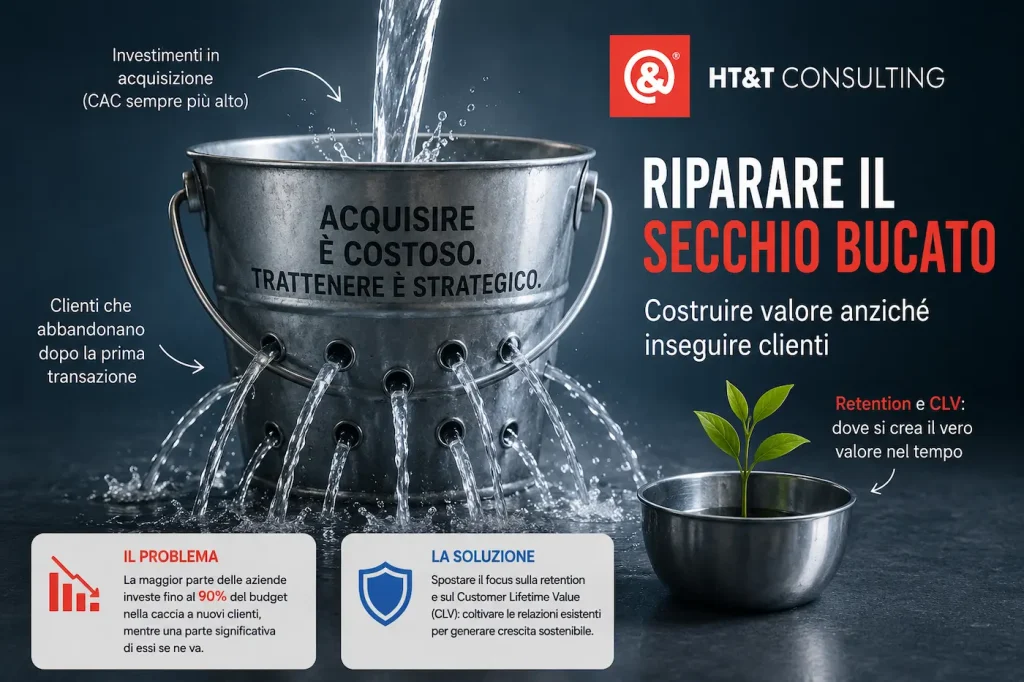
Modern marketing suffers from a costly paradox. Most companies, driven by a culture focused on quarterly growth, invest the vast majority of their budget—often up to 90%—in a single activity: hunting for new customers.
This strategy is the business equivalent of trying to fill a leaky bucket. Every new customer acquired at a high cost, with Customer Acquisition Costs (CAC) constantly increasing, enters a system that is not designed to retain them. As a result, a significant percentage of those customers slip away after the first transaction, forcing the marketing team to spend even more money to replace them.
Only 10% of the budget, and often even less in terms of strategic attention, is dedicated to cultivation: the patient and infinitely more profitable task of nurturing customers who have already been acquired.
The AI Accelerator
If this strategy was inefficient yesterday, today, in the era of AI-powered search, it has become strategic suicide.
We are witnessing a fundamental shift in the way people search for information. Users no longer “search” on Google to find the ten best answers on the first page. Instead, they “ask” ChatGPT, Perplexity or directly Google’s AI Mode. These tools do not behave like search engines; they function as synthesis engines. They do not show your website—they consume your website (along with those of your competitors) to formulate a single definitive answer.
Moreover, the answers they provide are no longer based primarily on product keywords but on customer intent.
This creates two critical challenges:
- The Disintermediation of Acquisition: AI has positioned itself as a powerful new intermediary between your business and your future customers. Becoming the source that AI chooses to cite is exponentially more difficult than ranking first on Google. Acquisition, already expensive, has become an even more complex gamble. If yesterday we had sellers of fake SEO, today we have sellers of fake GEO—where SEO stands for Search Engine Optimization and GEO stands for Generative Engine Optimization.
- Rising Expectations: Users have become accustomed to instant, hyper-personalized and contextual responses. They no longer have patience for generic experiences.
In this new digital landscape, the only relationship you can truly own, control and build a competitive advantage around is the one you have already established with your existing customers.
The relentless pursuit of leads at any cost is destroying margins. It is time to shift the focus and invest in a broader strategy—a true Digital Ecosystem—designed around the one metric AI cannot disintermediate: Customer Lifetime Value (CLV).
The Growth Misconception
Why do companies fall into this trap? The answer lies in a combination of tradition, incentives and measurement systems.
The Numbers Behind Retention
According to Bain & Company, increasing customer retention by just 5% can increase profits by between 25% and 95%.
According to Harvard Business Review, acquiring a new customer costs between five and twenty-five times more than retaining an existing one.
For this reason, companies with high CLV typically enjoy higher margins, more sustainable growth and lower dependence on advertising.
For decades, marketing has been synonymous with “making noise” to attract attention. Marketing departments and agencies—including ours—have historically been rewarded for generating new leads and new users, not for reducing churn rates. Sales teams are incentivized to close the first sale, not the second or third.
To make matters worse, attribution models reinforce this mindset. It is easy to measure the effectiveness of a Google Ads campaign that generates an immediate sale through last-click attribution. It is exponentially more difficult to measure the value of a weekly newsletter that prevents a customer from switching to a competitor six months later.
The result is a strategic disaster disguised as tactical success:
100%
- CAC (Customer Acquisition Cost) is out of control: Competition for attention has turned digital advertising into an increasingly expensive auction. The battle to become the AI’s preferred source will make organic acquisition an even greater luxury.
- Customers become mercenaries: A customer acquired solely through discounts or aggressive offers develops no real loyalty. They are a mercenary who will leave as soon as a competitor presents a better offer.
- Margins erode: If your CAC approaches the value of the first transaction (AOV, or Average Order Value), your business is not profitable. You are simply moving money around and working for advertising platforms.
The only way out is to stop focusing on the first receipt and start focusing on the total value a customer will generate throughout their entire relationship with your brand.
What Is Customer Lifetime Value (CLV)?
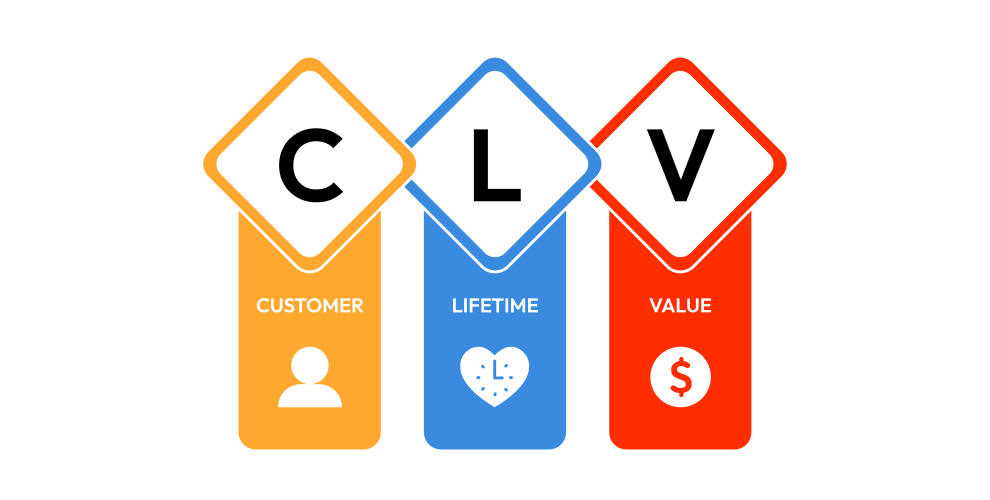
Customer Lifetime Value (CLV) is not just another metric to display on a dashboard (by the way, we are Google Marketing Platform certified and we know how to build dashboards at an exceptional level). It is a business philosophy.
For this reason, CLV should always be considered alongside other growth and profitability indicators. We discussed this topic in depth in our guide to the most important KPIs and business acronyms.
Most companies calculate CLV in a simplistic way (average order value × number of purchases × average customer lifespan). However, true strategic CLV is much more than that.
×
Purchase Frequency
×
Relationship Duration
=
CLV
- It is pure profit: The acquisition cost of an existing customer is zero. Every sale after the first carries a significantly higher profit margin because the largest marketing cost has already been absorbed.
- It is business resilience: Loyal customers with high CLV are less sensitive to price. They do not abandon you because a competitor offers a 10% discount. Their relationship with your company is not transactional—it is relational. They forgive mistakes and give you the benefit of the doubt.
- It is the engine of the Flywheel, a concept made famous by Amazon’s strategy and often referred to simply as the flywheel effect. This is the most important insight. Customers with high CLV do not merely buy more. They become promoters, ambassadors and passionate advocates for the brand. Satisfied, loyal customers bring in new customers through word of mouth, positive reviews and social sharing.
In this scenario, a high-value customer does not simply have a high CLV; they also have a CAC close to zero. They do not just generate profit—they actively reduce future acquisition costs by fueling a virtuous cycle of growth.
Email and automation: how can we afford not to invest in them?
Customer Intelligence: A Competitive Advantage in the AI Era
If Artificial Intelligence works with public data available on the web, Customer Intelligence works with proprietary data that only your company owns.
Preferences, purchases, behaviors, feedback, surveys, customer service interactions and data collected directly from customers represent an information source that no public AI system can replicate.
This is the same principle behind Marketing Intelligence applied to SEO, AEO and GEO: data should not be used only to measure performance, but to make better decisions.
Companies that build Customer Intelligence systems will enjoy a more defensible competitive advantage than those that simply compete for visibility in AI-driven search engines.
Designing the Digital Ecosystem
Pillar 1
Content
From pre-purchase bait to an ongoing service built on proprietary experience and data.
Pillar 2
Automation
One-to-one communication at scale, behavioral triggers and zero-party data collection as a competitive advantage.
Pillar 3
Community
The walled garden that AI cannot disintermediate and that creates emotional switching costs.
When these three elements work together, the customer is not merely acquired: they are educated, supported and involved in a relationship that increases their value over time.
Turning customers from game to be hunted into crops to be cultivated requires a system. An occasional birthday newsletter is not enough. What is needed is a digital ecosystem, an environment designed to increase customer value at every touchpoint after the first purchase.
This ecosystem rests on three strategic pillars: Content, Automation and Community.
In the age of AI, traffic will increasingly become a commodity. The customer relationship will become the true competitive advantage.
Massimiliano Baldocchi, HT&T Consulting
Content as a Service
Most content marketing strategies come to an abrupt halt at checkout. Content is used as bait to attract customers (Inbound Marketing), but once they bite, they are abandoned.
In a CLV ecosystem, post-purchase content is even more important than pre-purchase content. And in the AI era, this content cannot be generic. AI can generate “10 tips for…” articles in seconds. Your post-purchase content must be based on two things AI does not possess: your proprietary expertise and your proprietary data.
The goal is to transform a purchase from a one-time event into an ongoing experience.
- Outstanding onboarding: As soon as a customer purchases, they should receive more than an invoice. They should receive a sequence of content reflecting your unique expertise. If you sell nail polish, do not simply send a tracking link. Send a two-minute tutorial video, a guide to “the three mistakes we’ve seen our best customers make when starting out,” and an invitation to a webinar with your specialist on how to achieve the best results.
- Expertise-based content: Help customers become better. If you sell mountain camping holidays, your newsletter should not contain only discounts for the next trip. It should include guides based on your direct experience: “We tested these three trails: here’s what we learned and what the maps don’t tell you.” Customers are not loyal to products—they are loyal to brands that provide experiences they cannot find elsewhere.
- Exclusive content driven by data: Make existing customers feel like members of a club. Give them early access to products and, above all, access to insights that only you possess. “We analyzed purchasing data from our 24,000 customers: here’s an emerging trend nobody else is seeing.” This is content AI cannot replicate. It makes your brand unique and increases engagement rates when you eventually promote products or services.
This approach reinforces purchasing decisions, reduces returns and creates the foundation for cross-selling and upselling.
Email & Automation
The value generated by content must be delivered to the right person at the right time. Most email marketing fails because it sends the same message to everyone.
In a CLV ecosystem, email and marketing automation become tools for one-to-one communication at scale. In the AI era, their primary purpose evolves. They are not just used to send messages—they are used to collect intelligence.
While the world focuses on Artificial Intelligence (AI), brands should focus on Customer Intelligence (CI).
- Behavioral segmentation: Stop segmenting only by demographics. Segment by behavior. A customer who purchased three times in the last six months should receive different communications from someone who has not purchased in a year.
- Post-purchase triggers: Automate the journey. If a customer purchases a basic product, an automation should recommend the advanced version after thirty days, explaining its benefits.
- Active acquisition of zero-party data: This is your secret weapon against AI. AI infers intent from public searches; you ask directly. Use email to send short surveys and quizzes such as “What is your next goal?” or “What problem are you trying to solve?” These responses become zero-party data. You can then personalize communications not only based on what customers have done, but on what they want to do. This is your proprietary intelligence and your true competitive moat.
This kind of automation does not annoy customers—it helps them. It anticipates their needs and positions the brand as a proactive partner.
Community as a Fortress
This is the most powerful strategic lever and the ultimate moat in the age of AI (Warren Buffett’s thinking is particularly enlightening and often comes to mind).
If content provides value and automation provides relevance, community provides belonging.
A common mistake is to think of a community as a technical support forum. A true strategic community is a place where customers connect with each other, not just with the brand. Above all, it is a proprietary, non-mediated channel.
- It is a shield against AI: Google’s AI experiences and ChatGPT cannot enter your private WhatsApp group or customer-only forum. AI is disintermediating public search on the open web, making walled gardens more valuable than ever. A community is your private living room—the one place where AI cannot listen to or mediate the conversation.
- It creates emotional switching costs: Customers may find a cheaper product elsewhere. But will they leave a community where they have built relationships, earned recognition and received support from peers? That is much harder. Communities create emotional switching costs.
- It generates peer-to-peer value: In the best communities (think Lego Ideas or enthusiast groups around motorcycle brands), members create value themselves. They share advice, solve problems and showcase projects. This reduces support costs while dramatically increasing the perceived value of your ecosystem.
- It is the engine of Customer Intelligence: Your community is the ideal environment for organically collecting zero-party data, listening to the authentic language of customers and identifying super-users and future brand evangelists.
Building a community requires time and investment in community management, but its return in terms of retention and brand defense in the AI era is immeasurable.
Beyond the Transaction
For decades, marketing has been built around the Funnel model. Brands invest at the top (Awareness), convert at the bottom (Purchase), and then the customer disappears. The funnel is a linear model that ends with a sale.
A CLV-focused digital ecosystem destroys the funnel and replaces it with the Flywheel. To make this possible, companies need reliable data, meaningful dashboards and a clear understanding of the customer journey. These topics are explored in our article on Data Visualization for faster and smarter decision-making.
In a flywheel model, the customer is not the end of the process—they are the fuel.
- Attract (Acquisition): We use marketing (or AI uses us) to acquire a customer for the first time. This provides the initial push to the flywheel.
- Engage (The Ecosystem): Once the customer is inside, the ecosystem activates. We educate them through Content, support them through Automation and connect them through Community.
-
Delight (The Outcome): Customers who feel valued and understood do two things:
- They buy again: Increasing CLV and business profitability.
- They talk about you: Becoming advocates who generate referrals, reviews and recommendations.
This word-of-mouth generated by loyal advocates is nothing more than free customer acquisition. The flywheel completes a full rotation and spins faster because the energy created by satisfied customers amplifies the original marketing investment.
Your 90% acquisition budget eventually becomes 80%, then 70%. Not because you are acquiring fewer customers, but because your existing customers are doing much of the work for you.
A New Role for Agencies: From Traffic Providers to Ecosystem Architects
This shift in thinking requires a radical transformation in the role marketing agencies play—a transformation we embraced with the arrival of AI.
Agencies that limit themselves to generating leads or optimizing campaigns for AI are participating in the leaky bucket game. They provide a commodity—traffic—and are constantly under pressure to deliver short-term results at lower prices.
The strategic partner of the future is an ecosystem architect or, even better, a builder of digital fortresses.
In a world where AI controls the open web, our role is to design and build the proprietary walled garden where your customers are protected from competitors, nurtured with value and celebrated as members, while still maintaining a strong presence across the open web in the most efficient way possible.
Our work is no longer divided into separate disciplines:
- We do not only manage acquisition.
- We do not only manage email marketing.
- We do not only manage content.
We design, together with our clients, the system that connects these activities into a coherent customer experience. Our KPI is not simply Click-Through Rate (CTR) or Cost Per Lead (CPL). Our KPI is also the increase of your Customer Lifetime Value and the reduction of your Churn Rate.
Growth Is Already in Your Customer Database
Continuing to invest 90% of your budget in acquisition during the AI era is not a growth strategy—it is an expensive dependency on intermediaries you cannot control.
Real growth—the sustainable, scalable and profitable kind—is not “out there.” It is already inside your customer database. It is hidden among the customers you have already paid to acquire and are now neglecting. To unlock that value, however, you need a solid data foundation, a topic we explored in our guide to the Data Warehouse for SMEs.
Stop trying to fill the leaky bucket. It is time to repair the holes and build the fortress.
The strategic question every CEO and Marketing Director should ask today is this:
What experience have we designed for the customers we already have, to ensure they will still be with us one year from now, regardless of what AI does next?
The answer to that question is the blueprint of your future, and at HT&T we can help you build it.
Key Takeaways
- AI makes customer acquisition increasingly difficult.
- Customer Lifetime Value is becoming the most important strategic metric.
- Content, automation and community increase customer value over time.
- Customer Intelligence creates a competitive advantage that AI cannot replicate.
- Companies that invest in retention will become less dependent on advertising platforms.
Frequently Asked Questions About Customer Lifetime Value (CLV)
1. What is Customer Lifetime Value (CLV)?
Customer Lifetime Value, or CLV, represents the total value a customer generates for a business throughout the entire duration of the relationship. It includes repeat purchases, profit margins and the likelihood of customer retention.
2. Why is it important to measure CLV?
Measuring CLV helps companies understand how much each customer truly contributes to profits, making it easier to optimize acquisition costs and focus marketing efforts on the customers who generate the most value.
3. How is CLV calculated?
A basic formula is: Average Purchase Value × Average Purchase Frequency × Average Relationship Duration. More advanced models may include margins, discount rates and retention costs.
4. What factors influence CLV?
Customer experience, service quality, purchase frequency, discounts, post-sale communication and customer loyalty all play a major role in determining CLV.
5. Which strategies help increase CLV?
The most effective strategies include loyalty programs, personalized offers, proactive customer support, upselling and cross-selling initiatives, as well as consistent and targeted communication.
6. What is the difference between CLV and LTV?
The two terms are often used interchangeably. However, CLV generally refers to the value generated by an individual customer, while LTV may refer to the average value across a customer segment or an entire customer base.
7. How can CLV be used to segment customers?
CLV allows businesses to group customers according to the value they generate. This makes it possible to allocate more resources to high-value customers while implementing reactivation strategies for lower-value segments.
8. What mistakes reduce CLV?
Neglecting the customer experience, failing to communicate after a purchase, responding slowly to complaints and focusing exclusively on acquisition while ignoring retention can significantly reduce CLV.
9. Which tools help monitor CLV?
CRM platforms, marketing automation systems, Google Analytics 4 and advanced solutions such as Google Meridian can help businesses analyze and optimize Customer Lifetime Value using aggregated data.
10. How does CLV improve business decision-making?
Integrating CLV into business strategy helps organizations allocate budgets more effectively, plan more impactful campaigns and build long-term customer relationships, making every investment more sustainable over time.
References & Further Reading
Economic Moat
The concept popularized by Warren Buffett that describes sustainable competitive advantages capable of protecting a company from competitors over the long term.
Customer Lifetime Value
A comprehensive review of academic literature on CLV and a future research agenda for understanding the economic value of customer relationships.
Why Customer Lifetime Value Matters
Wharton University explains why CLV is one of the most important metrics for sustainable business growth.
The Value of Customer Retention
Bain & Company demonstrates how increasing customer retention by 5% can boost profits by up to 95%.
Google AI Overviews
Official Google documentation on the evolution of search toward generative systems and synthesized answers.
Flywheel vs Funnel
HubSpot’s Flywheel model, which replaces the traditional funnel by placing the customer at the center of growth.
Continua a leggere
5 minutes of reading

20 minutes of reading

8 minutes of reading

And it consumes less energy.
To return to the page you were visiting, simply click or scroll.