LinkedIn: A Strategic partner for Company Website SEO

LinkedIn and SEO: Why Is It Strategic for Businesses?
LinkedIn is no longer just a platform for job searching, networking, or sharing company updates. Today, it is one of the most important digital ecosystems for building authority, distributing B2B content, generating qualified leads, and strengthening a brand’s presence across search engines and AI-powered search systems.
According to official LinkedIn data, the platform now has more than 1.3 billion members and over 71 million companies with a presence on the network. This makes it one of the leading digital spaces where professionals, decision-makers, recruiters, entrepreneurs, and managers connect with brands, content, and expertise.
Members Worldwide
LinkedIn is the world’s largest professional networking platform.
Companies
Company pages actively present on the platform.
Italian Users
One of the largest professional communities in Europe.
Decision-Makers and Professionals
An environment focused on business, expertise, and professional relationships.
In Italy, LinkedIn has 19.2 million users (June 2026).
However, the numbers do not tell the whole story. LinkedIn is a space where professionals intentionally go to find solutions, content, and business partners. Unlike many other social media platforms, it is not primarily a place for distraction. This intentionality makes its audience and engagement dynamics significantly different:
- United States: 211 million users
- India: 117 million users
- Brazil: 70 million users
- United Kingdom: 37 million users
- France: 28 million users
- Spain: 18 million users
What Is LinkedIn Used for in a Business Context?
LinkedIn can support multiple strategic areas of a business, from communication and sales to recruitment and digital reputation management.
Professional Networking
Connect with clients, partners, suppliers, stakeholders, and professionals who are relevant to your industry.
Brand Positioning
Helps businesses showcase their expertise, methodology, values, case studies, and competitive differentiators.
B2B Lead Generation
Enables companies to attract qualified prospects through organic content, advertising campaigns, messaging, and social selling activities.
Recruitment and Talent Attraction
Makes the company more visible and credible in the eyes of candidates, collaborators, and highly skilled professionals.
Employee Advocacy
Empowers employees by turning founders, managers, and specialists into trusted brand ambassadors.
SEO, GEO, and AI Search
Strengthens a company’s digital identity by encouraging brand mentions, branded searches, qualified traffic, and visibility within generative search engines.
Does LinkedIn Help SEO?
Yes, but not in the oversimplified way it is often described. LinkedIn should not be viewed as a platform for obtaining direct backlinks to “boost” website rankings. Most social media links contain attributes that limit their direct SEO value.
High-Quality Backlinks Through Amplification
The real SEO value of LinkedIn is indirect but highly strategic. The platform helps distribute content, increase brand visibility, generate qualified traffic, stimulate branded searches, and create citation opportunities from other websites, industry blogs, magazines, and digital media outlets.
This approach closely aligns with modern SEO strategies, where brand authority and content quality matter far more than outdated link-building tactics. We explore this topic in greater detail in our guide to SEO for Businesses.
LinkedIn should not be used as a shortcut for acquiring backlinks, but as an accelerator of authority, visibility, and trust. That is where its true SEO value lies.
Orlando Guiggi, Project Manager at HT&T Consulting
If the content is valuable, others will discover it, appreciate it, and reference it in their blogs, articles, and industry reports. Those citations can generate real follow links and genuine authority. LinkedIn is the discovery channel.
Qualified Organic Traffic to Your Website
A LinkedIn post with a call-to-action linking to your website can generate direct visits.
These visits can:
- Reduce the bounce rate (an indirect signal of content quality)
- Increase time on page when the destination content is relevant
- Generate additional internal navigation if users explore other pages or articles on your website
Lead Generation and Editorial Mentions
LinkedIn is a place where journalists, bloggers, and industry researchers discover case studies, data, and topics worth exploring. A well-crafted LinkedIn article can attract editorial mentions from authoritative websites, leading to natural backlinks.
Correlation vs. Causation: LinkedIn itself does not directly improve rankings (Google does not rank a page higher simply because it exists on LinkedIn). Instead, LinkedIn accelerates content discovery, increasing the likelihood that others will link to it. Those links are what search engines recognize and use as ranking signals.
Brand Reputation and Perceived Authority
A LinkedIn company page rich in content, engagement, and community interaction communicates credibility. Professionals who discover your business through Google often view your LinkedIn presence as validation of your expertise and trustworthiness.
This effect is largely psychological yet measurable: higher click-through rates from search results, lower bounce rates, and increased engagement on your website. These are all signals that search engines may associate with a strong and authoritative brand.
The Connection Between LinkedIn, SEO, and Brand Authority
Google and other search engines increasingly evaluate the overall credibility of a brand. What matters is not only what a company publishes on its website, but also how it is recognized, referenced, and perceived throughout the digital ecosystem.
LinkedIn contributes to this process by strengthening three fundamental dimensions:
Identity
A complete, consistent, and regularly updated company page helps clarify who the company is, what it does, and what expertise it represents.
Expertise
Posts, articles, analyses, case studies, and contributions from company specialists demonstrate genuine industry knowledge.
Authority
Interactions, mentions, meaningful comments, and shares reinforce the perception of the brand as a trusted source.
LinkedIn and Google’s EEAT Framework
In recent years, Google has placed increasing emphasis on the concepts of Experience, Expertise, Authoritativeness, and Trustworthiness (EEAT). While EEAT is not a direct ranking factor, it is a framework used to assess source credibility and overall content quality.
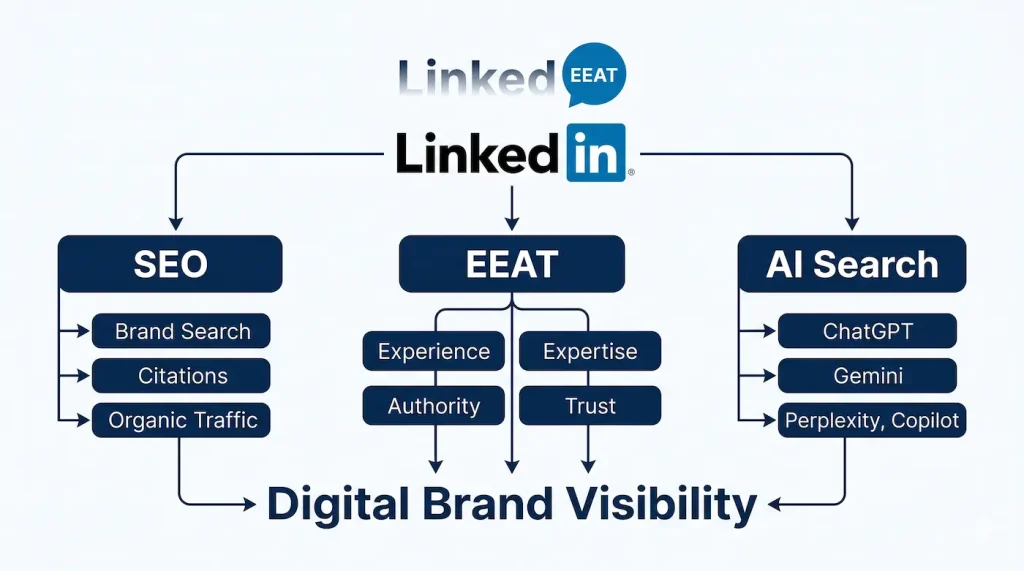
LinkedIn can actively strengthen all four of these elements by making a company’s identity, people, and expertise more visible and verifiable.
Experience
Case studies, completed projects, testimonials, measurable outcomes, and content published by company professionals help demonstrate real-world experience.
Expertise
Guides, in-depth articles, analyses, and technical content showcase specialized knowledge and deep understanding of specific topics.
Authoritativeness
Mentions, interactions, shares, qualified comments, and a consistent presence within professional discussions contribute to strengthening the perceived authority of the brand.
Trustworthiness
Complete profiles, up-to-date company information, verifiable professional relationships, and consistent content increase trust in the company.
For this reason, LinkedIn should not be considered solely a communication or lead generation tool. It is one of the touchpoints that helps build an organization’s digital credibility in the eyes of customers, partners, search engines, and AI-powered search systems.
When Google, users, or artificial intelligence systems look for signals of trustworthiness, they evaluate the entire digital ecosystem surrounding a brand, and LinkedIn represents one of its most authoritative components.
Gabriele Giuntini, Account Manager at HT&T Consulting
LinkedIn and AI Search: Why Does It Matter for GEO?
Online visibility is no longer driven solely by Google. More and more users are searching for information through tools such as ChatGPT, Gemini, Copilot, Claude, Perplexity, and other generative search engines. This is why GEO (Generative Engine Optimization) is becoming increasingly important.
AI search systems do not rely solely on content published on a company’s website. They process signals from multiple public sources, including websites, company profiles, editorial content, citations, social media pages, professional profiles, and brand mentions. In this context, LinkedIn becomes a critical platform for helping AI systems better understand who a company is, what expertise it possesses, and in which areas it can be considered authoritative.
A well-maintained LinkedIn profile, an up-to-date company page, and consistent activity from key individuals within the organization can all contribute to strengthening the digital representation of a brand, including within AI-generated responses.
Widely shared, cited, and discussed LinkedIn content helps reinforce brand authority signals across the digital ecosystem. This can increase the likelihood that such information will be discovered and indirectly used by AI search systems. It is a form of Answer Engine Optimization (AEO) that is indirect yet highly effective.
How LinkedIn Improves a Website’s Organic Visibility
LinkedIn can support a company’s SEO efforts through several indirect mechanisms.
| LinkedIn Activity | SEO Impact | GEO / AI Search Impact |
|---|---|---|
| Publishing in-depth articles and niche content | Increases qualified traffic and branded searches | Strengthens perceived topical expertise |
| Sharing case studies | Encourages citations and natural backlinks | Helps AI associate the brand with real-world projects |
| Personal profile activity | Amplifies content distribution | Makes experts, founders, and managers more recognizable |
| Complete company page | Improves brand consistency and recognition | Strengthens the company’s digital identity |
| Engaging with other professionals | Increases visibility and referral traffic | Generates public signals of relationships and authority |
What Content Should You Publish on LinkedIn to Support SEO and AI Search?
Not all content delivers the same value. To generate meaningful results, LinkedIn should be used as an editorial channel rather than simply a promotional noticeboard.
The most effective content demonstrates expertise, addresses real audience challenges, and connects the brand to strategic topics within its industry.
How-To Guides
Practical content that explains how to solve a problem, choose a solution, or improve a process.
Case Studies
Real examples of projects, results, methodologies, and value delivered to clients.
Market Analysis
Content that helps interpret industry trends, market shifts, data, and competitive scenarios.
Thought Leadership
Insights, opinions, and strategic perspectives authored by founders, managers, or company specialists.
White Papers and Reports
High-value informational resources, ideal for lead generation and positioning the brand as an authoritative source.
Expert Commentary
Qualified contributions on industry posts, events, regulatory updates, technology trends, and market developments.
The Role of Personal Profiles: Why Isn’t a Company Page Enough?
In B2B environments, a company page is important, but it is often not enough. People naturally engage more easily with other people than with corporate logos. This is why the personal profiles of founders, executives, sales professionals, consultants, and specialists play a central role.
An effective LinkedIn strategy should combine corporate communication with employee advocacy. The company page strengthens brand identity, while personal profiles increase proximity, trust, and relationship-building capabilities.
This approach is particularly important for both SEO and GEO because it helps connect the brand with real people, recognizable expertise, and content created by subject-matter experts.
An often-overlooked aspect: content published by individuals tends to generate significantly more engagement than content published directly by company pages. This is why the most effective LinkedIn strategies combine corporate communication with employee advocacy.
Mistakes to Avoid in Your LinkedIn Strategy
Many companies are present on LinkedIn but fail to achieve meaningful results because they use the platform inconsistently or in an overly self-promotional way.
The Most Common Mistakes
- Publishing only promotional content or company announcements.
- Sharing website links without adding editorial value or context.
- Neglecting the personal profiles of key stakeholders and experts.
- Operating without a clear editorial strategy.
- Failing to align LinkedIn content with SEO, commercial, and reputation goals.
- Copying blog articles verbatim without adapting them to the platform’s format and audience.
- Measuring only likes and follower counts while ignoring traffic, leads, conversations, and branded search demand.
How to Build a LinkedIn Strategy Focused on SEO, GEO, and Lead Generation
To achieve tangible results, LinkedIn must be integrated into the company’s overall digital strategy. It should not be managed as an isolated channel but as part of a broader ecosystem that includes the website, blog, SEO, advertising, CRM, newsletters, events, and sales activities.
An effective strategy should start by answering a few key questions:
- Which topics do we want to be recognized as authorities on?
- Which people within the organization are best positioned to represent our expertise?
- Which website content deserves greater distribution and visibility?
- Which keywords, topics, and audience questions can we effectively own?
- How can we transform LinkedIn visibility into traffic, leads, and business opportunities?
Answering these questions enables the creation of a stronger editorial plan that supports SEO efforts while also strengthening the brand’s presence across generative search engines.
LinkedIn, SEO, and AI Search: One Connected Ecosystem
Today, digital visibility no longer depends on a single channel. A potential customer may discover a company on LinkedIn, search for it on Google, read a blog article, subscribe to a newsletter, see an advertising campaign, and eventually ask an AI system to recommend the best suppliers or consultants in a specific industry.
Within this journey, LinkedIn plays an increasingly important role because it connects brands, people, content, and professional relationships. It is a space where companies can demonstrate expertise long before they attempt to sell.
For this reason, LinkedIn should be viewed as a strategic asset for SEO, reputation management, lead generation, and AI Search visibility. It is not just a social network—it is a professional positioning platform.
LinkedIn is no longer just a content distribution channel: it is one of the primary sources that helps define a brand’s authority, expertise, and relevance in the eyes of users, search engines, and AI-powered search systems.
Giuseppe Pane, Head of Analytics, HT&T Consulting
Practical Strategies: How to Use LinkedIn for SEO
It is not enough to simply “publish high-quality content” (that is often little more than empty marketing rhetoric).
Here is what you should do in practice:
Fully Optimize Your Company Profile
Your LinkedIn company page should include:
- A clear headline: Not simply “BTO Solutions” but “BTO Solutions | Digital Marketing Consulting | SEO • Google Ads • E-commerce”
- A complete description: 500+ characters including your primary keywords and a link to your website.
- A rich About section: Mission, values, and areas of expertise. Write for the professionals looking for you, not for algorithms.
- A custom URL: linkedin.com/company/your-company-name rather than linkedin.com/company/12345
- Featured content: Showcase your 3–5 best articles, resources, and case studies.
Editorial Plan: 2–3 Posts per Week
Consistency matters. You do not need to publish 20 posts per month; what matters is maintaining a regular presence. Here is a simple framework:
| Day | Content Type | SEO Goal |
|---|---|---|
| Monday | Industry insights, reports, or data analysis | Generate visibility and encourage discussion around industry topics |
| Wednesday | Common mistake + solution (your perspective) | Position yourself as an expert and drive traffic to in-depth content |
| Friday | Case study or “lesson learned” | Increase engagement, attract prospects, and encourage natural mentions |
LinkedIn Articles (Long-Form Content) Optimized for Discovery
The LinkedIn article format offers the greatest SEO potential. Here is how to optimize it:
- Title: Include the primary keyword (e.g., “SEO for E-commerce: 5 Strategies That Actually Work”).
- Subtitle (first line): Use a compelling hook such as “Discover how e-commerce businesses increase organic traffic by 40%+”.
- Length: Aim for 1,500–2,500 words. LinkedIn tends to favor comprehensive content.
- Links: Include 2–3 links to your website, preferably to pillar pages or related resources.
- Structure: Use clear headings, bullet points, and one image every 300 words.
- Final CTA: “Read the full guide on our website” followed by a link.
Hashtag Research and Keyword Targeting
Do not use hashtags randomly. Use tools such as LinkedIn Analytics and SEMrush to identify:
- High-volume hashtags (#SEO, #DigitalMarketing)
- More specialized and less competitive hashtags (#TechnicalSEO, #B2BMarketing)
- Trending weekly hashtags relevant to your industry
Tip: Use 3–5 hashtags per post, not 20. Quality always outperforms quantity.
Real Engagement as a Visibility Driver
The LinkedIn algorithm rewards engagement. Therefore:
- Reply to comments within the first hour after publishing (the most critical window).
- Engage with other professionals’ content in your industry, not for self-promotion but for meaningful conversations.
- Tag colleagues and partners when relevant to increase reach and visibility.
- Track the right metrics: engagement rate (comments + likes + shares / impressions). A good target is above 3%.
Promote Your LinkedIn Profile Across All Channels
Add your LinkedIn profile link to:
- Your website footer
- The About Us page
- Your corporate email signature
- Relevant blog and forum discussions where appropriate
At HT&T Consulting, we frequently develop integrated strategies where LinkedIn, SEO, content marketing, advertising, and marketing automation work together within a single growth framework. The goal is not simply to publish more content, but to build a stronger, more authoritative, measurable, and business-oriented digital presence.
We have also explored the strategic importance of LinkedIn in our dedicated guide to the LinkedIn Social Selling Index, a useful metric for understanding how relevant, active, and relationship-driven a professional profile truly is.
FAQ – LinkedIn, SEO and AI Search
Does LinkedIn help a website’s SEO?
Yes, primarily in an indirect way. LinkedIn helps distribute content, increase qualified traffic, generate branded searches, strengthen authority, and encourage citations or natural backlinks from other websites.
Do LinkedIn links have SEO value?
They should not be considered traditional SEO backlinks. Their primary value lies in content distribution, traffic generation, and the opportunity to gain visibility among people who may later cite or link to the brand from other sources.
Is LinkedIn useful for GEO?
Yes. LinkedIn helps strengthen a brand’s digital identity by connecting the company, its people, expertise, and public content. These signals can also be valuable within generative search and AI-powered search systems.
Can LinkedIn help a brand appear in ChatGPT, Gemini, or Perplexity responses?
There is no direct guarantee, but an authoritative, consistent, and up-to-date LinkedIn presence can contribute to clearer public signals associated with the brand, its expertise, and the people who represent it.
Which is more important: the company page or personal profiles?
Both are important. The company page strengthens brand identity, while the personal profiles of founders, managers, and specialists often generate greater trust, engagement, and perceived authority.
How often should you publish on LinkedIn?
For a strong business presence, it is advisable to maintain a consistent publishing schedule, such as 2–4 posts per week, combining corporate updates, technical content, case studies, expert commentary, and contributions from personal profiles.
What types of LinkedIn content perform best for SEO and AI Search?
How-to guides, case studies, market analyses, reports, white papers, thought leadership content, and expert commentary are among the most effective formats because they demonstrate expertise and increase the likelihood of citations, traffic, and topical recognition.
References and Sources
Useful resources for learning more about LinkedIn, SEO, link attributes, and content quality.
Continua a leggere
6 minutes of reading

16 minutes of reading


And it consumes less energy.
To return to the page you were visiting, simply click or scroll.