Marketing Intelligence: SEO, AEO e GEO for growth

Optimizing to Grow (Beyond the Jevons Paradox)
Optimization does not mean doing more, but doing better. Marketing Intelligence transforms SEO, AEO and GEO from efficiency exercises into strategic levers to reduce waste, increase relevance and drive business decisions in an ecosystem dominated by data and artificial intelligence.
Marketing Intelligence is a decision-making system that integrates market data, user behavior and competitive signals to guide strategic choices, reduce waste and increase productivity.
Marketing Intelligence does not optimize what already exists. It decides what deserves to exist.
The Jevons Paradox applied to marketing warns us that greater efficiency does not automatically create greater value. When optimization is driven solely by cost reduction or increased volume, it generates noise and waste. When it is guided by Marketing Intelligence, it frees resources, improves decision quality and turns SEO, AEO and GEO into tools for strategic productivity.
Marketing Intelligence is the process through which a company collects, interprets and connects market data, user behavior, digital performance and competitive signals to make better decisions. It is not only about measuring what has happened, but also about understanding where to invest, what to eliminate and which opportunities to seize before competitors do.
In today’s marketing landscape, one question repeatedly returns to the desks of CMOs, marketing directors and business leaders: is optimizing everything the right approach? Those who observe the issue critically often refer to the Jevons Paradox, according to which increased efficiency paradoxically leads to increased consumption and, over time, new inefficiencies.
Applied to marketing, the risk is obvious: the more we optimize, the more content, campaigns and messages we produce, and the more noise we create.
At HTT, we start from a different assumption: optimization is not a goal, but a tool. When guided by the right data, it does not generate waste but frees resources. This is where Marketing Intelligence comes into play.
Today, MI is no longer just a collection of competitor data. It is the ability to read the market almost in real time and make decisions that reduce uncertainty before it becomes a cost. It is the same paradigm shift we explore in Marketing Trends 2026: AI, Data and Creativity Beyond the Hype, where AI stops being an experimental project and becomes an infrastructure for planning and measurement.
Many people confuse efficiency with productivity. Efficiency means doing the same thing with fewer resources. Productivity means doing better things with the resources that have been freed up.
Reducing the cost of a campaign that creates no value is efficiency. Understanding that the campaign should never have been launched and investing time and budget into a more relevant message is productivity.
Marketing Intelligence serves precisely this purpose: acting as a compass. It indicates which activities should be eliminated, which should be strengthened and which should never be started at all.
Without a Marketing Intelligence system, optimization risks becoming a mechanical exercise. Correct keywords, formally SEO-friendly content and campaigns that perform well in reports may have no impact on the real business because there is no strategic interpretation of what the data is actually saying.
This is where many companies fall into a false sense of control. Dashboards are full, KPIs are monitored, yet decisions are made by inertia. Organizations continue optimizing what is easy to measure rather than what is truly relevant. The result is marketing that is efficient in the numbers but ineffective in its impact.
This issue becomes even more evident when artificial intelligence and automation enter the picture. Increasingly powerful tools accelerate production and distribution, but they also amplify strategic mistakes when context, priorities and clear objectives are missing. We discussed this openly in AI and Marketing Automation: From Tool to System, because AI does not make marketing smarter by itself—it makes it faster.
Marketing Intelligence exists precisely to slow down at the right moment. To stop before producing, before optimizing and before investing. It connects quantitative data with real user intent, integrates market signals, behavior and brand perception, and transforms scattered information into coherent decisions.
In other words, MI does not answer the question what works? It answers the more uncomfortable and useful question: why is it working, and for how long will it continue to work?. This is the difference between tactical optimization and strategy.
Marketing Intelligence has become essential because digital visibility no longer depends on a single channel. Google, AI Overviews, ChatGPT, Gemini, Claude, Perplexity, voice assistants and social platforms interpret content in different ways, but they all look for signals that are coherent, reliable and contextualized.
In this environment, optimizing a single page or a single campaign is no longer enough. Companies need a system capable of reading user behavior, connecting SEO, AEO and GEO, measuring demand quality and transforming data into operational priorities.
Today, being on Google is no longer enough. Visibility has not disappeared; it has fragmented. People search, ask, compare and decide by moving across search engines, answer systems, voice assistants and platforms based on artificial intelligence.
Zero-click searches ~60% They disappear before the click B2B uses LinkedIn for research 50% Vendor evaluation (Italy/Spain) Marketers using AI 88% In their daily workflow in 2026 Organic traffic decline -63% LinkedIn organic reach since 2023
SEO remains the foundation, not because it is traditional, but because it builds the infrastructure of understanding. Information architecture, performance, technical quality and reliable content make a site readable, interpretable and sustainable over time, not only for Google but also for AI systems that draw from the web.
AEO emerges when search stops being exploratory and becomes resolution-oriented. Featured snippets, zero-click results and voice assistants reward those who can provide clear, concise and contextualized answers. Here, optimization is not only about what is said, but how and when it is said. If your brand is unable to respond directly to a need, someone else will occupy that space.
GEO represents a further shift in scenario. With systems such as ChatGPT, Perplexity, Gemini and Claude, brands no longer compete only for a position in the SERP, but to be cited within a generated answer. This shifts the focus from the single piece of content to the overall system of signals a brand releases online.
Optimizing for GEO means working on semantic coherence, distributed authority, verifiable sources and message continuity over time. It means asking not only what we say, but how we are described by artificial intelligences. This is a topic we also explore in llms.txt: from SEO for search engines to SEO for artificial intelligences, because future visibility is built today.
SEO, AEO and GEO are therefore not alternative channels, but layers of the same strategy.
Generative systems do not evaluate a brand only through a keyword or a single page. They reconstruct a context: what the company states, how it is cited by external sources, how consistent the published content is, which entities are associated with the brand and how clear its specialization is.
This is why GEO cannot be treated as a simple technical evolution of SEO. It is work on the algorithmic perception of the brand. A company becomes more citable when it produces clear, updated, verifiable and consistent content over time.
Messages, services and content must reinforce the same competitive identity. Data, citations, case studies and references increase trust and the reusability of information. The brand must be clearly connected to people, services, sectors, technologies and markets. Recognizability comes from the consistent repetition of themes, language and positioning.
At HTT, we integrate SEO, AEO and GEO through a structured model that connects technical infrastructure, informational response and generative citation into a single decision-making architecture.
Architecture, performance, semantic structure and technical authority. This is the layer that makes the site interpretable and sustainable over time. Answer-first content, highly readable summaries and a structure designed for answer engines and zero-click experiences. Distributed semantic coherence, verifiable sources and positioning in generative AI systems. The layer that integrates signals, reduces uncertainty and transforms visibility into strategic choices.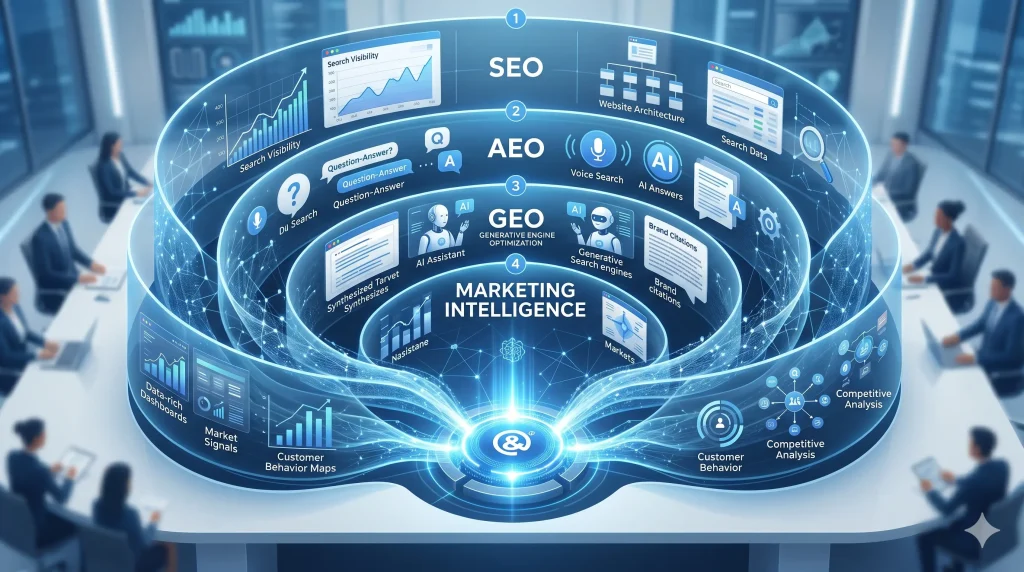
In Brief
What Is Marketing Intelligence in Brief
What Marketing Intelligence Means Today
Marketing Intelligence helps to:
Efficiency and Productivity: A Difference That Matters
Data Without Direction: When Optimization Becomes Blind
Why Marketing Intelligence Matters Today
SEO, AEO and GEO: Visibility Is No Longer a Single Channel
Marketing Intelligence is what holds them together, preventing optimization from becoming a sum of disconnected tactics. To explore the individual layers in more detail:
How Artificial Intelligences Interpret a Brand
Semantic coherence
Verifiable sources
Entity SEO
Editorial continuity
The HTT Framework: Marketing Intelligence Layered Model for SEO, AEO and GEO
SEO — Technical Foundation
AEO — Direct Answer
GEO — Generative Citability
Decision Layer — Marketing Intelligence
SEO builds visibility. AEO builds answers. GEO builds citation. Marketing Intelligence governs the system.
Jevons Paradox and Marketing: Waste or Value?
The Jevons Paradox warns us that efficiency can lead to excessive use of resources. In marketing, this translates into information overload: redundant content, overlapping campaigns and messages that cancel each other out.
When optimization is guided by Marketing Intelligence, however, the opposite happens. Structural waste is reduced: budget invested in unqualified traffic, time spent on invisible content and opportunities lost due to a lack of contextual understanding. We do not consume more; we produce better.
How to Implement a Marketing Intelligence Strategy
An effective Marketing Intelligence strategy does not start with tools, but with the decisions a company needs to improve. Dashboards, AI, analytics and automation only create value when they help people make better choices.
-
Define critical decisions.
Identify which marketing and business decisions need to become faster, more reliable and more measurable. -
Integrate internal and external data.
Connect analytics, CRM, advertising, SEO, user behavior and competitive signals. -
Build an SEO, AEO and GEO perspective.
Analyze not only rankings, but also answers, AI citations and the brand’s generative perception. -
Eliminate low-impact activities.
Reduce content, campaigns and investments that generate volume but not value. -
Turn insights into actions.
Make data usable for editorial priorities, campaigns, positioning and commercial development.
Tools for Implementing Marketing Intelligence
Marketing Intelligence does not require a single software platform, but rather an integrated ecosystem.
These are the operational layers we use at HTT:
Data and Analytics
Google Analytics 4, Google Search Console, Data Studio/Looker, and Supermetrics to centralize and correlate data from multiple sources.
SEO and Visibility
Ahrefs, SEMrush and Screaming Frog for technical analysis, keyword research and backlink monitoring.
Automation and AI
n8n to orchestrate data flows, and n8n + Supermetrics for automated reporting and anomaly alerts.
GEO Monitoring
Tracking brand citations across ChatGPT, Perplexity and Gemini.
Emerging tools include Brandwatch AI, Mention and llms.txt to help AI models better understand your brand identity.
Conclusion
Optimization only makes sense if you know where you are going. Marketing Intelligence provides that map. In an ecosystem made up of search engines, answer engines and artificial intelligence, the winners will be the brands capable of being relevant, consistent and recognizable—not those that simply produce more noise.
FAQ
What is Marketing Intelligence?
Marketing Intelligence is the process through which a company collects, interprets
and connects market data, user behavior, digital performance and competitive
signals to make better and faster decisions. It does not simply describe what
happened, but guides where to invest, what to eliminate and which opportunities
to seize before competitors do. It differs from traditional data analysis because
it transforms information into concrete operational priorities.
How is it different from simple data analysis?
Data analysis describes what happened: visits, conversions and campaign performance.
Marketing Intelligence goes further: it interprets why it happened, connects
heterogeneous signals (SEO, CRM, competitors, user behavior) and guides what
should be done next. In short: data analysis is a mirror, Marketing Intelligence
is a compass.
Are SEO, AEO and GEO alternatives?
No. They are complementary layers of the same digital visibility strategy.
SEO builds technical infrastructure and authority.
AEO optimizes content to directly answer user questions
(featured snippets, zero-click results and voice assistants).
GEO positions the brand within AI-generated responses
(ChatGPT, Gemini, Claude and Perplexity). They perform best when integrated
into a unified system guided by Marketing Intelligence.
What is Answer Engine Optimization?
It is the optimization of content to provide direct answers to search engines, voice assistants and AI systems.
What is Generative Engine Optimization?
It is the set of strategies that allows a brand to be accurately cited within responses generated by artificial intelligence.
Does the Jevons Paradox apply to marketing?
Yes, when optimization lacks strategic direction and produces volume instead of value.
Does Marketing Intelligence reduce costs?
It primarily reduces waste: time, budget and attention invested in low-impact activities.
Is it useful for SMEs too?
Absolutely. In fact, it is often even more valuable for SMEs, where every wrong decision has a greater impact on results.
Is GEO already relevant today?
Yes. AI systems are already a real touchpoint in users’ decision-making processes.
Does HTT work only on SEO?
No. HTT’s approach integrates SEO, AEO, GEO, data analytics and business strategy.
References and Further Reading
The concepts covered in this article are based on established theoretical contributions, official documentation and contemporary research on data, marketing and artificial intelligence.
William Stanley Jevons (1865)
The Coal Question. The original work in which the Jevons Paradox was first formulated.
Google Search
Search Quality Rater Guidelines. A key document for understanding quality, E-E-A-T and content usefulness.
Google Search Central
Creating Helpful, Reliable, People-First Content. Essential for quality-focused SEO and AEO strategies.
Google Helpful Content System
An official overview of the system that rewards genuinely useful content and discourages content created solely for rankings.
OpenAI Research
Research and technical documentation on generative models and AI systems.
Google DeepMind
Official publications on generative models, AI evaluation and multimodal systems.
Stanford HAI – AI Index Report
Annual report on the global evolution of artificial intelligence, adoption trends and economic impact.
HT&T Insights
Related articles on AI, automation and generative visibility.
Continua a leggere
10 minutes of reading

17 minutes of reading

27 minutes of reading

And it consumes less energy.
To return to the page you were visiting, simply click or scroll.