Businesses in ChatGPT: OpenAI Introduces Business Profiles, Analytics and Business Agents

Businesses in ChatGPT: OpenAI Introduces Business Profiles, Analytics and Business Agents
On November 10, 2026, OpenAI introduced Businesses in ChatGPT, a free beta program that allows eligible businesses to claim and verify their profiles, update business information and access aggregated data on mentions, views and clicks generated through ChatGPT. The initiative also introduces Business Agents, conversational AI assistants designed for businesses, initially available to eligible e-commerce and online service providers in the United States. For SEO and GEO, this opens up a new opportunity: complementing AI visibility analysis with first-party data directly from the platform.
For years, businesses have invested in visibility across search engine results. Today, part of the discovery and evaluation process takes place directly within conversations with artificial intelligence. Users can ask which product to buy, which supplier to choose or which alternatives to compare without starting from a traditional search results page.
With Businesses in ChatGPT, OpenAI is introducing dedicated tools for businesses within this emerging search and decision-making environment. OpenAI describes the initiative as a way to connect with the 1.2 billion people who use ChatGPT every week. The most immediate comparison is with Google Business Profile and Search Console, but this is more than just a business listing: the initiative combines verified information, interaction measurement and new conversational experiences.
This development reflects the broader shift from SEO to GEO: the challenge is no longer simply being found, but understanding how a brand is represented and referenced in AI-generated responses.
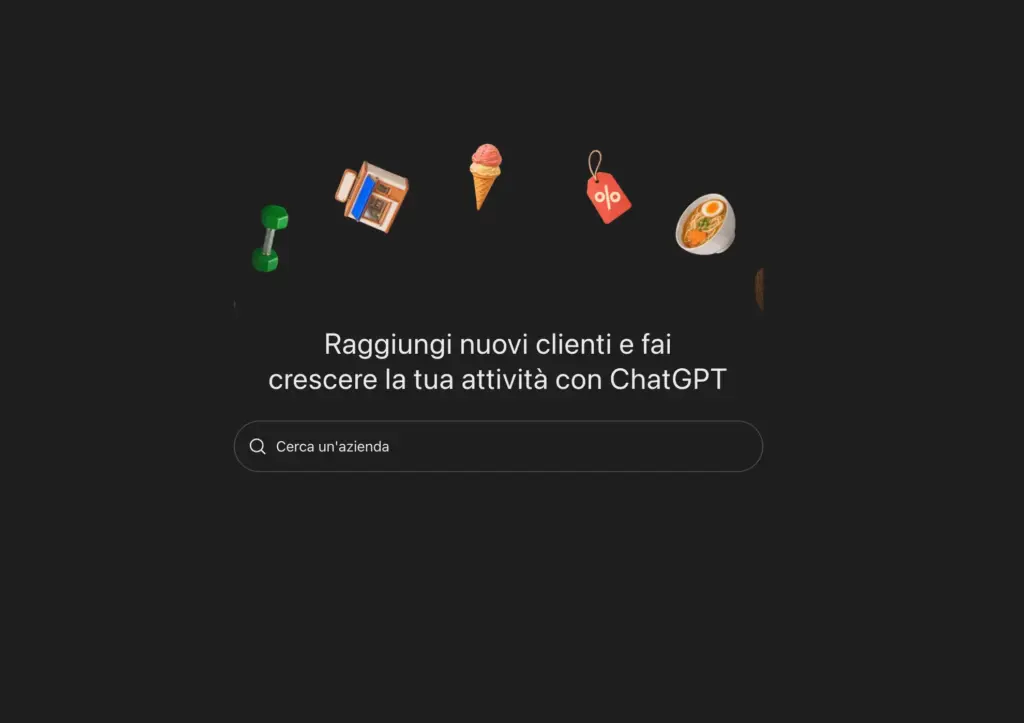
What is Businesses in ChatGPT and how does it work?
Businesses in ChatGPT is a new set of features that allows eligible businesses to manage their presence in ChatGPT. The system revolves around three complementary components: the verified business profile, Business Hub and Business Agent.
The verified business profile
Businesses can claim their profiles and, once the required verification steps have been completed, update information such as their description, business activities, services and website links. A claimed profile may display a verification badge, but this does not constitute a commercial endorsement or recommendation by OpenAI.
Retailers can also provide product feeds containing pricing and availability information. Eligible Shopify merchants can connect their stores through Business Hub or Shopify, using the integration with Shopify Catalog.
Business Hub: management and measurement
Business Hub is the interface through which businesses can manage their profiles and access Insights. The most significant development for marketers is the availability of aggregated data on how users interact with businesses within ChatGPT.
Business Agent: connecting directly with businesses
Business Agent adds a conversational dimension: where available, it allows users to interact with an AI assistant that explicitly represents the business, using information and guidelines provided by the organization itself.
These three components do not necessarily share the same geographic availability or eligibility requirements.
How much does it cost?
At launch, claiming a business profile and using Business Hub are free of charge, with no payment step required during the setup process. Advertising campaigns in ChatGPT, if activated, are billed separately.
Is Businesses in ChatGPT available in Europe?
Yes, eligible European businesses can access the profile claiming process through Business Hub, provided that the required verification methods are supported in their country. However, this does not mean that every business can immediately complete the process or access all available features.
OpenAI distinguishes between access to business profiles and Insights and the ability to publish a Business Agent. The latter feature is initially limited to eligible e-commerce businesses and online service providers based in the United States.
Eligibility depends on factors such as business category, location, verification and integrity requirements. The availability of ChatGPT in a European country does not automatically guarantee access to every feature of the program.
To check availability, businesses can visit the official Businesses in ChatGPT page or access Business Hub directly, which is also available from the ChatGPT sidebar on the web.
How to claim and verify your business profile
The process starts in Business Hub. After signing in to ChatGPT, an authorized representative searches for the business, selects the corresponding listing or follows the process for adding a business that is not yet listed.
OpenAI may offer several methods to verify the representative’s connection to the business, including phone verification, business email, website domain verification or a Shopify connection. The options available depend on the business and the verification process offered. Domain verification, for example, is convenient for those managing the website infrastructure, but it is neither mandatory nor universally available.
Claiming a business profile and verifying your identity are two separate steps. Once the claim has been approved, OpenAI requires identity verification through Persona before allowing profile changes to be published, access to Insights and, for eligible businesses, the creation of a Business Agent.
For agencies managing multiple clients, it is important to clearly establish profile ownership and access permissions. The official policies allow profiles to be managed only by business owners or their authorized representatives.
What data does ChatGPT Business Hub provide?
This is where the new initiative becomes particularly significant for digital marketers. OpenAI is introducing a first-party measurement system for interactions between users and businesses within ChatGPT.
According to the official Business Hub documentation, Insights provides aggregated data for a reporting period, typically the last 28 days, including mentions, profile views, website clicks and discovery topics.
Profile views
Profile views indicate how many times users have opened a business listing in ChatGPT. They represent an intermediate signal of interest between a mention in a response and a click through to the website.
Mentions: when ChatGPT displays or references a business
The definition of a mention varies depending on the type of business. For an online business, a mention is counted when its website is referenced; simply including the brand name in the text is not sufficient. For a local business, a mention is counted when its location is displayed as a result, even if no subsequent click occurs.
This distinction is fundamental: a mention recorded by Business Hub does not necessarily constitute a commercial recommendation. A brand may be included in a comparison, used as an informational source or displayed as a local result without being recommended as the preferred choice.
Website clicks: measuring traffic-generating interactions
Business Hub allows businesses to see how many clicks to their websites are recorded across the monitored experiences. This is a useful metric for assessing the transition from visibility to interaction, but it should not be confused with sessions, leads or conversions.
To assess the actual contribution to business performance, these metrics should be analyzed alongside Google Analytics 4 data, referral traffic attributable to ChatGPT and conversion events configured on the website.
Discovery topics: the subjects associated with a brand
Discovery topics represent aggregated categories of subjects covered in responses where a business has been referenced. They are not the original questions asked by users, nor do they provide a list of individual conversations.
However, they can offer valuable insights into which subject areas generate the greatest visibility, highlighting potential differences between a company’s desired positioning and the topics with which ChatGPT associates its brand.
Privacy and measurement limitations
OpenAI does not share individual user conversations or chats with Business Agents with businesses. Data is aggregated and made available only when certain activity thresholds are met.
A missing metric does not necessarily indicate a lack of visibility. It may result from insufficient activity volume, data still being processed or reporting availability.
Business Hub therefore represents a valuable new source of information, but it is not a comprehensive system for reconstructing every ChatGPT response or the user’s decision-making journey.
Business Agents: when AI becomes a commercial touchpoint
Business Agents represent the next evolution of the initiative. They go beyond displaying business information by allowing users to start a dedicated conversation within ChatGPT to explore products, services, commercial terms and the characteristics of a company’s offering.
A user comparing several products could, for example, consult a retailer’s profile and start a conversation with its Business Agent to better understand technical differences, availability or purchasing conditions.
The agent uses information and instructions configured by the business, which can test its behavior before publication. However, it should not be confused with ChatGPT’s independent responses: OpenAI provides a separate conversation that is clearly identified as an interaction with the business.
The terms and conditions assign businesses responsibility for the configuration, controls and behavior of their agents, including any integrations with external systems.
Business Agents and advertising in ChatGPT
OpenAI also offers the possibility of sponsoring a Business Agent and using it as the destination for advertisements within ChatGPT. Sponsored placements must be clearly identified and kept separate from the assistant’s independent responses.
This introduces a potential new customer acquisition model: from advertising exposure to a conversation with the brand, without necessarily leaving the ChatGPT environment.
For businesses, this opens up new opportunities but also creates new measurement requirements. It will be necessary to distinguish between organic visibility, sponsored interactions, conversations with Business Agents and actual commercial outcomes.
However, a Business Agent should not simply be regarded as a traditional landing page. The experience is conversational, AI behavior is not entirely deterministic, and the degree of control available to businesses is different.
Shopify and ChatGPT: product catalogs, Business Agents and advertising campaigns
One of the most interesting integrations within Businesses in ChatGPT involves Shopify. Merchants can connect their online stores to ChatGPT through Shopify Catalog, automatically synchronizing product information, including pricing and availability, without having to manage a separate catalog manually.
OpenAI allows eligible merchants to initiate the connection directly from their Shopify admin or ChatGPT Business Hub. Products can then be included in ChatGPT’s discovery and comparison experiences when relevant to users’ requests.
The integration goes beyond product catalogs. For businesses that meet the eligibility requirements, a Business Agent can answer potential customers’ questions using product information and guidelines defined by the merchant. This creates a conversational sales assistance experience that can complement the traditional e-commerce purchasing journey.
ChatGPT Ads: advertising and measurement directly from Shopify
OpenAI has also developed ChatGPT Ads for Shopify, an application that allows eligible merchants to connect or create an advertising account, synchronize their product catalog with Ads Manager, configure commercial event tracking through OpenAI Pixel and manage advertising campaigns without leaving the Shopify admin.
This advertising integration was announced on September 16, 2026, before the launch of Businesses in ChatGPT. The two initiatives are complementary, but product catalog synchronization for organic product discovery should not be confused with synchronization for paid advertising campaigns.
ChatGPT Ads for Shopify was also initially made available exclusively to US merchants. The presence of the app in the Shopify App Store therefore does not guarantee that all its features are already available to European merchants.
For e-commerce businesses, the strategic implications are significant: the product catalog becomes a source of information that can support organic discovery, conversational experiences and, where available, advertising activities within ChatGPT. Product data quality, completeness and up-to-date availability are therefore becoming increasingly important in GEO and digital commerce strategies.
Does claiming a business profile improve visibility in ChatGPT responses?
No. OpenAI clarifies that claiming a business profile does not guarantee better positioning, recommendations or increased sales.
A verified profile allows businesses to provide more accurate and up-to-date information and manage certain aspects of their presence, but ChatGPT continues to generate independent comparisons and recommendations.
Furthermore, information submitted through Business Hub is not necessarily the only source used by the model. ChatGPT may incorporate content from the web and other available sources. Profile changes may take time to be published or reflected in responses.
The comparison with Google Business Profile and Search Console is useful for understanding the management and analytical role of the new system, but it should not be interpreted as a technical equivalence.
The quality of a brand’s digital presence continues to depend on accessible content, consistent information, verifiable sources, up-to-date documentation and brand reputation. These are the dimensions addressed by SEO, AEO and GEO strategies.
What changes for SEO, GEO and AI brand reputation measurement?
The most significant change is not simply the ability to update a business listing. It is the introduction of a new source of data on brand exposure within artificial intelligence systems.
Until now, a substantial part of GEO measurement has relied on structured queries across AI models, response collection, citation analysis and competitor benchmarking. Business Hub adds a different perspective: aggregated data on interactions actually observed within ChatGPT.
However, the two methodologies do not measure exactly the same phenomenon and are not interchangeable.
| Dimension | Business Hub | Structured GEO monitoring |
|---|---|---|
| Data source | Aggregated interactions observed within ChatGPT | Responses generated through controlled queries |
| Coverage | ChatGPT | Multiple models and platforms, depending on the methodology |
| Mentions and clicks | Available aggregated metrics | Citations and links observed in sampled responses |
| Competitive analysis | No dedicated benchmarking feature | Available for predefined brands and scenarios |
| Response analysis | Does not display user conversations | Analyzes the text of responses generated during testing |
| Sentiment and recommendations | Not equivalent to the mentions metric | Can be analyzed using explicit methodological criteria |
| Primary purpose | Measure aggregated exposure and interactions | Understand context, brand positioning and competitors |
Why Business Hub does not replace multi-model monitoring
Business Hub monitors a single ecosystem. It does not provide an equivalent view of Gemini, Perplexity, Claude or Google’s AI-powered experiences. Furthermore, it does not systematically reveal which competitors were preferred, the reasoning behind those preferences or the specific questions that prompted them.
These dimensions remain essential for evaluating a brand’s competitive positioning. A mention can have very different implications depending on whether a company is presented as a market leader, a budget-friendly alternative, a specialist provider or a solution that is not recommended.
How to integrate Business Hub data with HT&T’s BRMA methodology
In our approach to AI Brand Reputation and BRMA monitoring, measurement goes beyond the frequency of mentions. We analyze the context of responses, inclusion in shortlists, competitors, sentiment and the relationship between brands and the needs expressed by users.
Business Hub could add another layer of insight: aggregated interactions actually recorded by ChatGPT, which can be compared with findings obtained through structured monitoring.
From an operational perspective, three distinct questions emerge: how often the brand is displayed in ChatGPT, how it is represented across different AI models and what measurable results are generated by traffic reaching its owned channels.
It is through the integration of these different layers, rather than through a single metric, that businesses can gain a more comprehensive understanding of AI’s contribution to their digital strategy.
What businesses, e-commerce retailers and brands should do now
The introduction of Businesses in ChatGPT does not require an immediate overhaul of an organization’s digital strategy. Instead, it calls for an assessment of its existing presence and the development of a consistent information ecosystem.
Verify and manage your business profile
The first step is to check whether the business is listed in Business Hub, whether its profile can be claimed and which information is displayed. Management should be assigned to an authorized representative, with access credentials and permissions properly documented.
Ensure consistency across digital information sources
Business descriptions, services, locations, contact details, product characteristics and commercial information should be consistent across the company’s website, public profiles and authoritative external sources. For local businesses, addresses, contact information and location details are particularly important.
Review product catalogs and product data
For e-commerce businesses, it is becoming increasingly important to ensure the quality and accuracy of product feeds, including identifiers, descriptions, pricing, availability and links to product pages. The integration with Shopify Catalog makes this particularly relevant for merchants using the platform.
This development is part of a broader transformation of digital commerce, in which product discovery and purchasing are becoming increasingly interconnected. A similar trend, albeit through different mechanisms, can already be observed in social commerce and TikTok Shop.
Integrate Insights with analytics tools
When available, mentions, clicks and discovery topics should be collected at consistent intervals and analyzed alongside GA4 data, conversions and SEO and GEO activities.
It is important not to combine different metrics as though they represent the same event. Business Hub clicks, sessions attributed to ChatGPT and website conversions have different definitions and measurement methods.
Measure the quality of your brand’s AI presence
An increase in mentions does not automatically demonstrate an improvement in brand reputation or the likelihood of being chosen. Businesses should therefore maintain a structured analysis of AI-generated responses, taking into account accuracy, context, relevance and competitive positioning.
The priority is not simply to appear more frequently, but to ensure that the brand is accurately represented at the moments when potential customers are evaluating a solution.
From presence to measurement: the strategic significance of this development
Businesses in ChatGPT marks an important step in the evolving relationship between businesses and artificial intelligence platforms. OpenAI is introducing tools that allow organizations to contribute to the quality of available information, monitor certain interactions and, where supported, engage directly with potential customers.
The system is still in beta and has limitations in terms of access, coverage and measurement. It is not a universal Search Console for artificial intelligence, nor does it offer a shortcut to securing recommendations.
However, it reinforces a principle that is becoming increasingly central to marketing: visibility in AI-generated responses must be managed and measured, distinguishing between presence, brand representation, interaction and commercial outcomes.
For businesses, the challenge will not simply be to claim a profile. It will be to build a digital presence that is sufficiently clear, reliable and measurable to support the brand even when the customer’s decision-making journey begins within a conversation with artificial intelligence.
Frequently asked questions about Businesses in ChatGPT
What is Businesses in ChatGPT?
It is an OpenAI program that allows eligible businesses to claim and manage a profile in ChatGPT, update business information and access aggregated data on mentions and clicks. Some businesses can also publish a Business Agent.
Is Businesses in ChatGPT available in Europe?
Eligible European businesses can access the profile claiming process where the required verification methods are supported. Business Agents are initially limited to eligible e-commerce businesses and online service providers in the United States.
How do you claim a business profile in ChatGPT?
Access Business Hub from the web version of ChatGPT, search for your business and initiate the claiming process. Once the claim has been approved, additional verification steps, including identity verification through Persona, are required to access profile management and analytics features.
Does claiming a business profile improve positioning in ChatGPT?
No. OpenAI clarifies that claiming a profile does not guarantee increased visibility, preferential positioning or sales. ChatGPT continues to generate independent recommendations and comparisons.
What metrics does Business Hub provide?
Insights provides aggregated data for a reporting period, typically the last 28 days, including mentions, profile views, website clicks and discovery topics. Data availability is subject to minimum reporting thresholds.
Can businesses access users’ conversations?
No. OpenAI does not share individual user conversations or chats with Business Agents with businesses. Discovery topics are aggregated categories, not transcripts or individual questions.
What is the difference between Business Hub and GEO monitoring?
Business Hub provides aggregated metrics on interactions within ChatGPT. Structured GEO monitoring analyzes responses generated through controlled queries, potentially across multiple AI models, to evaluate context, competitors, citations and recommendations. The two approaches are complementary.
What is a ChatGPT Business Agent?
It is an AI assistant that represents a business within a separate conversation in ChatGPT. It uses information and guidelines configured by the organization to answer users’ questions about products and services. Initial availability is limited to eligible businesses in the United States.
Sources and further reading
OpenAI – Introducing Businesses in ChatGPT
The official announcement of November 10, 2026, outlining the program’s features, Business Hub and Business Agents.
OpenAI Help Center – Setting up your business
Practical documentation on claiming business profiles, verification procedures, Insights, mentions and discovery topics.
OpenAI – Businesses in ChatGPT Terms
Terms and conditions governing profile management, data and responsibilities associated with Business Agents.
OpenAI – Business Agents Policy
Rules governing Business Agents, how they represent businesses and the information they use.
OpenAI – ChatGPT Business Hub
Direct access to the official platform for claiming and verifying business profiles, managing business information and accessing available Insights.
Continua a leggere
35 minutes of reading

27 minutes of reading

24 minutes of reading

And it consumes less energy.
To return to the page you were visiting, simply click or scroll.