TikTok Shop Italia: come funziona per acquirenti, venditori e brand.

TikTok Shop is TikTok’s integrated e-commerce platform, allowing users to discover and purchase products directly within the app through videos, livestreams, and profile storefronts. Launched in Italy on March 31, 2025, it surpassed 21,000 active sellers in its first year. Since January 8, 2026, the standard seller commission has been 9%, with reduced rates available for certain product categories and eligible new sellers.
With TikTok Shop, social commerce is evolving towards a model in which content, creators, advertising, and transactions coexist within the same platform. The goal is to shorten the journey from product discovery to purchase, turning videos and livestreams into measurable sales opportunities.
For brands, however, opening a store does not automatically generate sales. The channel’s long-term viability depends on the ability to create effective content, engage relevant creators, manage product catalogues and logistics, and maintain sustainable margins. In this article, we explore how TikTok Shop works in Italy, the opportunities it offers, and when integrating it into an e-commerce strategy may make business sense.
What Is TikTok Shop and Why Does It Matter?
TikTok Shop is TikTok’s integrated commerce infrastructure, enabling users to discover, evaluate, and purchase products without leaving the app. This represents a significant departure from the social commerce models European brands had become accustomed to until recently.
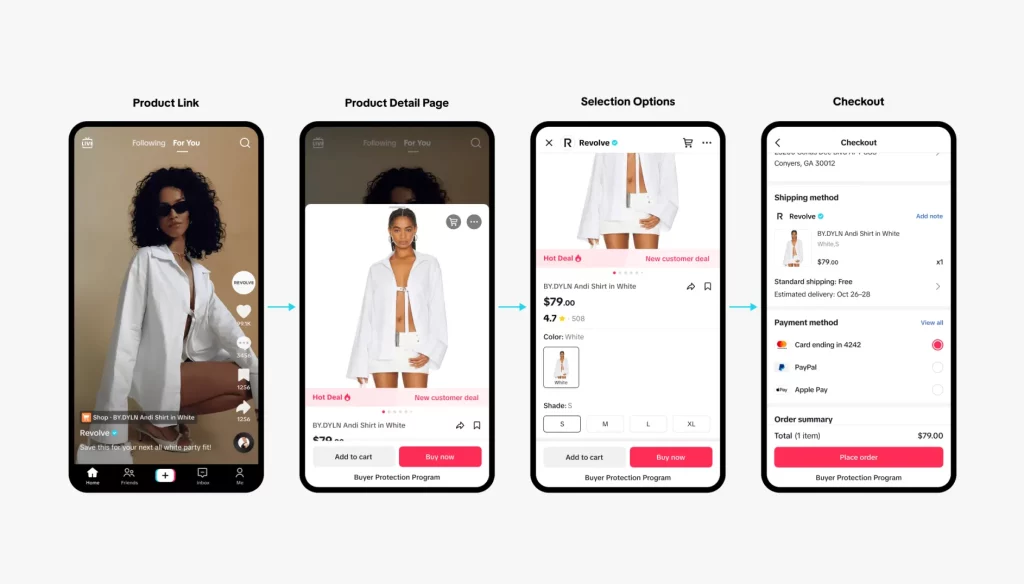
Traditionally, the customer journey worked like this: social content generated interest, a click redirected users to an external website, and the final conversion happened there. TikTok now aims to bring these steps together within a single experience, reducing friction, unnecessary steps, and potential customer drop-off. From a business perspective, this means a shorter conversion funnel. For users, it means that content watched for entertainment can immediately become a purchasing opportunity.
This is precisely what makes TikTok Shop strategically interesting. Not because it replaces an e-commerce website, but because it can serve as a native product discovery and conversion channel in categories where products lend themselves to short-form videos, livestreams, demonstrations, reviews, before-and-after comparisons, tutorials, or unboxing content.
There is another frequently underestimated factor: TikTok does not treat shopping as an isolated feature, but as part of a broader ecosystem in which products are embedded within content recommendation and distribution systems. This makes TikTok Shop less like a simple product catalogue on a social network and more like a content-driven commerce ecosystem, where products compete for attention within a distinct editorial and creative environment.
What Do the Numbers Reveal About TikTok Shop in Italy After Its First Year?
One year after its launch in Italy, data published by NielsenIQ and TikTok Newsroom in April 2026 point to a relatively young channel that has already become significant within Italy’s social commerce landscape. These figures describe the platform’s first year of activity and should not be interpreted as forecasts of individual brands’ performance.
The leading product categories are fashion (21%), beauty (14%), and home products (13%). Shoppable videos account for 38% of revenue, while livestreams generate 20%. TikTok has approximately 25.2 million monthly users in Italy, and TikTok Shop reaches 18.8% of the country’s online shoppers.
However, significant room for growth remains. In Italy, customers make an average of 2.7 purchases per year, compared with 8.9 in the United Kingdom, where TikTok Shop has been operating since 2021. This suggests growth potential, but also highlights the importance of maintaining realistic expectations about sales volumes in the short term.
How Does Shopping on TikTok Shop Work?
To understand TikTok Shop’s potential, it is important to start with a simple principle: it is much more than a digital storefront. It combines native shopping features, algorithm-driven product discovery, seller management tools, and direct connections between creators, content, and commerce.
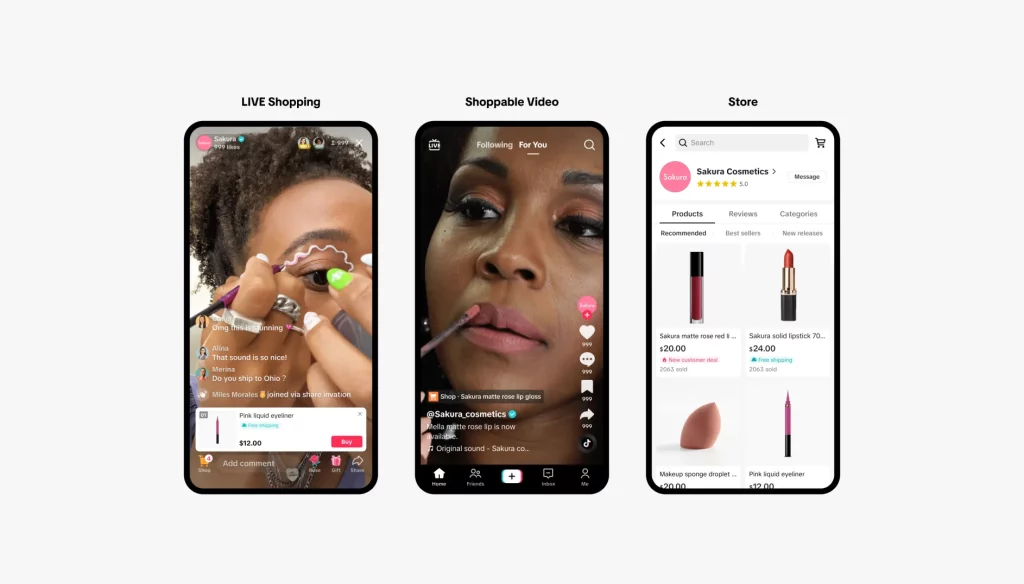
In practice, TikTok provides several native shopping formats:
- Live shopping: during a livestream, products can be demonstrated, explained, and purchased in real time. The format has some similarities with traditional television shopping, but operates through a much more dynamic, interactive, and creator-led approach.
- Shoppable videos: videos within the feed that feature tagged products or shopping links. Rather than interrupting the TikTok experience, these videos integrate purchasing opportunities directly into the content.
- Product showcase: a storefront accessible through a brand’s or creator’s profile, allowing products to be displayed and organised in a dedicated shopping space.
- Shop tab: a dedicated shopping discovery section where products are recommended based on users’ interests, behavioural signals, and related content.
These formats do not operate independently. On TikTok, content is both the starting point of the customer relationship and a key driver of sales. Brands that approach TikTok Shop simply by uploading their product catalogue risk disappointing results: without a clear content strategy built around creativity, storytelling, and product demonstrations, the shopping experience is unlikely to reach its potential.
Another important consideration is the operational infrastructure required on the seller’s side. Store registration, business document verification, bank account connection, product management, and compliance with platform policies are not secondary details. They represent the minimum operational requirements for participating credibly in a channel that can no longer be considered merely experimental.
For users, the main advantage is the promise of a more seamless shopping experience: fewer redirects, fewer pages to load, and less friction between discovery and conversion. For brands, the opportunity lies in a more integrated sales funnel. However, there is also a trade-off: part of the commercial relationship takes place within an ecosystem the brand does not fully control. This raises important questions about customer data, profitability, customer ownership, and platform dependency. TikTok Shop should therefore be evaluated within a broader marketing intelligence framework.
How Much Does It Cost to Sell on TikTok Shop in Italy?
Opening a store does not involve a fixed setup fee: TikTok Shop charges a commission on each sale. Since January 8, 2026, the standard commission rate in major European markets, including Italy, has increased from 5% to 9%.
| Category | Commission |
|---|---|
| Standard commission | 9% (previously 5% until December 2025) |
| Certain electronics, beauty, and personal care products | 7% |
| Eligible new sellers | 4% for the first 60 days |
The reduced commission for new sellers is reserved for businesses deemed eligible by TikTok Shop that open their first store in the European Union. For Italian sellers, the onboarding mission requires completing the process specified in Seller Center and uploading at least five products within the deadlines established by the platform. The reduced 4% commission may apply for up to 60 days. The 7% category-specific reductions apply only to eligible products, not to entire product categories.
In addition to platform commissions, sellers must account for potential costs associated with affiliate creators, advertising, logistics, order management, and returns. Fees and conditions may change over time: before planning an investment, businesses should consult the official TikTok Shop commission policy and verify the terms applicable to their account in Seller Center.
What Is the Difference Between TikTok Shop and Shopping on Meta Platforms?
For years, the most natural comparison has been with Instagram Shopping and, more broadly, the Meta ecosystem. Today, however, this comparison requires a more nuanced perspective.
Meta has enabled brands to develop highly effective strategies around awareness, visual merchandising, retargeting, and product catalogues. However, in most European markets, social platforms still primarily serve as environments where products are displayed, presented, promoted, or advertised, while the final conversion takes place elsewhere: on a website, an e-commerce store, a landing page, or an external marketplace.
TikTok Shop, by contrast, aims to make purchasing an integral part of the native platform experience. Rather than simply showcasing products, it seeks to transform entertainment into immediate product discovery and purchasing opportunities. This makes the platform particularly relevant when purchases are driven less by rational, planned searches and more by a combination of emotions, impulse buying, and online purchasing behaviour, social proof, engaging content, and the credibility transferred by creators.
In other words, Instagram can be highly effective as an aspirational storefront, while TikTok Shop also aims to become a place where transactions happen. This distinction changes the metrics brands should monitor, the types of content they need to produce, their relationships with creators, and even the way they structure their product assortment.
Why Are Creators So Important on TikTok Shop?
While creators have long been powerful drivers of visibility and influence on Instagram, TikTok Shop gives them an even more direct role: they can become an integral part of the sales process.
This is a significant shift. In traditional social media marketing, creators promoted products, but conversions generally took place elsewhere, often outside their immediate environment. With TikTok Shop, creators can become part of the commercial value chain: they introduce products, demonstrate how they work, build trust, generate interest, and, in many cases, guide users towards purchasing without leaving the platform.
The effectiveness of this model goes beyond technology. TikTok is an environment where content perceived as authentic, dynamic, engaging, or useful often attracts attention more effectively than conventional, highly polished advertising. When creators successfully combine product demonstrations, natural communication, entertainment, and expertise within a specific niche, the distinction between promotion and personal recommendation becomes less pronounced.
This is where many brands risk adopting the wrong approach. Treating TikTok Shop as a conventional sales channel overlooks the fact that the real asset is not simply the product catalogue, but the quality of the way products are presented through content. Mediocre, overly corporate, or poorly adapted creative content is unlikely to deliver strong results, even when the underlying product is competitive. Conversely, creators who can communicate a product’s value through the right language and format may generate attention, trust, and conversions at a pace that other channels rarely achieve.
At least two strategic implications follow from this shift.
- Small businesses can compete more effectively. Even without substantial budgets, brands with compelling products and effective content can gain visibility by investing in storytelling, demonstrations, and community engagement.
- Medium-sized and large brands can distribute their sales capabilities across creators, ambassadors, and affiliate partners, developing a model that depends less exclusively on owned channels and more closely resembles a distributed commercial network.
This does not mean that brands lose their central role. Rather, that role evolves. Maintaining a brand profile is no longer enough. Businesses need to design a system in which the brand, creators, advertising, creator marketplaces, organic content, and affiliate content work together.
In this sense, TikTok Shop also represents a cultural challenge for businesses: it tests their willingness to accept that sales do not always originate from perfectly controlled brand messaging, but often emerge through more fluid, relationship-driven, and decentralised forms of storytelling.
From Advertising to Advertainment: Why Content Sells Better When It Entertains
One of the most useful concepts for understanding TikTok Shop is advertainment: content that serves a commercial purpose while also entertaining, engaging, informing, or helping audiences discover something new.
On TikTok, purely promotional messaging tends to be less effective on its own. Content that demonstrates a product in use, compares it with alternatives, solves a specific problem, shows a tangible result, connects with a cultural trend, or adopts the platform’s native communication style is often more engaging.
This is precisely why certain product categories are particularly well suited to the platform: beauty, fashion, accessories, home products, useful everyday items, books and publishing, non-regulated food products, gifts, and products that can be tested or demonstrated. These are not the only categories that can succeed, but they are among those where content can more naturally become a commercial driver.
Are Creator Partnerships More Measurable? Affiliate Marketing and the Importance of Transparency
One of the most interesting aspects of TikTok Shop is the structure of commercial partnerships between sellers and creators. Transparency has long been a central issue in the broader influencer marketing industry.
Many brands have invested in creators and influencers, achieving strong results in terms of awareness and brand positioning, while facing greater challenges in directly linking compensation to actual commercial performance. Traditional collaboration models have often relied on fixed fees, content packages, estimated reach, or expected engagement, making the relationship between marketing expenditure and generated sales less transparent.
Within TikTok Shop, this relationship can become easier to measure because the platform more directly connects content, creators, products, and transactions. When a creator promotes a product and the purchase takes place within the shopping ecosystem, it becomes easier to establish commission structures, attribution mechanisms, and performance-based compensation models.
This does not eliminate every challenge. Brands still need to manage creator quality, brand alignment, reputation, advertising compliance, profitability, and long-term economic sustainability. However, it can make partnerships more commercially accountable: less emphasis on abstract promises and more on measurable results.
For brands, the potential advantage is clear: they can better assess which creators generate discovery, which drive clicks, which produce orders, and which fail to deliver meaningful business outcomes. For creators, the advantage is different but equally important: they can monetise their actual ability to influence purchasing decisions, rather than relying exclusively on the nominal size of their follower base.
This distinction matters because follower count is relevant on TikTok, but it is not sufficient on its own. The platform has demonstrated that highly successful content can also come from relatively small accounts. In this environment, the combination of micro- and mid-sized creators, niche expertise, credible communication, and sales-based commissions can create new competitive opportunities for less established brands.
What Rules Must Creators Selling on TikTok Shop Follow?
As creator partnerships become more commercial, transparency becomes increasingly important. In July 2025, the Italian Communications Regulatory Authority (AGCOM) approved guidelines and a code of conduct for influencers. Creators exceeding 500,000 followers or one million views are required to register on an official list and comply with obligations similar to those applicable to publishers, including the clear identification of commercial communications. Violations may result in fines of up to €250,000, rising to €600,000 for breaches involving the protection of minors.
All creators, including those with smaller audiences, remain subject to the rules against undisclosed advertising: affiliate content must be clearly identifiable as commercial communication. The same principle applies to product reviews, which must not be influenced by undisclosed incentives, as explained in our article on fake online reviews.
Which Product Categories Are Best Suited to TikTok Shop?
When discussing TikTok Shop, one question comes up repeatedly: which products sell best? The most useful answer is not a rigid list of categories, but a set of criteria: products tend to perform better when they can be understood quickly, demonstrated effectively, made desirable within seconds, and presented through engaging content.
Data from TikTok Shop’s first year in Italy supports trends already observed in international markets: the leading categories are fashion (21%), beauty (14%), and home products (13%), with growing interest in small electronics such as headphones and earbuds. More broadly, beauty and personal care, fashion, accessories, useful household products, trend-driven items, and products suitable for practical demonstrations or impulse purchases tend to be well suited to the platform. However, these patterns need to be interpreted within a broader strategic context.
Simply belonging to the right product category is not enough. What matters is how the product fits into the culture of the TikTok feed. Beauty products have a natural advantage because they lend themselves to demonstrations, before-and-after content, tutorials, reviews, texture tests, and comparisons. Fashion products offer similar opportunities through styling videos, hauls, fit checks, outfit combinations, and occasion-based content. Home products and gadgets work particularly well when they solve a practical or visual problem in just a few seconds.
Conversely, products involving long decision-making processes, extensive rational evaluation, complex configurations, a strong need for consultation, or very high average order values may face greater challenges in generating direct conversions through TikTok Shop, unless supported by a particularly sophisticated content and creator strategy.
For this reason, the question brands should ask is not simply whether their category is suitable, but rather: can our product be effectively communicated using TikTok’s native language? Can it be featured in a demonstration, a livestream, a short story, a comparison, a practical test, or a repeatable creator-led format?
If the answer is yes, TikTok Shop may be a valuable opportunity. If not, the platform may still be useful for awareness and discovery, but less effective as a direct sales conversion channel.
What Are the Benefits and Limitations of TikTok Shop for Brands?
The most obvious advantage of TikTok Shop is its ability to combine content, distribution, and conversion within a single environment. This can reduce purchasing friction and create a more direct connection between consumer attention and sales.
A second advantage is the power of discovery-driven content. On TikTok, success does not depend exclusively on capturing existing demand. Brands can also generate interest and desire through compelling content that reaches users who were not actively looking for a particular product.
A third advantage is the opportunity to develop a commercial ecosystem in which creators are not merely brand ambassadors, but active drivers of sales.
However, there are also important limitations. The first concerns platform dependency: the more transactions take place within a third-party ecosystem, the more brands need to consider profitability, customer data, direct customer relationships, and long-term strategic risks.
The second concerns operational capabilities: product catalogue management, inventory, customer service, returns, platform policies, product compliance, and content governance must all be managed carefully. Launching TikTok Shop without an adequate operational structure can lead to inefficiencies and reputational damage.
Another critical issue is profitability. With standard platform commissions rising to 9% and additional commissions potentially payable to creators, an average order value of approximately €25 leaves limited room for products with low margins. Before opening a store, businesses should model the economics of individual products.
Finally, there is the question of brand reputation. Reviews, comments, and creator videos remain available online and may contribute to how a brand is represented by search engines and AI assistants. For this reason, TikTok Shop should be included within a broader brand reputation monitoring strategy.
Another risk is the illusion of an easy shortcut. TikTok Shop cannot magically compensate for a weak e-commerce operation, an undifferentiated product, or an unclear value proposition. It can amplify what already works, but it can also quickly expose weaknesses in products, content, and commercial strategies.
Which Businesses Should Consider Opening a TikTok Shop?
TikTok Shop is particularly relevant for brands whose product catalogues include at least some of the following characteristics: visually appealing products, easily understandable pricing, immediate benefits, strong compatibility with short-form video, opportunities for practical demonstrations, sufficient margins to support creator commissions and operational costs, and the ability to test creative formats quickly.
It may be especially attractive to direct-to-consumer (DTC) brands, emerging businesses, companies selling highly demonstrable products, beauty and fashion brands, e-commerce businesses already working successfully with user-generated content (UGC) or creators, and companies seeking to complement their owned channels with a more discovery-oriented commercial presence.
Conversely, TikTok Shop may be a lower priority for businesses selling highly complex products, B2B solutions, consulting services, products with long sales funnels, or categories requiring extensive information and personalised advice that cannot easily be delivered through the platform’s native formats.
In many cases, the most useful question is not whether TikTok Shop should replace other channels, but what role it should play within the overall marketing and sales mix. It can serve as a testing environment, a sales accelerator, a channel for managing excess inventory, a product launch tool, a way to engage specific communities and niches, or a source of creative and commercial insights that can also improve other customer touchpoints.
The question businesses should ask themselves today is: is our brand ready to operate effectively in an environment where content, creators, and commerce converge?
Even when transactions take place on third-party platforms, the way brands structure their content and information ecosystem on their own websites remains crucial. In this context, topics such as JSON-LD, AEO, and GEO continue to play an important role in improving how search engines and AI systems understand, interpret, and represent brand information.
Frequently Asked Questions About TikTok Shop
Below are concise answers to common questions about TikTok Shop, designed to address practical information needs for consumers, brands, and e-commerce managers, including questions submitted to Google, generative search engines, and conversational AI systems.
What Is TikTok Shop in Simple Terms?
Is TikTok Shop Available in Italy?
What Is the Difference Between TikTok Shop and Instagram Shopping?
Do Sellers Need a Verified Account to Sell on TikTok Shop?
Which Brands Are Most Likely to Succeed on TikTok Shop?
Are Creators More Important on TikTok Shop Than on Other Social Platforms?
Can TikTok Shop Replace a Brand’s Own E-commerce Website?
Is Opening a TikTok Shop Enough to Generate Sales?
References and Further Reading
TikTok for Business – TikTok Shopping and Showcase
Official overview of native commerce features, including in-feed videos, LIVE shopping, and product showcases.
TikTok Support – TikTok Shop
Official information for users confirming the ability to discover and purchase products directly within the app.
TikTok for Business – Setting Up TikTok Shop in Seller Center
Official documentation covering business verification, bank account configuration, and the operational steps required to launch a store.
TikTok Seller Center Italy – EU Seller Onboarding
Guidance on seller registration and the onboarding process within TikTok Shop’s European ecosystem.
TikTok Seller Center Italy – EU Seller Registration Policy
Reference documentation covering eligibility requirements, restrictions, and seller responsibilities.
TikTok Seller Center – Content and Prohibited Products Policies
Official policies useful for assessing category eligibility, product compliance, and potential risks associated with launching a TikTok Shop.
TikTok Support – How TikTok Shop Recommends Content
Insights into the relationship between product information, categorisation, and the platform’s recommendation systems.
TikTok Newsroom – Discovery and Economic Impact in Europe
Broader context on TikTok’s role in brand discovery, consumer demand, and economic value creation across Europe.
TikTok Shop is one of the clearest signals of a broader transformation: digital commerce is moving towards models in which platforms, creators, algorithms, and content play an increasingly important role throughout the purchasing journey. This development also connects with the emerging concept of agentic commerce.
Continua a leggere
8 minutes of reading

10 minutes of reading


And it consumes less energy.
To return to the page you were visiting, simply click or scroll.