
The 22 Immutable Laws of Marketing
How to create a Market where you can be first.
If you can’t win the game, change the playing field. The Law of Category is the second of the 22 Immutable Laws of Marketing developed by Al Ries and Jack Trout, and represents the most practical consequence of the Law of Leadership.
When the top position in an existing category is already occupied, the most effective strategy is not necessarily to compete better, but to define a new space where your brand can become the reference point.
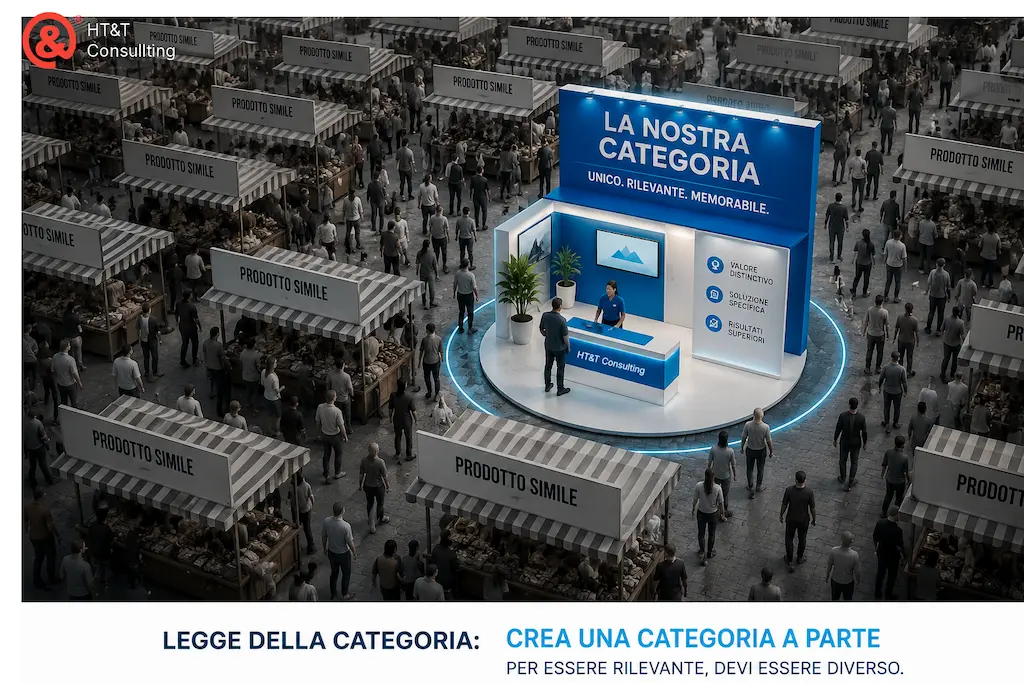
The Law of Category at a Glance
If a brand cannot be the first in an existing category, it should aim to create a new category in which it can be recognized as the first.
A competitive advantage does not always come from being better; it often comes from being meaningfully different.
What Is the Law of Category?
In The 22 Immutable Laws of Marketing, Al Ries and Jack Trout present the Law of Category as a direct consequence of the Law of Leadership.
If being first in the customer’s mind provides a competitive advantage that is difficult to overcome, then trying to displace the existing leader in the same category is often an inefficient strategy.
The alternative is to define a new, recognizable, and relevant category in which your brand can be perceived as the first.
If you can’t be first in a category, set up a new category you can be first in.
Creating a category does not necessarily mean inventing an entirely new market from scratch. In most cases, it means identifying an aspect that the existing category does not adequately represent, such as:
- a specific audience;
- a new use case;
- a different technology;
- a new service model;
- a meaningful attribute;
- a different way of purchasing or using the product.
Once this difference is clearly defined, named, and recognized by the market, the brand that introduced it can become the reference point for the new category.
Why Is Creating a Category More Effective Than Competing in an Existing One?
When a company enters a market dominated by an established leader, customers naturally evaluate the newcomer through comparison:
- like the leader, but cheaper;
- like the leader, but faster;
- like the leader, but more modern;
- like the leader, but designed for a different audience.
This comparison creates a structural disadvantage: the market leader becomes the benchmark and continues to define the category in the customer’s mind.
A competitor may offer a technically superior product, yet it is still perceived as an alternative rather than the reference point.
The Perception Advantage
A new category removes the direct comparison. Instead of deciding which brand is better within the existing category, customers evaluate whether the new category addresses a different need.
As a result, the nature of competition changes. Rather than trying to prove it is better than the market leader, the brand seeks to become the name associated with a new problem, a new need, or a new way of solving it.
What Is the Difference Between a Category, a Subcategory, and a Niche?
These three concepts are often used interchangeably, but they describe different marketing strategies.
| Concept | Description | Strategic Goal |
|---|---|---|
| Category | Defines a new competitive space with its own distinct identity. | Become the leading reference in the new market. |
| Subcategory | Introduces a meaningful distinction within an existing category. | Own a valuable segment that the market leader does not dominate. |
| Niche | Focuses on a narrow audience or a highly specific need. | Serve a limited group of customers more effectively. |
A niche does not automatically become a new category. For that to happen, the difference must be significant enough to change how customers perceive, search for, and buy that type of solution.
Historical Examples of the Law of Category
Marketing history offers many examples of companies that, rather than confronting the market leader head-on, redefined the market by creating or strengthening a new category.
7Up: The Uncola
Instead of trying to become a better cola than Coca-Cola or Pepsi, 7Up positioned itself as The Uncola, presenting itself as an alternative to the entire category and creating its own distinctive space in consumers’ minds.
Red Bull: The Energy Drink Category
Red Bull did not enter the market as just another soft drink. It defined and popularized the energy drink category, quickly becoming its global point of reference.
Dyson: The Bagless Vacuum Cleaner
In a mature market, Dyson built its differentiation around cyclonic technology and the elimination of the vacuum bag, turning a technical feature into a recognizable subcategory.
Eataly: The Italian Food Marketplace
Eataly did not position itself simply as a supermarket or a restaurant. Instead, it helped define the premium Italian food marketplace by combining retail, dining, education, and food culture under one concept.
Avoid Oversimplification
These success stories were not driven by clever naming alone. Their categories were built through innovation, distribution, marketing, investment, and the ability to deliver a meaningful difference.
How to Identify an Opportunity for a New Category
A new category should never be the result of creativity for its own sake. It must respond to a genuine market need.
To determine whether a real competitive opportunity exists, it helps to start by asking a few strategic questions.
| Question | Strategic Signal |
|---|---|
| Is there an audience that market leaders serve poorly? | There may be an opportunity to create a category dedicated to that audience. |
| Is there an underserved use case? | A new use case may justify creating an independent subcategory. |
| Does the technology genuinely improve the experience? | A technical innovation can become the foundation of a new perceived category. |
| Is the buying model fundamentally different? | Subscriptions, marketplaces, AI agents, or integrated services can redefine an existing category. |
| Can the difference be explained in just a few words? | A category that is easy to understand has a much better chance of being adopted. |
| Can the brand sustain the category over time? | Leadership requires consistent investment in products, content, communication, and long-term commitment. |
The Most Important Test
A category succeeds when customers immediately understand why it exists and how it solves a problem better than the available alternatives.
Creating a Category Is About More Than Giving It a Name
The most visible part of a new category is often its name, but what truly matters is the value system that supports it.
A credible category should be built on at least four essential elements:
A Real Problem
The category must address a genuine customer need rather than artificially creating an irrelevant distinction.
A Meaningful Difference
The product, process, technology, or service must justify the new positioning.
A Shared Language
People should be able to understand, remember, and naturally reuse the category’s name.
Verifiable Evidence
Data, case studies, product features, and measurable results should support the brand’s promise.
The Law of Category in the Age of SEO, AEO, and GEO
The Law of Category has become even more relevant in the era of search engines and generative AI systems.
Traditional search engines organize information using keywords, entities, semantic relationships, and authority signals. Generative AI systems, however, must also reconstruct concepts, definitions, and categories in order to generate useful answers.
Being among the first organizations to clearly define a new category can increase the likelihood that a brand becomes semantically associated with that concept.
From Ranking in Search Results to Being Referenced by AI
Traditional SEO focuses on ranking web pages for specific search queries. With Generative Engine Optimization (GEO), the objective also becomes being recognized as a trusted source, a relevant entity, or the authoritative reference for a specific topic.
Achieving this requires content that can:
- clearly define the category;
- explain how it differs from existing categories;
- document its practical applications;
- provide examples, data, and credible sources;
- use consistent terminology over time;
- connect the brand to the concept through authoritative content.
The Example of GEO
Generative Engine Optimization itself is an example of category creation. As traditional SEO matured, the market began distinguishing the practices specifically designed to improve visibility within AI-generated answers.
GEO is not presented simply as “better SEO,” but as a discipline with its own objectives, metrics, and methodologies.
The Example of Agentic Commerce
A similar evolution is taking place in digital commerce. AI platforms, protocols, and intelligent systems are not merely competing to build better ecommerce websites; they are defining the category of agentic commerce, where AI agents can search for, compare, and purchase products on behalf of users.
Category Leadership and Generative Authority
Organizations that are first to define, document, and develop a category increase their chances of being cited whenever search engines or AI systems need to explain that concept.
This outcome does not depend on the name alone, but on the quality and consistency of the knowledge ecosystem built around the category.
How to Build Content Around a New Category
A single article is rarely enough to establish a new category. What is needed is a consistent ecosystem of content.
Definition Page
Explain what the category is, why it exists, and which problems it solves.
Glossary
Define related terminology and reduce semantic ambiguity.
Comparisons
Clarify how the category differs from existing alternatives.
Case Studies
Demonstrate that the category delivers measurable, real-world results.
Research and Data
Strengthen authority and improve the likelihood of being cited by search engines and AI systems.
FAQs and Structured Data
Help search engines and AI systems identify clear, reusable answers.
Mistakes to Avoid When Creating a New Category
Changing Only the Name
Applying a new label to a product that is essentially identical to existing alternatives does not create a new category. The market will quickly associate the brand with the original category.
Using a Confusing Definition
A name that is overly technical, ambiguous, or difficult to remember makes category adoption much harder.
Creating a Category That Is Too Small
An overly specific distinction may create a niche with insufficient demand or commercial potential.
Failing to Produce Enough Content
If the category is not consistently explained, documented, and supported over time, competitors may occupy both the semantic and competitive space.
Making Claims That Cannot Be Proven
A category should describe a genuine difference. Unsupported claims can lead to skepticism, legal challenges, or regulatory issues.
Confusing Originality with Value
Being the first to coin a term is not enough. A successful category must also be useful, credible, and capable of being adopted by the market.
Categories in Regulated Industries
When positioning relies on terms that imply specific production methods, professional qualifications, or quality standards, those claims must be supported by evidence.
As discussed in our article on the use of the terms artisan and handcrafted in websites and advertising, an unsupported category claim may expose a company to consequences that go beyond a simple loss of credibility.
How We Work at HT&T Consulting
At HT&T Consulting, creating a category is a positioning process supported by market analysis, strategic content, and operational execution.
Our work begins with market and competitor analysis, continues with identifying underserved customer needs, and culminates in defining the value proposition, naming, and content architecture.
The category is then strengthened through:
- service pages and editorial content;
- proprietary definitions and glossaries;
- original research and data;
- semantic SEO and structured data;
- AEO and GEO strategies;
- monitoring brand mentions across search engines and generative AI systems.
The goal is not simply to invent a new term, but to build a competitive space that is credible, recognizable, and sustainable over time.
Conclusion
The Law of Category is one of the most valuable principles in strategic marketing because it reminds us that there is more than one way to become first.
When an existing category is already dominated by a strong leader, the most useful question is no longer:
How can we become better than the market leader?
Instead, it becomes:
Which customer need, audience, or use case still lacks a clearly defined category?
In the age of semantic SEO, AEO, and GEO, this principle takes on an additional dimension. Search engines and generative AI systems organize knowledge through concepts, entities, and relationships.
Being the first to define a category, document it with authoritative content, and consistently associate it with your brand can help establish your organization as a trusted reference for both people and AI systems.
Key Takeaway
The Law of Category is not about inventing artificial differences. It is about identifying a genuine market opportunity, giving it a clear and understandable name, and building a sustainable competitive advantage around it.
Frequently Asked Questions About the Law of Category
What is the Law of Category in marketing?
The Law of Category is the second of the 22 Immutable Laws of Marketing by Al Ries and Jack Trout. It states that if a company cannot become the leader in an existing category, it is often more effective to create a new category where it can be recognized as the first.
What is the difference between the Law of Category and the Law of Leadership?
The Law of Leadership explains the advantage of being first in a category. The Law of Category explains what to do when that position is already occupied: create a new competitive space instead of confronting the leader directly.
What is the difference between a category and a niche?
A niche generally refers to a smaller audience within an existing market. A new category changes the way the market understands a solution by introducing a distinct identity, problem, or value proposition.
Is it possible to create a new category in a mature market?
Yes. Mature markets often present opportunities related to underserved audiences, new technologies, purchasing models, use cases, or services. However, the new category must represent a meaningful and relevant difference.
Does the Law of Category also apply to small and medium-sized businesses?
Yes. For SMEs, creating a focused category can be an effective way to avoid competing directly with larger companies and instead build authority and recognition within a more specialized market.
How can you tell the difference between a real category and one that exists only in name?
A genuine category addresses a customer need, audience, or use case that existing categories fail to represent adequately. It should also be supported by tangible features, processes, or measurable advantages.
Why is naming important when creating a category?
A strong name makes the category recognizable, memorable, and easy to communicate. However, the name alone is not enough—it must represent a real and meaningful difference.
How does the Law of Category relate to SEO?
Creating and documenting a category allows you to develop content around a consistent set of keywords, entities, and topics, strengthening both organic visibility and your brand’s semantic authority.
How is the Law of Category connected to GEO and AEO?
Generative AI systems and answer engines organize information around concepts and categories. Companies that define and document a new category first are more likely to be recognized and cited as authoritative sources.
What content is needed to establish a new category?
Useful content includes a definition page, a glossary, comparisons with existing categories, case studies, original research, FAQs, structured data, and a consistent stream of authoritative editorial content over time.
References and Further Reading
The following resources provide valuable insights into the Law of Category, brand positioning, and the creation of new competitive spaces.
The 22 Immutable Laws of Marketing
Al Ries & Jack Trout
The book that introduced the Law of Category alongside the other fundamental principles of strategic marketing.
Positioning: The Battle for Your Mind
Al Ries & Jack Trout
The landmark work on brand positioning and the challenge of competing against an established market leader.
Blue Ocean Strategy
W. Chan Kim & Renée Mauborgne
A classic reference on creating uncontested market space, closely aligned with the principles behind the Law of Category.
Blue Ocean Strategy
Wikipedia
An introductory overview of the strategic framework developed by Kim and Mauborgne.
The Law of Leadership
HT&T Consulting
Our in-depth guide to the first of the 22 Immutable Laws of Marketing and the competitive advantage of being first in the customer’s mind.
From SEO to GEO
HT&T Consulting
An analysis of the evolution from traditional search engine optimization to visibility within AI-generated answers.
Continua a leggere
25 minutes of reading

7 minutes of reading


And it consumes less energy.
To return to the page you were visiting, simply click or scroll.