
How to measure marketing without losing your mind?
“Half the money I spend on advertising is wasted; the trouble is I don’t know which half”. This famous quote, attributed to retail pioneer John Wanamaker, sums up the historical dilemma of our industry.
Today, despite technology, the issue of attribution, namely understanding which channels and campaigns are actually generating results, has become a titanic challenge. Many professionals chase the illusion of a single source of truth, searching for a magic number that indicates the perfect ROI for every euro spent. But, as we have also seen when discussing the relationship between ROAS and real profit, in operational reality that perfect number does not exist.
At HT&T Consulting, we address this challenge by starting from the very nature of our services, which are characterized by a high degree of intangibility. To make the value of our work visible, we apply a “Molecular Model”: we surround the intangible core of strategic consulting with tangible elements such as data, reports and Data Visualization dashboards and tools that allow the client to visualize the benefits of the offering.
Reading these data, however, requires the right lenses to avoid disastrous strategic decisions.
Why is attribution an inherently imperfect problem?
The problem is not only technical, but structural. Today’s purchase journeys are fragmented across different devices and channels, making it almost impossible to track every single step.
Added to this is the isolation of so-called Walled Gardens, where each channel monitors only its own ecosystem and tends to attribute the credit for every conversion to itself.
“I have been complaining for a decade about a fundamental flaw in Web Analytics tools: they encourage a one-night stand rather than engagement aligned with the customer’s actual intentions”.
As Avinash Kaushik points out, this short-sightedness has fuelled the Last-Click paradigm for years, assigning 100% of the credit to the last click before a purchase.
“Companies remain stuck on last-click attribution because it has been the standard for too long. But it is counterproductive for two simple reasons: except for trivial purchases, no one arrives and buys immediately, and above all it encourages renting traffic rather than building a relationship with the consumer over time”.
Rewarding only the final interaction pushes companies to cut budgets for Awareness channels, namely those intended to generate brand awareness and demand, causing demand to collapse in the medium term and CAC, the cost of acquiring a customer, to soar.
The 4 fundamental methodologies: the importance of triangulation
Since no method provides the absolute truth, the most rigorous strategy is triangulation.
Triangulation in services marketing is not simply an aggregation of data, but a cross-validation process necessary to eliminate the structural biases of each individual measurement method.
Since every attribution model is, by definition, a partial and imperfect representation of reality, triangulation acts as a system of statistical checks and balances.
The three pillars of triangulation
Observation
Native Attribution and MTA. It is based on direct or probabilistic user tracking. It tells us what happened (a click, a view) along the purchase journey.
It is essential for day-to-day operations, but suffers from privacy issues and the platforms’ tendency towards “self-attribution”.
Experimentation
Incrementality Testing. It is the application of the scientific method. Through control groups, it isolates causality.
It does not simply tell us what happened, but whether it would have happened anyway even without the marketing intervention.
Modeling
Marketing Mix Modeling. It is a top-down approach that uses statistical analysis on large historical datasets.
It ignores the individual user and looks at correlations between total investments and sales, including macroeconomic factors, seasonality and offline channels.
The strategic value of the process
Relying on a single pillar exposes the company to critical decision-making risks:
- using observation alone leads to overinvesting in channels that “harvest” demand without creating it, such as aggressive retargeting or Brand Search;
- using experimentation alone is costly and does not provide granular data for optimizing individual ads;
- using modeling alone prevents companies from reacting quickly to rapid changes in the digital market.
Triangulation is the synthesis of these signals. If Native Attribution shows exceptional performance, but Incrementality Testing shows a low impact and MMM finds no correlation with total revenue, the evidence suggests that the channel is not generating real incremental value.
Strategic “truth” emerges only where the three signals converge.
Let’s now look in detail at some concrete examples from recent months, useful for exploring the use case and the methodology applied.
Native Platform Attribution
This is the attribution provided directly by tools such as Google Ads or Meta Ads. Its main advantage lies in the immediate availability of data and its extreme granularity, which is essential for feeding the machine learning algorithms of the platforms themselves.
On the other hand, since it is a self-referential model, it ignores external contributions and systematically overestimates campaigns close to conversion, undervaluing the work done upstream by discovery channels.
Native Attribution: Organic Cosmetics sector
Real HT&T case
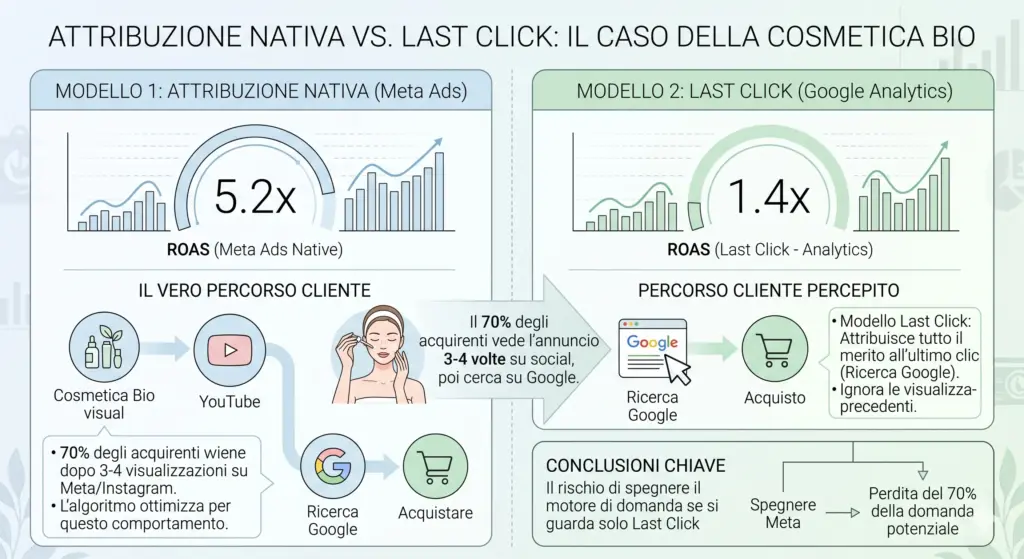
A company in the cosmetics sector invests €8,000 per month in Meta Ads campaigns to promote a line of facial serums. Meta’s native attribution reports a ROAS of 5.2x, while Google Analytics, using a Last Click model, attributes a ROAS of just 1.4x to the same channel.
Data analysis: 70% of purchases occur after 3 or 4 views of the product on Instagram, but the user ultimately completes the purchase by searching for the brand name on Google.
Why it matters: ignoring the native attribution data would lead to switching off Meta ads, eliminating the demand that is then simply “harvested” by search engines.
Multi-Touch Attribution (MTA)
This approach, typical of Google Analytics 4, follows digital journeys to distribute conversion credit among the various touchpoints, i.e. points of contact.
The main benefit is the ability to map the consumer’s digital journey almost in real time. However, MTA depends heavily on the ability to correctly recognize and connect the different touchpoints, a capability that has been progressively reduced by tracking restrictions and the gradual shift towards a cookieless ecosystem.
To mitigate data loss, Server-Side Tracking (SST) is also used, which we explored in depth in this dedicated guide. This technology moves part of the data collection and processing from the user’s browser to the company’s server infrastructure, providing greater control over measurement.
Despite this, MTA remains blind to some impressions without clicks and to behaviors that take place outside measurable digital environments, such as offline word of mouth.
Multi-Touch Attribution and Server-Side Tracking: Design Furniture sector
Scenario based on observed data
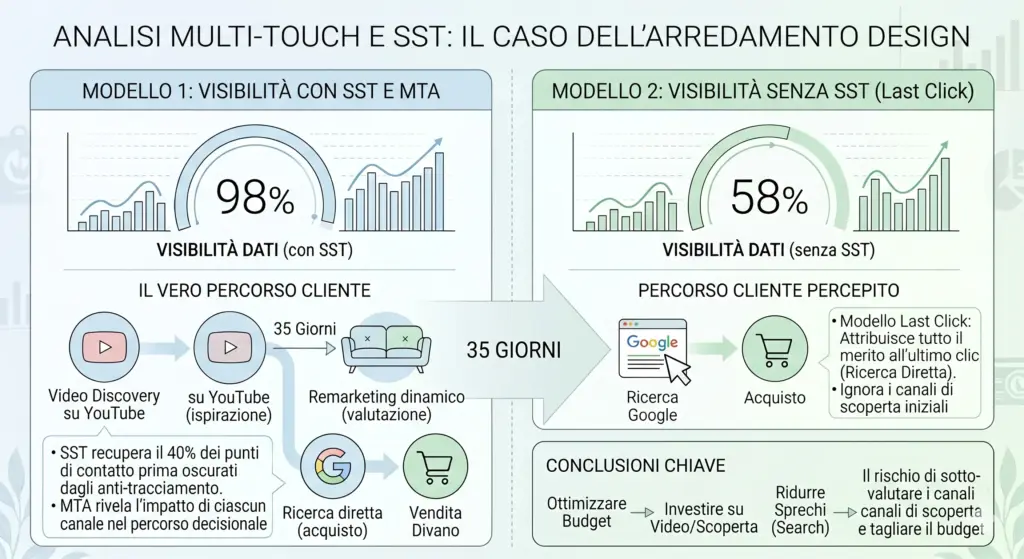
A company in the furniture sector sells high-end sofas, with an average order value of €2,500 and a decision-making cycle of 35 days.
Thanks to the implementation of Server-Side Tracking, the company recovered the tracking of 40% of touchpoints previously obscured by browser anti-tracking systems.
Data analysis: MTA revealed that the standard journey involves: Video Discovery on YouTube during the inspiration phase, dynamic remarketing during the evaluation phase and direct search at the time of purchase.
Why it matters: without SST and MTA, all the credit would be assigned to direct search, making the fundamental role of video during the discovery phase invisible.
Incrementality Testing (Lift Test)
The goal is to understand how many additional sales were generated compared with a scenario in which there was no advertising at all.
“Incrementality and attribution are not the same thing. Incrementality identifies the conversions that would not have occurred without specific marketing tactics. Attribution is simply the science, and sometimes mistakenly the art, of distributing credit for those conversions”.
Through experiments such as Geo-Lift, activating campaigns in some cities and switching them off in others, the true cause-and-effect relationship can be measured.
The main limitation is scalability: it is not possible to test all channels simultaneously, and the opportunity cost of temporarily switching off certain campaigns must be accepted.
Incrementality Testing: Food Delivery sector
Real HT&T case
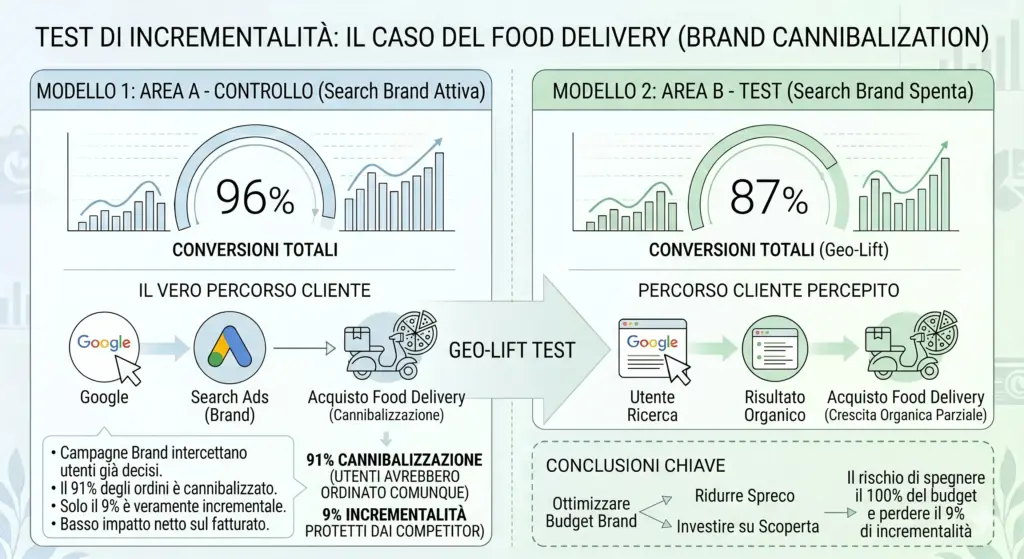
A company in the food delivery sector wanted to test the effectiveness of Search campaigns on its own brand keywords, i.e. paying to appear when users are already searching for the company’s name. Italy was divided into two geographically homogeneous areas based on traffic volumes.
Real data: in the area where the ads were switched off, total orders fell by 9%. Although organic traffic increased, it did not compensate for the loss of visibility and the presence of competitors in the advertising spaces above the organic result.
Why it matters: the test showed that 91% of users would have ordered anyway, but the 9% of incremental orders justifies the investment to protect market share.
Marketing Mix Modeling (MMM)
Marketing Mix Modeling is a top-down statistical approach that analyzes historical series of aggregated data over long time periods.
It evaluates advertising investments, prices, promotions and external factors such as macroeconomics. Its greatest strength is its holistic nature and the fact that it is privacy-first, as it does not require individual tracking.
Its limitation is the lack of tactical granularity: it will not tell you which specific ad performed best, making it particularly useful for major decisions regarding the macro-allocation of budgets. We explored Marketing Mix Modeling in depth in a dedicated article.
Marketing Mix Modeling: Financial Services sector
Case based on econometric analysis
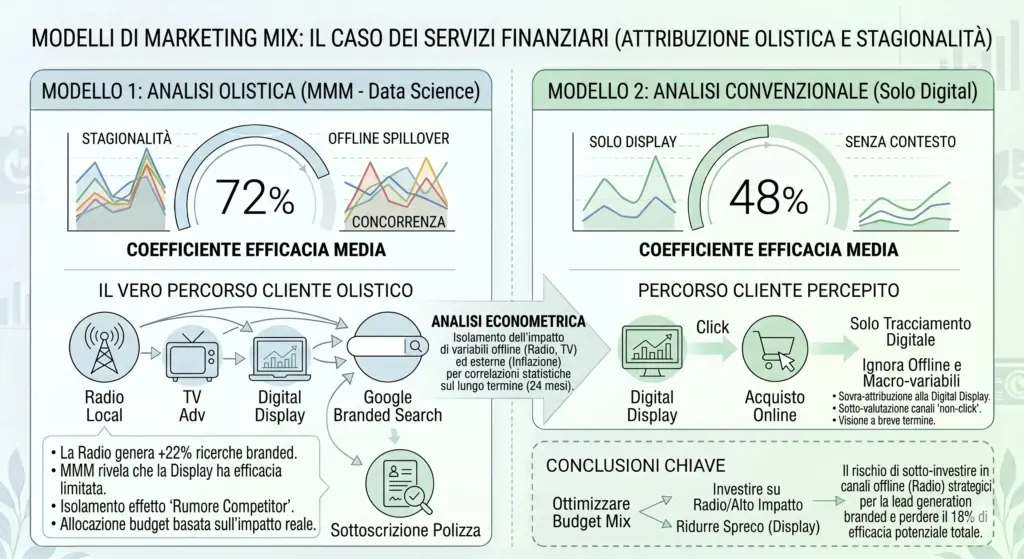
A company in the insurance sector with a marketing budget of €3 million, divided between TV, Radio and Digital, uses MMM models to overcome the limitations of cookies. Statistical analysis of the last 24 months isolated the impact of each channel on new insurance policy subscriptions.
Data analysis: the model showed that radio advertising generates a spike in branded searches in the two hours following broadcast, with an effectiveness coefficient 18% higher than standard digital banners.
Why it matters: this approach allows the company to allocate its budget based on the impact on total revenue, including variables that cannot be digitally tracked, such as seasonality or competitors’ offline campaigns.
Tailored strategies and the human factor
The choice of method depends on the maturity of the business.
Startups
They should focus on rapid validation through native attribution and simple sequential tests.
Scale-ups
They need to strengthen data quality with Server-Side Tracking and start implementing rigorous Lift Tests.
Corporates and advanced e-commerce businesses
They achieve maximum control through complete triangulation: MMM for macro-level allocations, Lift Tests to calibrate models and MTA to optimize day-to-day performance.
In an advanced strategy, these tools are therefore not alternatives, but become complementary parts of a broader Marketing Intelligence approach.
Whatever the size of the project, the winning approach remains constant experimentation combined with critical thinking.
Technology provides the numbers, but at HT&T Consulting we firmly believe that interpretation requires experience, expertise and intelligence.
FAQ: a practical guide to Marketing Attribution
What is attribution and why is the “perfect number” an illusion?
Attribution seeks to understand which channels actually generate sales.
Finding the “perfect number”, i.e. the exact ROI, is extremely difficult because
purchase journeys are fragmented across online, offline and different devices,
and each platform observes only part of the customer journey.
Why can the Last-Click attribution model be harmful?
Because it assigns 100% of the credit to the last ad or channel clicked,
ignoring the touchpoints that contributed to brand discovery and evaluation.
Relying exclusively on the last click can therefore lead to cutting
investments that generate new demand.
What is Multi-Touch Attribution and how does Server-Side Tracking help?
MTA attempts to reconstruct the user’s journey and distribute conversion credit
among the different touchpoints. Server-Side Tracking can improve
the quality and control of data collection, reducing some of the limitations
typical of exclusively browser-side tracking.
What is the difference between Attribution and Incrementality?
Attribution distributes the credit for a sale among the different observed
touchpoints. Incrementality, on the other hand, seeks to measure the cause-and-effect
relationship: through experiments such as Lift Tests, it estimates how many additional
conversions occurred thanks to a specific marketing activity and would not have
occurred otherwise.
Does it make sense for an SME or Startup to invest in Marketing Mix Modeling?
It depends on the quantity and quality of the available data, the continuity
of investments and the complexity of the marketing mix. For smaller businesses,
it is generally more effective to start with native attribution, a solid
measurement infrastructure and targeted incrementality tests, introducing
more complex models when data maturity justifies them.
What is triangulation and why is it essential for large companies?
Since no measurement method is perfect on its own, triangulation combines
different signals to cover their respective blind spots. MMM can guide
macro-budget allocation, Lift Tests can verify the causal effectiveness of
campaigns, and MTA can support the day-to-day optimization of digital activities.
Sources and further reading
Useful references for exploring attribution, incrementality, web analytics
and Marketing Mix Modeling in greater depth.
Avinash Kaushik
Digital Analytics & Attribution
Insights into attribution, customer journeys, incrementality,
performance measurement and the limitations of Last-Click models.
JetMetrics
Marketing Mix Modeling
Resources dedicated to Marketing Mix Modeling, incremental measurement
and the statistical allocation of marketing investments.
Analytics Mania
Google Analytics & Tracking
Practical guides on Google Analytics, Google Tag Manager,
tracking, attribution and digital data collection.
HT&T Consulting
Server-Side Tracking
HT&T’s in-depth analysis of server-side tracking,
data collection and the limitations of browser-side tracking.
HT&T Consulting
Marketing Mix Modeling
HT&T’s guide to using Marketing Mix Modeling
to assess the impact of different channels and allocate marketing budgets.
HT&T Consulting
ROAS, AI and real profit
An in-depth analysis of the limitations of advertising metrics
and the difference between attributed performance and real economic value.
Continua a leggere
4 minutes of reading

13 minutes of reading

5 minutes of reading

And it consumes less energy.
To return to the page you were visiting, simply click or scroll.