
Why Sanremo is Sanremo
We watch Sanremo with one eye on the competition and the other on communication. It’s inevitable when you work in this industry.
Five nights where brands, artists, hosts and very different audiences meet on the same stage, and where every narrative choice produces a result in real time, without the possibility of correction.
This year something happened that struck us more than the controversies, more than the outfits, more than the duets.
Sal Da Vinci won. And in the way he won, there was almost everything we try to explain to our clients every day.
1. Where is your most loyal audience hiding?
Sal Da Vinci is not a newcomer, and he had not disappeared. In the years between his Sanremo in 2009 and this one, he kept working: theatre, live music, a solid career in his own world.
The point is that this world did not overlap with mainstream circuits, digital playlists, or the trends of the moment.
Then in 2024 came Rossetto e Caffè, with more than 120 million streams, without a campaign, without promotional pushes.
Just people sharing a song because it meant something to them.
That audience base was not dormant. It was simply somewhere we were not looking.
This is an important distinction for brands as well: sometimes the problem is not that the audience has disappeared, it’s that we are looking for it in the wrong places.
Before declaring that a product no longer works, it is worth asking: “is there already someone who loves us, and we simply don’t meet them through our usual channels?”
2. Real moments matter more than perfect content
When Laura Pausini said his name, Sal Da Vinci collapsed to his knees.
Tears, a broken voice, “I can’t even understand what’s happening.”
No pose, no staged moment.
That reaction went around social media in minutes and outperformed any content produced during the Festival.
It wasn’t communication. It was genuine emotion, and that’s why it became the most shared moment of the week.
We work in a sector obsessed with optimization.
Every word matters, every image is approved three times, every post has its own A/B test.
And that’s fine.
But sometimes we need to remember that people don’t connect with perfect brands, they connect with human brands.
Showing a mistake, a surprise, an unfiltered moment is not a risk: often it’s the only thing that remains.
3. How do you turn a product into a memorable experience?
Per Sempre Sì did not remain just a song in the competition.
Sal Da Vinci brought the Festival outside the Ariston Theatre, with a symbolic declaration of love in front of the San Siro Co-Cathedral that literally stopped the center of Sanremo.
The song became a ceremony.
The artist became an officiant.
The people present didn’t just witness something: they experienced something.
This is the difference between promoting a product and building an experience.
It’s not about budget. It’s about perspective.
The real question is not “how do we get people to talk about us?” but “in which moment of our audience’s life can we actually matter?”
When you find that answer, you stop doing advertising and start creating memory.
4. A real story is the only one that cannot be copied
“This is the victory of all those like me who come from the bottom.”
A single sentence, spoken with a broken voice on stage.
Naples, family, the years when nobody calls you, the endless apprenticeship.
Sal Da Vinci didn’t need a copywriter to build his brand purpose.
The story was already there: lived, real, recognizable.
Many brands invest heavily in purpose and get very little in return, because purpose becomes a statement instead of a story.
Where was your company born?
What did you risk?
What did you get wrong before understanding what to do?
These things cannot be invented, optimized or replicated.
They are your strongest narrative asset, and often the one that gets told the least.
5. Who is really your audience?
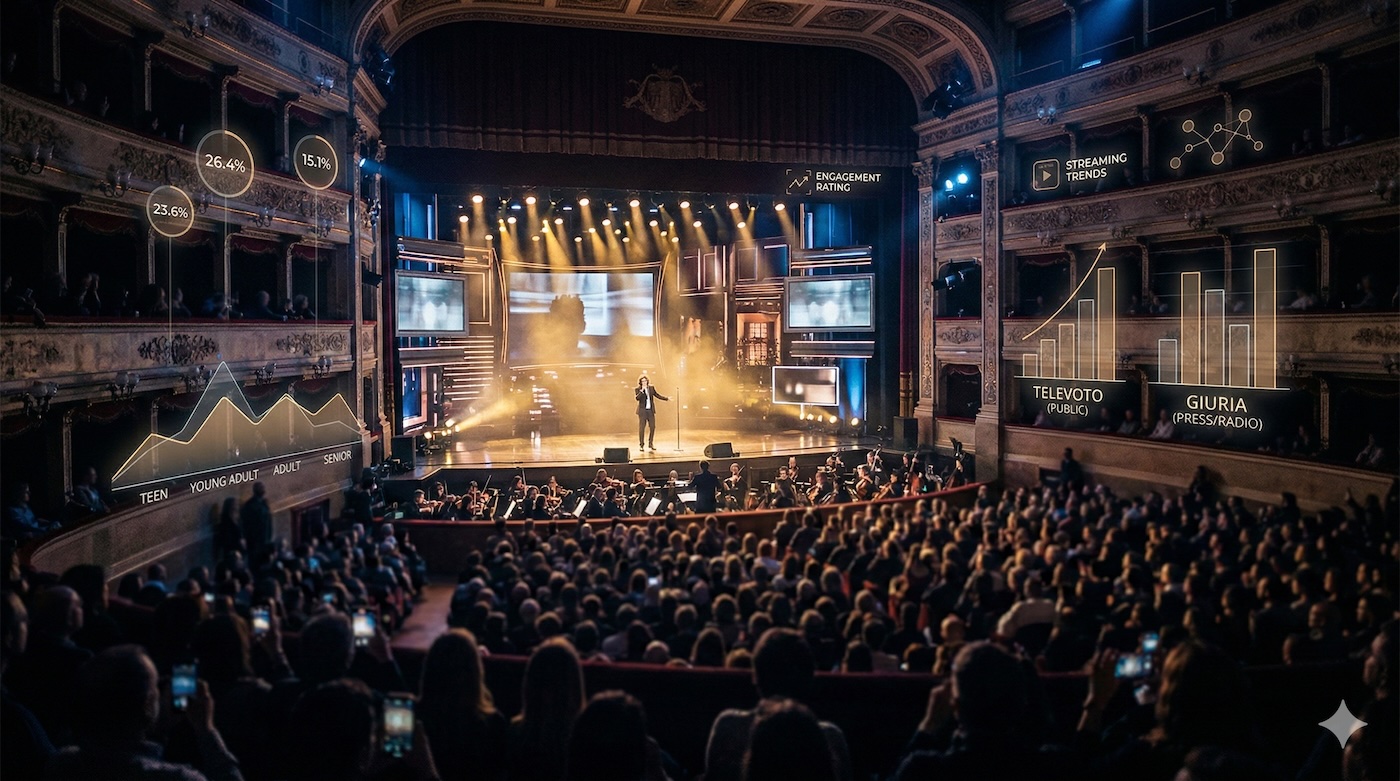
In the televote Sayf won with 26.4%.
Sal Da Vinci had 23.6%.
Yet he still won, thanks to the press room and the radio jury.
This is not an anomaly. It is a map.
In any industry, the “audience” is composed of different layers:
end customers, industry professionals, media, distributors, partners.
A strategy that speaks only to the mass audience may lose exactly where the decisions that matter are made.
Who are the gatekeepers of your market?
Are you investing there too, not only in visible campaigns?
In marketing, the winner is not the most perfect brand, but the most recognizable one.
And recognizability always comes from a truth, not from an algorithm.
Marketing lessons from Sanremo 2026
6. Leadership transitions put a brand’s identity to the test
Carlo Conti announced that he will not return in 2027.
Stefano De Martino will arrive instead, hugely popular but deeply different in language and audience.
The Festival as a brand will have to survive this change.
It is not guaranteed.
And it is not just a problem for RAI.
Every time a company changes its main public face, it risks losing the perceived coherence from the outside.
Do your values exist independently from the person who represents them?
If the answer is no, there is work to do.
7. Can being deeply local become a global strategy?
Sal Da Vinci will go to Eurovision 2026.
He is 56 years old, from Naples, and sings a love ballad with strong melodic roots.
It is not the kind of profile an algorithm would choose.
Yet it works.
Because a true story, told with full identity, does not need to be translated.
When brands think about international expansion, they often smooth out the edges.
Sometimes it is worth doing the opposite: being so recognizably yourself that you become interesting precisely because no one else could be you.
Frequently Asked Questions
What does Sanremo 2026 teach brands?
Sanremo 2026 shows that authenticity, strong identity and a multi-layered understanding of the audience
are more powerful levers than optimization techniques alone.
Sal Da Vinci’s victory highlights how narrative consistency, rooted identity
and emotional connection can outperform purely performance-driven logic.
Why is authenticity so important in marketing?
People connect with what they perceive as real.
Perfection generates momentary attention, authenticity generates trust.
Unscripted moments, spontaneous and coherent with a brand’s identity,
are the ones that create memorability and organic sharing.
How can you reach an audience that seems to have disappeared?
Often the audience has not disappeared: it has simply moved.
It may exist in vertical communities, offline spaces, or non-mainstream circuits.
The solution is not necessarily increasing the budget,
but expanding the mapping of touchpoints and reviewing observation tools.
What is the difference between promoting a product and creating an experience?
Promoting a product means communicating features and benefits.
Creating an experience means inserting the brand into a meaningful moment in people’s lives.
In the first case the brand is seen.
In the second case it is remembered.
Can being local help international expansion?
Yes. A strong and rooted identity makes a brand distinctive even in global markets.
Excessively smoothing a brand’s personality to adapt to everyone
can reduce impact and recognizability.
Identity consistency is often the most powerful lever for international expansion.
Bibliography
Official results and percentages of Sanremo 2026
Televote analysis: Sayf first with 26.4%, Sal Da Vinci at 23.6%
How Sal Da Vinci won: night-by-night breakdown
Confirmation of Eurovision 2026 participation in Vienna
Conti → De Martino handover announced at the Ariston
Sal Da Vinci: biography and the “Rossetto e Caffè” phenomenon
Continua a leggere
13 minutes of reading

19 minutes of reading

4 minutes of reading
And it consumes less energy.
To return to the page you were visiting, simply click or scroll.