
Business KPIs (Key Performance Indicators) are the universal language that enables
CEOs, CFOs, Marketing, HR, IT and Operations teams to work in sync.
Tracking them means making data-driven decisions, growing sustainably and staying competitive.
KPIs for CEOs: growth and strategy
- Revenue Growth – year-over-year revenue increase.
- Gross Profit Margin – efficiency of direct production costs.
- Net Profit Margin – final profitability after all costs and taxes.
- ROI – return on investments in projects, marketing or technology.
- EPS – earnings per share for public companies.
- CAC – customer acquisition cost.
- CLV – total value of a customer over the relationship.
- Market Share – share of the reference market.
- NPS – customers’ likelihood to recommend the company.
- NRR – net revenue retained and expanded from existing customers.
- Rule of 40 – growth % + EBITDA margin %, SaaS benchmark.
KPIs for CFOs: financial strength
- EBITDA – operating profit before taxes and depreciation.
- EBITDA Margin – EBITDA as a percentage of revenue.
- Working Capital Ratio – balance between current assets and liabilities.
- Quick Ratio – immediate liquidity excluding inventory.
- Debt-to-Equity – balance between equity and debt.
- Operating Cash Flow – cash generated by core activities.
- Free Cash Flow – cash available after investments.
- ROA – return on total assets.
- DSO – average days to collect receivables.
- DPO – average days to pay suppliers.
- Burn Multiple – for startups, cash burn vs ARR growth.
KPIs for Sales: growth and conversion
- Sales Funnel Conversion Rates – % movement between funnel stages.
- Win Rate – % of deals closed.
- Quota Attainment – % of targets reached by the sales team.
- Sales Cycle Length – average days to close a deal.
- AOV – average order value.
- Lead-to-Opportunity Ratio – % of qualified leads becoming opportunities.
- Churn Rate – % of customers lost in a period.
- Pipeline Coverage – pipeline-to-target ratio (3–5x is optimal).
- ARPA – average revenue per account.
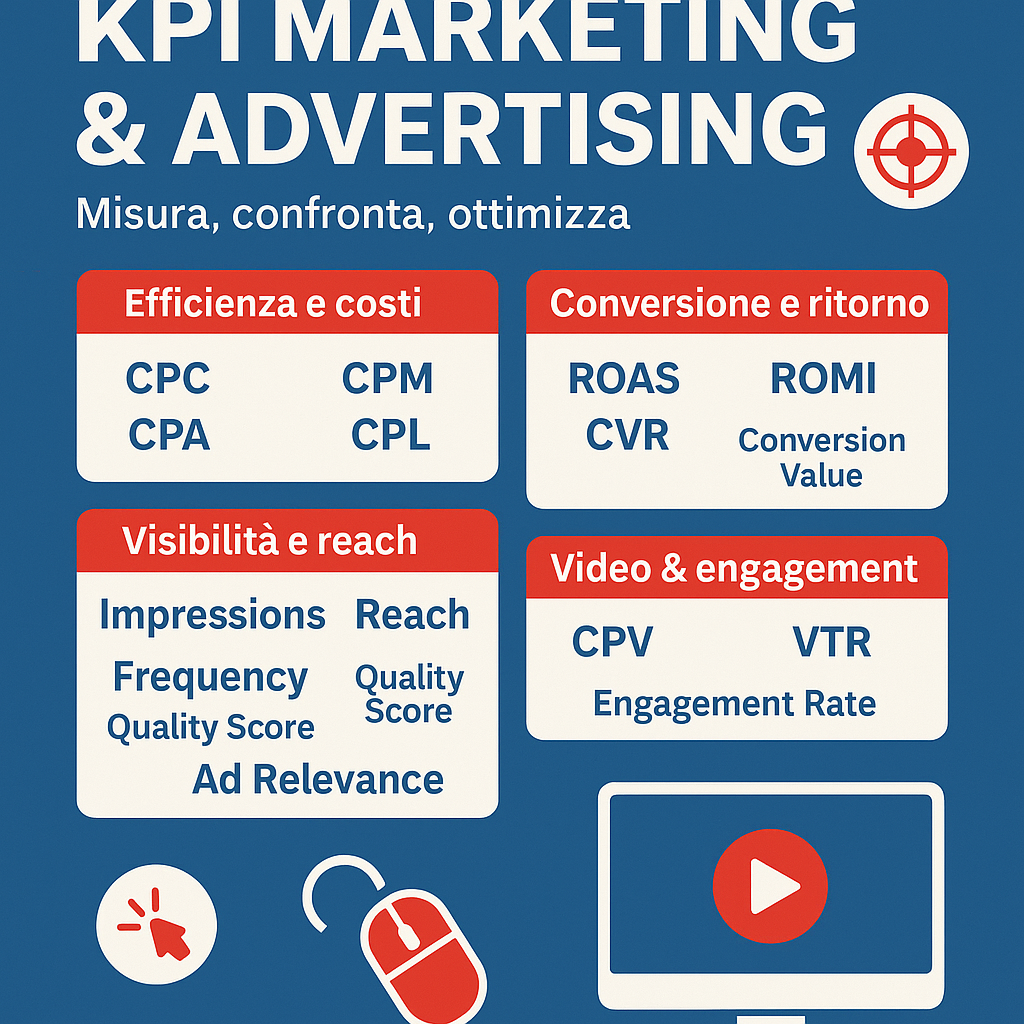
Marketing and Advertising KPIs: demand, visibility and ROI
In digital marketing and advertising campaigns, KPIs are used to measure reach,
engagement, costs and economic returns.
- ROMI – overall return on marketing investment.
- ROAS – revenue generated / ad spend.
- CPA – average cost to acquire a customer.
- CPL – average cost to generate a qualified lead.
- CPC – average cost per click.
- CPM – cost per 1,000 impressions.
- CTR – click-through rate.
- CVR – conversion rate after clicks.
- CPV – cost per video view.
- VTR – % of users who watch a video to a set point.
- Engagement Rate – level of user interaction.
- Impressions – number of ad views.
- Reach – unique users reached.
- Frequency – average times a user sees an ad.
- Quality Score – Google Ads quality rating.
- Ad Relevance – relevance of ads (Meta/LinkedIn).
- Conversion Value – monetary value of conversions.
- Attribution Model KPIs – weight of each channel in conversions.
- CAC Payback Period – months needed to recover CAC through margin.
- Incremental Lift – true incremental impact of a campaign.
KPIs for Operations: efficiency and quality
- Inventory Turnover – stock rotation over a period.
- DIO – average days inventory is held.
- On-Time Delivery – % of orders delivered on schedule.
- OTIF – on-time and in-full delivery.
- Defect Rate – % of defective products.
- First Pass Yield – % of products right the first time.
- OEE – equipment effectiveness. Best-in-class > 85%.
- Cycle Time – average process completion time.
- Cost Per Unit – average production cost per unit.
Human Resources KPIs: people and culture
- Employee Turnover – % of employees leaving the company.
- Employee Satisfaction – internal satisfaction levels.
- eNPS – Employee Net Promoter Score.
- Time-to-Hire – average hiring time.
- Cost Per Hire – average recruitment cost.
- Internal Promotion Rate – % of roles filled internally.
- Absenteeism Rate – % of lost working hours due to absence.
- Training Hours – average training hours per employee.
- Diversity KPIs – representation and inclusion metrics.
IT KPIs: efficiency and security
- System Uptime – % system availability.
- MTTR – mean time to resolution.
- MTBF – mean time between failures.
- First Response Time – average IT response time.
- SLA Compliance – % of tickets resolved within SLA.
- Cybersecurity Incidents – number and severity of attacks.
- Patch Compliance % – % of systems fully updated.
- Backup Success Rate – % of completed backups.
- IT Cost Per Employee – average IT cost per employee.
- Software Adoption Rate – % of users adopting new tools.
- Change Failure Rate – % of IT changes causing incidents.
Customer Success KPIs: retention and value
- GRR – gross revenue retention.
- NRR – net revenue retention including upsell and expansion.
- Customer Health Score – predictive retention score.
- Churn Rate – % of customers lost in a period.
- Expansion MRR – additional recurring revenue from upsell/cross-sell.
ESG KPIs: sustainability and impact
- Carbon Footprint – company CO₂ emissions.
- Energy Efficiency – energy use per unit produced.
- Diversity Ratio – % diversity in key roles.
- CSR Engagement – participation in social initiatives.
Frequently Asked Questions about Business KPIs
What are business KPIs?
Which KPIs should a CEO track?
Which KPIs are critical for a CFO?
Which KPIs measure marketing success?
Which KPIs matter most for HR?
Why are IT KPIs crucial?
Conclusion
Business KPIs are the compass that guides strategy and execution.
Each department tracks different indicators, but they all contribute to a single goal:
sustainable, efficient and competitive growth.
Bibliography and KPI Sources
Harvard Business Review – Measuring Performance
Research and articles on leadership, strategy and performance measurement.
Balanced Scorecard Institute
Strategic measurement frameworks to align KPIs and business goals.
Investopedia – KPI Definitions
Comprehensive glossary of financial and business performance metrics.
Google Analytics Help Center
Documentation on digital performance measurement and reporting.
ITIL Framework
Standards for IT service performance, uptime and incident management.
NIST Cybersecurity Framework
Guidelines for measuring cyber resilience and security posture.
ISO 9001 – Quality Management
Quality management standards and operational performance indicators.
Continua a leggere
12 minutes of reading
9 minutes of reading

22 minutes of reading

And it consumes less energy.
To return to the page you were visiting, simply click or scroll.