In recent months, AI Mode has become one of the most discussed topics in the world of Google Search.1
After an initial testing phase in the United States, the new experience based on generative artificial intelligence is progressively expanding and represents one of the most significant evolutions of Search in recent years.
What is AI Mode and why does it change marketing, e-commerce and paid advertising?
AI Mode is the evolution of Google Search from a link engine to an intelligent synthesis engine.
It does not simply return results ordered by ranking, but builds a generative answer by integrating sources, structured data, web content and semantic signals.
In practice, users no longer see only “ten blue links”: they receive an elaborated answer, often complete, contextual and visual.
This radically changes the dynamics of traffic, visibility and digital competition.
With AI Mode, the winner is no longer just whoever ranks first in the SERP.
The winner is whoever is selected and synthesized by artificial intelligence.
Why it changes marketing
Content is no longer just a tool to attract clicks: it becomes a reusable source of knowledge for AI.
Brands need to design modular, citable, semantically consistent and authoritative assets.
Why it changes e-commerce
Through its integration with Google Shopping Graph, AI Mode can show products, images, comparisons and prices directly within the generative answer.
Feed optimization, metadata quality and image accuracy therefore become decisive factors for visibility in the AI mosaic.
Why it changes paid advertising
AI-generated answers open the way to new contextual and embedded advertising formats.
Traditional PPC campaigns may lose part of their centrality, while ads integrated into the generative context and conversational micro-intents will become increasingly important.
AI Mode transforms Google from a traffic intermediary into a decision-making intermediary.
Marketing must evolve from a ranking logic to an algorithmic selection logic.
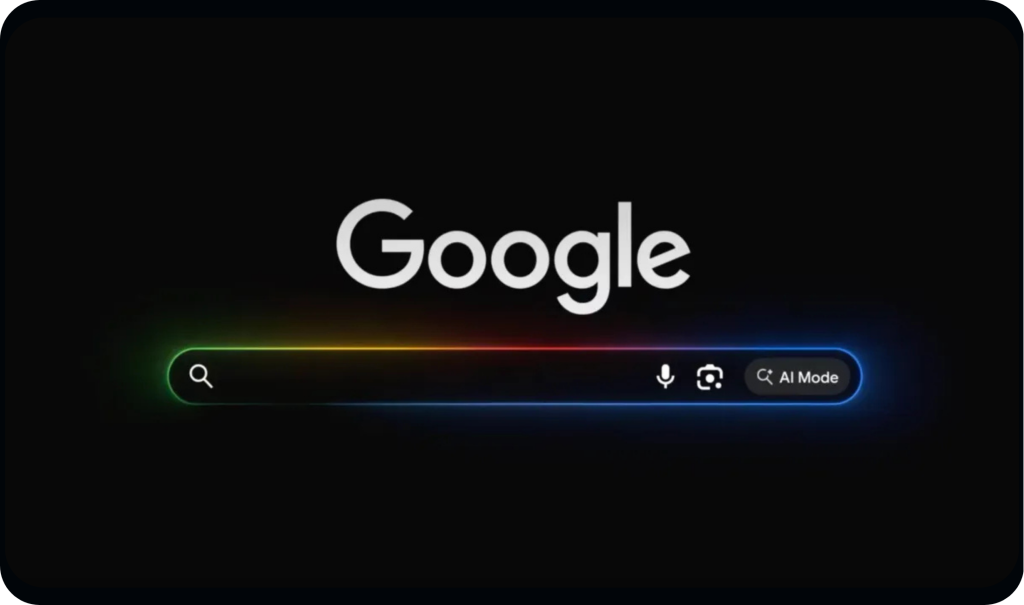
Google AI Mode, officially announced in 2025 as an evolution of the previous AI Overviews system, no longer provides only an automatic introduction to search results. It offers a conversational, multi-layered experience that deeply integrates generative models such as Gemini 3 with the traditional core of the search engine.
Let’s imagine typing a complex question into Google, for example:
“I’m on holiday in New York. Suggest a glamorous and romantic restaurant where I can go with my girlfriend, ideal for a couple who also wants to dance and have fun after dinner.”
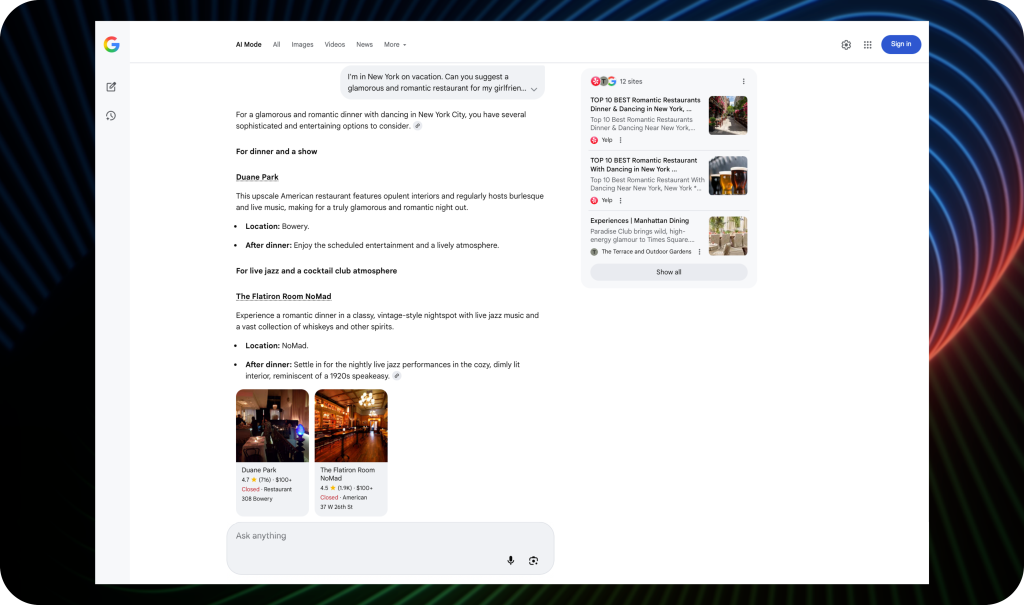
Instead of returning a list of ten links to explore, along with the initial sponsored links, Google provides a synthetic, reasoned and articulated answer, enriched with additional links, images and references, and invites the user to continue with follow-up questions. This is the core of the experience Google calls AI Mode.
Google defines AI Mode as its “most powerful search”, capable of reasoning, supporting multimodal inputs (text, voice, images), handling complex questions and enabling deeper exploration through dialogue, rather than limiting the experience to a static result.
But beyond the official promises, what actually changes for those working in digital, content, marketing and SEO optimization? And what risks, uncertainties and strategies are emerging?
The query fan-out mechanism
One of the most central, and least intuitive, aspects of AI Mode is what Google calls query fan-out. Instead of interpreting the user’s question as a single set of keywords and returning one answer or a series of documents, the algorithm breaks the query down into multiple related micro-questions, which it explores simultaneously.
If you ask “family holiday in France”, the algorithm could generate sub-searches such as “family tours in France”, “cheap flights for families to France”, “children’s attractions in French cities”, “kid-friendly hotels”, and so on. Each micro-search draws from different sources and returns pieces of knowledge that are then composed into an organic answer.
This approach has significant effects for those who produce content. Previously, the goal was to rank for a specific keyword. With fan-out, a piece of content may be “quoted” in results without ever being clicked, because the final answer — part conversation, part synthesis — can be self-sufficient. In other words, a website can contribute to the AI answer without becoming the place the user visits. With AI Overviews, important drops in click-through rate (CTR) have already been observed. Several websites report visibility drops of 20–40% compared with traditional search, and anyone who manages a website can “read” their own data and see what is happening.
Moreover, Google does not reveal exactly which subqueries it generates: we do not know which branches of the fan-out lead to success, nor how much weight each one carries. This makes a traditional SEO strategy based on tightly defined keywords almost impossible. It is as if the algorithm were operating in a dark territory, where the same semantic constructs a copywriter considers central are routed into a thousand internal streams, without direct visibility.
For marketers, this means that thematic relevance and depth — not just keyword density — become essential: content must be rich in conceptual relationships, internally coherent, supported by strong internal links and built with a horizontal approach to the topic, rather than a narrow and vertical one.
AI Mode merges with Chrome: browsing changes shape
In April 2026, Google took a significant step: AI Mode is no longer just a separate search feature, but is becoming deeply integrated into the Chrome browser, transforming the way people browse and consult the web.
The most concrete change is the split view: when clicking a link inside an AI answer, the page opens in a side panel while the conversation with artificial intelligence remains visible and active alongside it. Users no longer need to leave the chat to read a source: they can continue asking follow-up questions while keeping the website content in view. This is particularly useful for online shopping — users can find a product, open the retailer page side by side and ask the AI to compare it with other options.
The second new feature concerns the context of open tabs: through a “+” button in the search bar, users can attach recent browser tabs as if they were files or images, bringing AI Mode into an ongoing research activity without having to manually summarize the context. From the same menu, it is possible to start an in-depth search with Deep Search, open Canvas, generate images and select the Gemini model to use. It is even possible to combine multiple types of input — open tabs, images, PDFs — in the same request.
At the moment, these advanced features are available in the United States, with expansion to other countries planned. The direction is clear: Chrome is evolving from a browser into an AI-native operating environment, where artificial intelligence is not a separate add-on but a pervasive layer of the browsing experience. For those who develop websites and content, this opens a new challenge: designing pages that can also be consulted in a side panel next to an AI chat, not only as the final destination of a click.
The risk of becoming dependent on the search engine
When Google AI Mode starts answering users’ questions directly on the page, with discursive, in-depth and visual responses, the risk is that users may no longer have a reason to leave Google. If the answer is perceived as exhaustive, the click to the external website becomes residual. This tension had already emerged with AI Overviews, where the classic ten blue links were progressively pushed below the generated answer. Now, with AI Mode and its deep integration into Chrome, Google seems ready to take this logic even further.
As a response to the use of tools such as ChatGPT, Claude and others, Google keeps users inside its own environment to prevent them from staying inside competing AI platforms.
Google also becomes both a supposedly neutral engine and a content creator, because the generative answer is produced by its own algorithm.
The association representing major publishers has reacted strongly: according to them, AI Mode deprives publishers of traffic and revenue and represents an arbitrary use of third-party content. In other words, as Google moves toward a model where it answers on everyone’s behalf, publishers lose a fundamental lever of their economic ecosystem.
Toward agentic search
Google does not stop at synthetic answers: its stated goal is for AI to also be able to act on behalf of the user, carrying out concrete steps such as bookings, comparisons and multi-step tasks. This “agentic” dimension is being tested and, in some cases, is already active in experimental mode.2
If the system can take charge of a complex task — for example booking a restaurant, suggesting an itinerary and making adjustments based on constraints — it becomes an assistant that goes beyond simple search. Google refers to these as agentic capabilities integrated into AI Mode, although they are still limited to premium users in the United States and experimental access through Search Labs.

Behind these features lies an internal project that partially supports them, called Project Mariner: a prototype of a web agent that, given a goal (e.g. find flights to Tokyo, book a hotel, rent a car), can browse the web on behalf of the user, interact with websites, fill out forms and transform an abstract intent into a concrete action.
Mariner is currently limited to a small group of users, but its integration with Gemini and AI Mode suggests that Google is testing a transition toward a browser + embedded agent model. It can be seen as a response to features like ChatGPT’s Instant Checkout.
At the core of all this is Gemini 3, the latest model from Google DeepMind, which brings agentic capabilities to a new level: multi-step task management, improved tool usage and deeper reasoning. For premium plans (AI Ultra), agentic features are already available, with support for handling multiple tasks simultaneously and access to advanced capabilities.
If this transition becomes global, digital marketers will no longer compete only on visibility or traffic, but on their ability to be selected by the agent, becoming part of the AI’s internal decision-making system. Becoming “optional” within the agent’s flow — through services, APIs, partnerships and programmatic interfaces — may become more important than traditional text-based optimization.
SEO in the age of AI Mode: new metrics, new criteria
With AI Mode, the traditional SEO paradigm (keywords, links, titles, meta descriptions) evolves toward AEO and GEO, where the goal is to be selected and cited within generated answers.
Google’s guidelines state that there are no special requirements to appear in AI Mode, and that the approach remains focused on providing useful, reliable and well-structured content.3 However, what “useful” means in a context where the algorithm may choose to synthesize rather than refer out is very different from before.
First of all, the concept of E-E-A-T (Experience, Expertise, Authoritativeness, Trustworthiness) takes on a defensive role: the algorithm needs sources that are considered reliable and authoritative, from which it can extract and recombine information. Companies with weak, generic or indistinct content risk being completely ignored. Competition shifts toward substantive quality: in-depth articles, logical positioning, supporting multimedia content, authoritative sources, case studies and original data.
Then, given the fan-out mechanism, it becomes essential that a piece of content covers everything surrounding its main topic. A modular structure, with sections that function as standalone answers (independent knowledge blocks), allows the algorithm to extract useful portions even when the user’s question does not exactly match the main title. For example, an article about “garden care” should not only discuss planting, but also include sections on irrigation, fertilization, rain protection, tools and seasonal management. If AI fan-out generates a query like how to water every day, that specific paragraph can be selected independently for the answer. This article itself follows that approach: it doesn’t just talk about AI Mode, but also about its implications.
Equally important is internal coherence: cross-references, internal linking and the semantic logic connecting related concepts. Since AI Mode can jump between related topics (thanks to fan-out), it is crucial that the text works as a coherent system, not as a collection of disconnected pieces. Keywords and semantic variations should be distributed naturally, without over-optimization, as the AI can recognize and connect them even when they are not explicitly repeated.
Google has already introduced dedicated filters in Search Console to track impressions and clicks generated by AI responses. With the new integration into Chrome, however, metrics become even more complex: a click from AI Mode may open a site in a side panel next to the AI chat, without generating a traditional visit in the classic sense. It is no longer just about how many visits are generated, but how often content is cited, how long it remains visible in the panel, and whether users ask follow-up questions about it. Even if clicks decrease, presence within generated answers brings reputational benefits, branding and awareness.

Impact on marketing (content, paid, social)
The AI Mode revolution does not affect SEO alone, but impacts the entire digital marketing ecosystem. Content becomes primarily a vehicle for cognition rather than traffic. Editorial strategies must shift toward building modular assets that can be decomposed and recomposed by AI. Social campaigns will need to focus not only on attracting clicks, but on positioning within the AI-driven conversation itself, convincing the algorithm of their relevance.
As for advertising, early signals suggest that Google intends to monetize AI Mode: AI-generated responses will allow for contextual advertising placements, with less competition on impressions but higher quality for the remaining clicks.
The result may be that traditional PPC campaigns lose effectiveness (less visible space, reduced diversification), while new forms of advertising emerge, embedded directly within generative responses and tied to context and micro-intents.
Another key area is e-commerce: AI Mode is becoming increasingly visual, integrated with the Google Shopping Graph (50 billion products), and capable of delivering visual responses and product mosaics.
If a user searches for “light summer dress for women,” the AI can present images, prices, references and comparisons, even suggesting purchase options directly without requiring a visit to a website. In this scenario, catalog optimization, image quality, feed accuracy and metadata become critical for visibility within the AI ecosystem.
A risk emerges if Google becomes a walled garden even in search: if users never leave Google, the role of the website becomes marginal, and direct relationships with the brand — through newsletters, subscriptions and owned experiences — gain renewed importance. Brands that build proprietary assets (communities, applications, exclusive content) will not rely solely on the algorithm and will be able to reach users beyond Google.
Looking ahead, the push toward agentic AI could transform Google into an intermediary: users will make a request to the AI, the AI will decide which sources to activate, which tasks to execute and which websites to interact with. Marketers will need to think about how to be part of that internal decision-making process through APIs, integrations and programmable signals, rather than relying solely on content.
Emerging scenarios
While Google presents AI Mode as a service designed to help users, it is impossible to ignore that this model fundamentally reshapes the content ecosystem. A key question arises: how free does the web remain when AI decides what to show, what to cite and what to hide? Transparency around selection criteria, response priorities and content manipulation is still limited, and publishers are demanding more clarity from Google.
The risk of concentration increases: those who already benefit from authority and visibility may be favored as sources in AI-generated answers, amplifying their competitive advantage. Smaller players risk being excluded from the synthesis chain, losing visibility even when producing valuable content.
Finally, the speed of change is itself a challenge: strategies that work today may quickly become obsolete. It is essential to adopt an evolutionary mindset based on continuous experimentation, adaptation, monitoring and iteration.
Strategic actions for brands and clients
Given this scenario, what can a digital agency or a brand do to position effectively? There is no single formula, but several strategic guidelines can help.
- Adopt content as a “knowledge kit”: modular, interconnected texts with standalone answer blocks;
- Invest in quality, authority and originality: focus on original data, case studies, direct experience and unique content;
- Integrate semantic and relational signals within content, ensuring internal coherence and contextual linking;
- Optimize product catalogs (for e-commerce) with accurate images, well-structured feeds and rich metadata so AI systems can interpret them;
- Monitor AI-related metrics (impressions, citations, AI-driven clicks) via Search Console and other tools, not just traditional traffic;
- Develop proprietary channels (apps, newsletters, exclusive content) to build direct relationships with the audience;
- Prepare for agentic AI by exploring APIs, meta-services and interfaces that Google’s agents can interact with;
- Do not abandon traditional SEO, but consider it a foundational layer: backlinks, technical structure, performance and mobile remain essential;
- Maintain a culture of continuous testing and experimentation, as many aspects of AI Mode are still evolving rapidly.
Frequently asked questions about Google AI Mode
What is AI Mode in Google Search?
AI Mode is the evolution of Google Search toward a generative and conversational model.
Instead of showing only links, Google provides synthesized, contextual answers generated by artificial intelligence, drawing from multiple sources simultaneously.
Does AI Mode replace traditional SEO?
No. SEO remains the technical and semantic foundation for being indexed and understood by Google.
However, with AI Mode it becomes essential to integrate AEO (Answer Engine Optimization) and GEO (Generative Engine Optimization) to be cited in AI-generated answers.
How does AI Mode impact organic traffic?
AI Mode can reduce direct traffic to websites because many answers are provided directly within the SERP.
This shifts the focus from the quantity of clicks to the quality of visibility and brand presence within generated answers.
What is the impact of AI Mode on e-commerce?
AI Mode is integrated with the Google Shopping Graph and can display products, images, prices and comparisons directly in generative responses.
To be visible, it is essential to have structured feeds, complete metadata and high-quality images.
Will Google Ads change with AI Mode?
Yes. AI Mode opens the door to contextual advertising formats integrated into generative responses.
This may reduce the effectiveness of traditional PPC and favor ads aligned with conversational context and micro-intents.
Does AI Mode turn Google into a “walled garden”?
This risk exists. If users get complete answers without leaving Google, websites lose centrality.
That’s why building proprietary assets such as newsletters, communities and applications becomes strategic.
How can content be optimized for AI Mode?
Content should be modular, structured and semantically coherent, with standalone answer blocks.
Original data, case studies and authority increase the likelihood of being cited by generative systems.
What is Generative Engine Optimization (GEO)?
GEO refers to the set of strategies that enable a brand to be selected and accurately cited in AI-generated responses, going beyond traditional SERP positioning.
Does AI Mode favor only large brands?
Established brands may have an initial advantage, but high-quality, well-structured content supported by original data can still emerge, even for smaller players.
What is the best strategy to address AI Mode today?
Combine technical SEO, answer-first content, coherent semantic signals and proprietary assets.
An adaptive approach based on testing, monitoring and continuous iteration is essential.
References and official sources
Google – AI in Search
Official announcement of the evolution of Search toward AI Mode and generative experiences.
A key document to understand the shift from information retrieval to intelligent synthesis.
Google – AI Mode Agentic & Personalized
Updates on agentic capabilities and personalized AI responses.
Relevant to understand the impact on content, e-commerce and paid advertising.
Google Search Central – AI Features & Websites
Official guidelines on how AI features interact with websites.
A fundamental resource for technical SEO and visibility in generative answers.
Google Shopping Graph
The data architecture powering AI-driven shopping experiences.
Over 50 billion structured and continuously updated products.
Search Quality Rater Guidelines
The document defining authority, trust and content quality.
A conceptual foundation for understanding which sources AI tends to cite.
Digital Markets Act (DMA)
European regulatory framework for digital gatekeepers.
Relevant to understanding the evolution toward closed or “walled garden” models.
HT&T – Zero-Click Search
How AI Overviews and AI Mode have driven the rise of Zero-Click Search.
Data, analysis and strategies to stay visible in the era of generative search.
Continua a leggere
22 minutes of reading

20 minutes of reading

35 minutes of reading

And it consumes less energy.
To return to the page you were visiting, simply click or scroll.