Gucci, AI in luxury and experiential marketing

Gucci turned a collection into a mystery. And no one noticed while experiencing it.
Luxury marketing has always faced a fundamental challenge: it must create desire without appearing intrusive or forced. It is a constant balance between being present, with discretion, and reaching an audience that actively avoids any form of explicit persuasion. Gucci offered a surprising solution to this challenge with the project La Famiglia: Mystery Unfolds, launched alongside the new collection of the same name.
Beyond traditional marketing
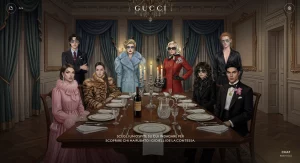
La Famiglia: Mystery Unfolds goes beyond the boundaries of traditional marketing. It is far from a commercial, an interactive lookbook, or even a conventional game. It is an immersive narrative experience: a villa, a family, and a theft create an environment where users are invited to freely move between characters and spaces to uncover the truth.
The approach is radically different from standard fashion campaigns, where traditional content dictates a visual path, a sequence, and a duration.
In this project, the user is fully autonomous, entering the space and defining their own journey. They can choose who to question, when to revisit previous steps, or change their investigative hypotheses.
The absence of a predefined path turns the space into something that each user experiences in a unique and personal way.
This freedom of exploration redefines the type of attention required, far from the distracted and fleeting attention of scrolling, and from the passive attention of waiting for a video to end. We are talking about intentional attention, deeply curious and active, almost investigative, driven by the desire to discover.
Google Gemini in the background: when technology works because it disappears
The core of “La Famiglia” is Google Gemini, which enables characters to provide coherent and dynamic responses to users. The real innovation lies in the ability to integrate AI in an almost imperceptible way.
In recent years, artificial intelligence in marketing has often been placed at the forefront, showcased as the main attraction, as if simply using it was the content itself. The result was often a momentary wow effect that quickly faded, leaving little substance behind.
Gucci has reversed this logic. AI is no longer a spectacle but an integrated tool, becoming invisible infrastructure. It operates in the background, ensuring characters remain consistent, responses stay plausible, and the narrative experience remains intact. In this way, users perceive the characters and their story, rather than the model behind them.
The product as a clue and the attention luxury has never been able to buy
In fashion marketing, brands invest enormous resources to make people look at their products. They hire top photographers, choose evocative locations, and build visually striking campaigns. Yet the attention they receive is often superficial, reduced to a quick glance, an automatic like, and then gone.
“La Famiglia” resolves this contradiction elegantly. Gucci garments and accessories are never presented frontally, never shown on a model, and never accompanied by captions. They appear worn by the characters and embedded in the details of those who wear them. The user truly observes them, because there is a reason to: they might be a clue.
A suspicious character’s coat becomes something to examine closely, to compare with previous statements, to interpret within the story. Attention becomes slower, investigative, almost analytical.
Paradoxically, this type of attention—the one luxury has always pursued but never managed to buy—is exactly what the mystery format generates naturally.
When entertainment becomes conversion
Branded entertainment is often criticized for engaging audiences without generating real conversions. Even when people appreciate and share content, the risk remains that the brand is quickly forgotten. This weakens the connection between a positive experience and the final purchase.
The “La Famiglia” project addresses this by introducing a clear progression mechanism. Solving the mystery acts as a gate to exclusive content: unseen materials, deeper insights into the collection, and early access to new products. Those who complete the experience gain a privilege not available to everyone.
This approach goes beyond simple incentives, aligning instead with the cultural codes of luxury. In this context, value lies in belonging to an exclusive sphere. Solving the mystery becomes the achievement of a privilege that carries far more weight than a simple discount.
As a result, the experience becomes the starting point of a long-term relationship, rather than a standalone piece of content.
Marketing that accepts being questioned
Adopting an interactive narrative experience means accepting a new challenge: the possibility of being questioned for the first time.
In traditional content, the brand maintains full control over message, sequence, and tone. With this type of interactivity, control is significantly reduced. Users can question characters on any topic, expecting answers that are coherent, credible, and sustainable. Any weakness in the storyline or superficiality in the characters will quickly emerge, compromising the entire experience.
This dynamic requires brands to build internal consistency and a narrative world strong enough to withstand deep exploration. It becomes essential to define how each character would respond in unexpected situations and to construct a narrative universe robust enough to handle any level of user interaction.
This is the future, but not for everyone
Considering “La Famiglia” as the universal future for all brands would be a mistake.
The success of the project relies on three interconnected factors: Gucci’s resources, a strong narrative identity capable of sustaining a fictional world, and an audience willing to invest time in complex experiences. If any of these elements were missing, the entire structure would collapse. A brand without solid storytelling attempting an interactive experience risks building something technically perfect but narratively empty.
The essence of the concept lies in moving beyond content consumption toward full immersion in experiential environments. The primary goal is to create experiences valuable enough to trigger active and spontaneous user engagement.
This forces brands to abandon the mindset of campaigns with a clear beginning and end, and adopt one based on ongoing, evolving experiences. It requires equal investment in internal consistency and visual impact. Most importantly, it demands accepting that people prefer discovering things on their own rather than being persuaded.
Gucci, rather than launching a campaign, has presented a model of how marketing could evolve. The real question is whether brands are willing to invest the effort required to deserve this level of engagement.
The model behind the experience: FAQ
What exactly is “La Famiglia: Mystery Unfolds” and how is it different from a traditional campaign?
It is an interactive narrative environment set in a villa, with characters, a storyline, and a theft to solve. The difference from a traditional campaign is structural: the brand does not decide what to show or in which order. The user enters the space and independently chooses how to move, who to question, and which clues to follow.
What role does AI play and why did Gucci use it differently?
Google Gemini powers the characters’ responses, allowing them to react dynamically and coherently to any question. Gucci’s distinctive choice was to make AI an invisible infrastructure. While most brands have showcased AI as the main attraction, often creating a short-lived wow effect, here it operates in the background without ever becoming the focus.
How are Gucci products presented and why does this approach work better than a traditional one?
Products appear worn by the characters, becoming clues to observe rather than objects to passively admire. The user observes a garment slowly, compares it with what a character has said, and interprets it within the story. This is exactly the type of intentional and investigative attention that luxury has always pursued but never managed to buy.
Is there a commercial mechanism behind the experience or is it just entertainment?
There is a precise progression structure. Those who solve the mystery gain access to exclusive content, behind-the-scenes materials about the collection, and early access to products. Completing the experience grants a privilege. The experience generates desire, and desire leads to purchase.
Can all brands replicate this model?
Not in this specific form, and attempting it without the right conditions would be a mistake. “La Famiglia” works because Gucci has the resources to build it, a strong narrative identity to support a fictional world, and an audience willing to invest time in complex experiences. A brand without solid storytelling risks creating something technically flawless but narratively empty. What can be generalized is this: stop interrupting people and start creating something worth seeking. The shift is not technical, it is cultural.
Sources and further reading
Gucci – La Famiglia: Mystery Unfolds
Official interactive narrative experience developed by Gucci for the collection launch.
Google Gemini
AI technology used to generate dynamic and coherent interactions between users and characters.
Branded entertainment in luxury
Approach that combines storytelling and brand strategy to increase engagement.
Experiential marketing
A model that transforms the user from a passive viewer into an active participant in the experience.


Continua a leggere
9 minutes of reading

5 minutes of reading

8 minutes of reading

And it consumes less energy.
To return to the page you were visiting, simply click or scroll.