
AI & eCommerce Architecture
Agentic eCommerce: ACP, UCP and What to Do Now
OpenAI’s ACP and Google’s UCP are already live for agentic eCommerce. How the new agentic protocols work, what they cost, and what a Shopify merchant must do today to avoid losing the channel.
What is agentic eCommerce?
Agentic eCommerce is a model in which artificial intelligence agents can directly query a product catalog via structured APIs and complete transactions through interoperable protocols such as ACP (Agentic Commerce Protocol) and UCP (Universal Commerce Protocol).
In summary
- Agentic eCommerce introduces a decision layer above the shop.
- The OpenAI–Shopify agreement enables structured API integrations.
- Competitive advantage shifts to data quality and consistency.
- SEO, AEO and GEO become information architecture.
- Checkout loses strategic centrality in favor of conversation.
eCommerce is no longer just a website with a catalog.
Agentic eCommerce is redefining digital commerce.
For over twenty years, we have designed architectures based on categories, filters, product pages and progressive funnels. That model is not disappearing — it is transforming.
A conversational system is emerging, where users no longer browse menus but express a need:
“I’m looking for a waterproof jacket for winter trekking under 200 euros“.
They don’t explore — they articulate intent.
At that point, a digital agent intervenes, capable of:
- Understanding context and constraints (budget, usage, preferences);
- Analyzing the catalog in real time;
- Filtering relevant alternatives;
- Explaining and justifying the proposed choice.
This shifts the center of gravity of eCommerce from navigation to intelligent mediation.
With open APIs and integration with advanced AI models,
Shopify is positioning itself as one of the platforms most ready for native agentic commerce.
Its API-first architecture, coherent data structure and headless ecosystem allow language models to connect directly to catalog, pricing and availability.
This is not about adding a chatbot, but about designing a decision layer above the shop.
eCommerce will no longer be searched. It will be requested, synthesized and decided by an agent.
In this scenario, differentiation will not depend only on the chosen platform, but on the quality of the underlying data architecture: structured feeds, semantically robust descriptions, consistency between stock, pricing and promotional logic.
Conversational commerce is not a feature. It is a paradigm shift in the relationship between user and product.
What is agentic eCommerce really?
Agentic eCommerce is a model in which an artificial intelligence system does not merely provide information, but actively intervenes in the decision-making process.
It does not simply display products: it selects them, compares them, and justifies them.
In traditional eCommerce, the user explores.
In agentic eCommerce, the user expresses a goal and the system builds a coherent proposal.
Technically, an eCommerce agent combines:
- Semantic intent understanding (natural language understanding);
- Structured access to product data via APIs or normalized feeds;
- Comparative reasoning capabilities between alternatives;
- Real-time personalization based on context and history;
- Multi-step support up to purchase completion.
This implies an architectural shift.
The catalog is no longer just HTML content optimized for SEO, but becomes a data layer that can be intelligently queried.
The agent must be able to access:
- Structured and consistent attributes;
- Up-to-date availability;
- Pricing and promotion rules;
- Shipping and return policies;
- Technical or compatibility constraints.
Without this data foundation, the agent cannot reason — it can only simulate.
A chatbot answers a question.
An agent interprets a goal and builds a solution.
The difference is subtle but structural.
The chatbot is an interface.
The agent is a decision system.
Looking ahead, this means the competitive value of a shop will no longer lie only in visual UX or checkout speed, but in the quality of data orchestration that allows AI to operate reliably.
Traditional eCommerce vs Agentic eCommerce
Key data: why conversational commerce matters now
The shift toward an agentic model is not theoretical. It aligns with the evolution of digital behavior in Europe and with the infrastructure emerging around AI agents.
What differentiates is data orchestration and intelligent interaction.
~50 million estimated shopping queries per day.
Source: Ekamoira, 2026
Discovery happens outside the shop: an API-ready catalog is required.
Source: Opascope / Checkout.com, 2026
The protocols are complementary, not alternative.
in 3–5 years, a much faster pace than the 20-year evolution of traditional eCommerce.
Source: Fortune / McKinsey, February 2026
Source: Google Search Central
Structured data helps search engines better understand content and display it as rich results.
If search becomes conversational and purchasing can occur within an AI interface, then competitive advantage is no longer just about traffic, but about consistency between data, commercial logic and intelligent response capability.

Why is Shopify today the most AI-ready platform?
Shopify was not born as an AI platform.
But over the years it has built an architecture that now makes it particularly suitable for integration with advanced artificial intelligence systems.
The API-first model, the headless ecosystem (Hydrogen, Storefront API), the coherent catalog data structure and centralized pricing and inventory management create the ideal conditions for a decision layer above the shop.
The agreement between OpenAI and Shopify is no longer an announcement: on February 16, 2026, OpenAI launched Instant Checkout in ChatGPT into production, available to all U.S. users (including Free). Etsy is the first live marketplace; over one million Shopify merchants (including Glossier, SKIMS, Spanx and Vuori) are in the onboarding pipeline.
Source: OpenAI, February 2026
The mechanism is based on two open protocols now operational:
-
ACP — Agentic Commerce Protocol: open standard developed by OpenAI and Stripe, released open source under Apache 2.0 license. It allows AI agents, users and merchants to collaborate to complete a purchase directly in chat.
Source: OpenAI Developer Docs -
UCP — Universal Commerce Protocol: co-developed by Shopify and Google, endorsed by 20+ retailers including Walmart, Target, Home Depot, Best Buy and Macy’s.
Supports REST, MCP (Model Context Protocol), Agent Payments Protocol (AP2) and Agent2Agent (A2A). It brings Shopify merchants directly into Google AI Mode and the Gemini app.
Source: Shopify, January 2026
Merchants implementing both protocols capture 40% more agentic traffic compared to those adopting only one.
In practical terms, this means AI models can directly query the Shopify catalog through structured APIs, accessing variants, pricing, availability and updated metadata without interpreting HTML pages.
This reduces errors, ambiguity and inconsistencies between conversational recommendations and the transactional system.
This means a conversational agent can:
- Access products, variants and availability in real time;
- Understand promotions and sales conditions;
- Interact with checkout;
- Guide the user through order completion.
It is no longer about “recommending” a product but about enabling an AI-mediated purchase flow.
With the OpenAI–Shopify integration, AI does not observe the shop.
It can operate inside the shop.
From a technical perspective, this drastically reduces the gap between conversational experience and transactional system.
The agent no longer needs to interpret HTML pages, but can directly query structured data via API.
For European D2C brands, this implies three immediate consequences:
- Accelerated time-to-market for agentic implementations;
- Lower custom complexity compared to legacy platforms;
- Greater control over data and governance.
Compared to more rigid enterprise solutions, Shopify offers a rare combination of scalability, flexibility and API openness.
This makes it today one of the most ready platforms for native conversational commerce.
Agentic eCommerce is not a plugin — it is an architectural evolution.
And today Shopify is structurally closer to that model than many competitors.
What changes for European D2C brands?
For a European D2C brand, adopting agentic eCommerce changes the way customers interact with products.
In a traditional context, users browse, compare, abandon and return. In the conversational model, interaction shortens: intent is expressed in natural language and the system builds a coherent proposal.
For a D2C brand, agentic AI means:
- Less friction in product discovery thanks to semantic intent understanding.
- Higher conversion rate on qualified traffic, because the proposal is filtered and justified.
- Reduced customer care workload through automation of repetitive and pre-sales requests.
- Scalable personalization across multiple EU markets, languages and currencies.
- Smoother cross-border support with contextual explanations on shipping, returns and taxation.
In Europe, where cross-border competition is increasing and traffic comes from multiple countries, languages and regulatory contexts, interaction quality becomes a differentiating factor.
A well-designed agent can adapt recommendations and tone depending on the originating market, maintaining consistency with pricing, availability and local policies.
The new competitive differentiator is not shop design, but interaction quality.
For more mature D2C brands, this introduces a second implication: the centrality of structured data. Without consistent attributes, clear promotional logic and semantically organized catalogs, AI cannot operate reliably.
Agentic eCommerce therefore does not replace strategy — it makes it more demanding.
How does it impact SEO, AEO and GEO?
With the emergence of AI Overviews and generative responses, digital visibility is no longer played exclusively on the traditional SERP.
Content can now be synthesized, cited or interpreted directly by a language model.
This changes the SEO paradigm and introduces two complementary dimensions:
- SEO: optimization for ranking in search engines.
- AEO (Answer Engine Optimization): optimization to be extracted as a direct answer.
- GEO (Generative Engine Optimization): optimization to be correctly interpreted by generative models.
In an agentic eCommerce context, the shop must be designed not only for human users, but also for AI systems.
Agentic eCommerce requires:
- Clean structured data (coherent and updated schema markup);
- Semantically organized catalogs with clear and normalized attributes;
- Descriptions optimized for language models, not only for keywords;
- Consistency between content, pricing and availability in real time;
- Structured API access for reliable queries.
Generative models do not “read” like traditional crawlers. They interpret, synthesize and evaluate consistency.
If data is ambiguous or misaligned, AI may return inaccurate responses.
The new visibility is not only position. It is citation, synthesis and reliability.
Platforms that enable structured API access, real-time updates and clear data governance will be more easily integrable into AI systems.
In this scenario, SEO, AEO and GEO are not separate disciplines.
They are different layers of the same information architecture.
What are the risks of agentic eCommerce?
The adoption of agentic AI systems is not without critical issues.
Like any automated decision layer, it amplifies the quality — or the fragility — of the underlying architecture.
The main risks concentrate around four areas:
- Product data governance: incomplete or inconsistent attributes can generate incorrect recommendations.
- Dynamic pricing management: promotions, discounts or pricing rules not aligned in real time can create discrepancies between AI proposal and checkout.
- Control over recommendations: an agent may suggest non-strategic alternatives (e.g., low-margin or non-priority products).
- Compliance, privacy and security: management of personal data, conversation logs, API access and protection against manipulation.
There is also a reputational risk: if the agent provides inaccurate information about availability, shipping or technical compatibility, brand trust can deteriorate quickly.
From a technical perspective, risks emerge especially when:
- The catalog is not semantically normalized;
- APIs are not designed for intelligent querying;
- No validation controls exist on AI responses;
- There is no continuous monitoring of interactions.
AI does not create disorder — it makes it more visible and faster.
Massimiliano Baldocchi, HT&T Consulting
For this reason, agentic eCommerce requires preventive architectural design, with clear policies on data, pricing, business priorities and quality control.
Adoption should not start from the conversational interface, but from the solidity of the infrastructure.
Amazon, Google and OpenAI: the agentic protocol war
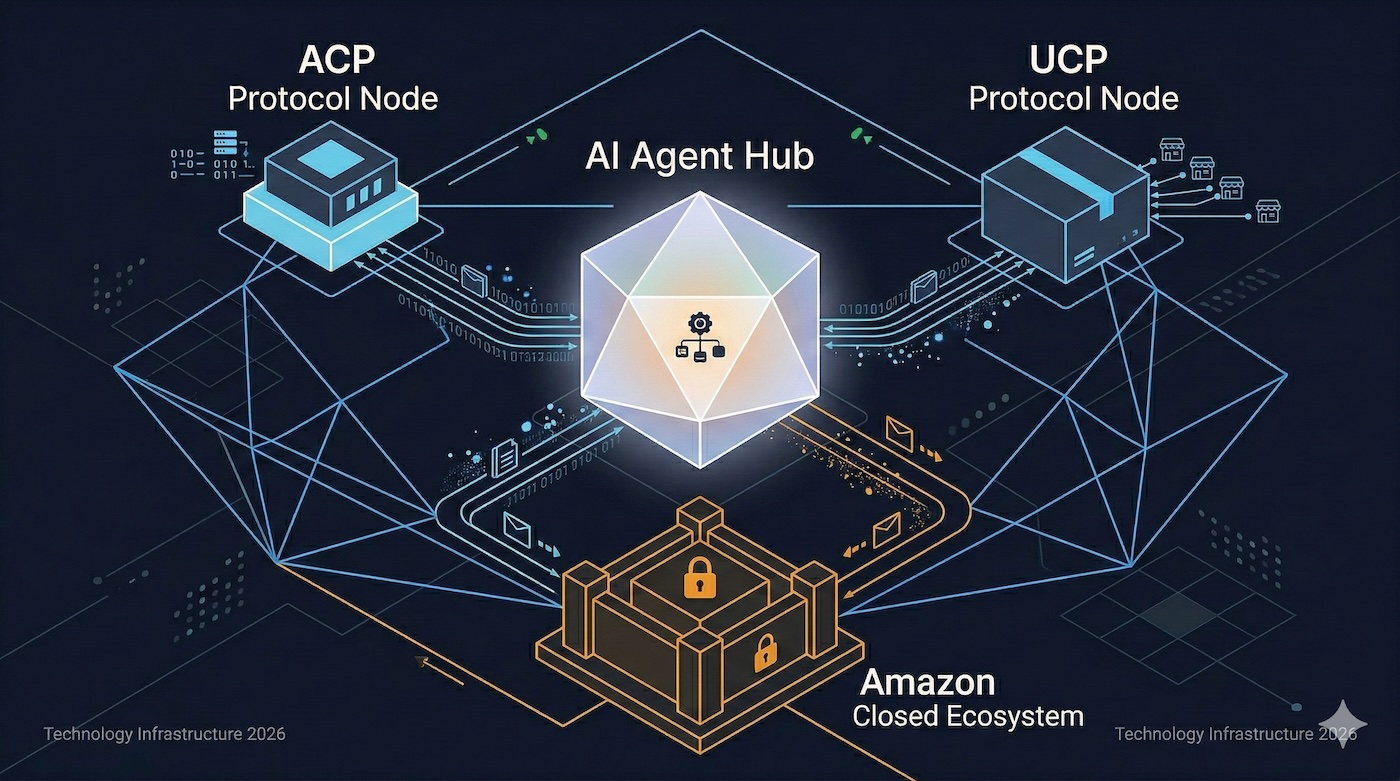
Agentic commerce does not have a single standard.
Today, two open protocols coexist alongside a closed ecosystem — and others may emerge in the near future from additional AI players. Choosing between them is already a strategic decision for every brand.
| Protocol | Led by | Where it works | Status |
|---|---|---|---|
| ACP — Agentic Commerce Protocol | OpenAI + Stripe | ChatGPT Instant Checkout | Live since Feb 16, 2026 (U.S.) |
| UCP — Universal Commerce Protocol | Shopify + Google | Google AI Mode, Gemini, Microsoft Copilot | Announced Jan 2026, rollout in progress |
| Amazon closed ecosystem | Amazon | Rufus AI, Alexa+, Buy for Me | Live, not interoperable |
Amazon has not joined either ACP or UCP.
It is building proprietary agents (Rufus AI, Alexa+, Buy for Me) within its closed ecosystem, without external interoperability.
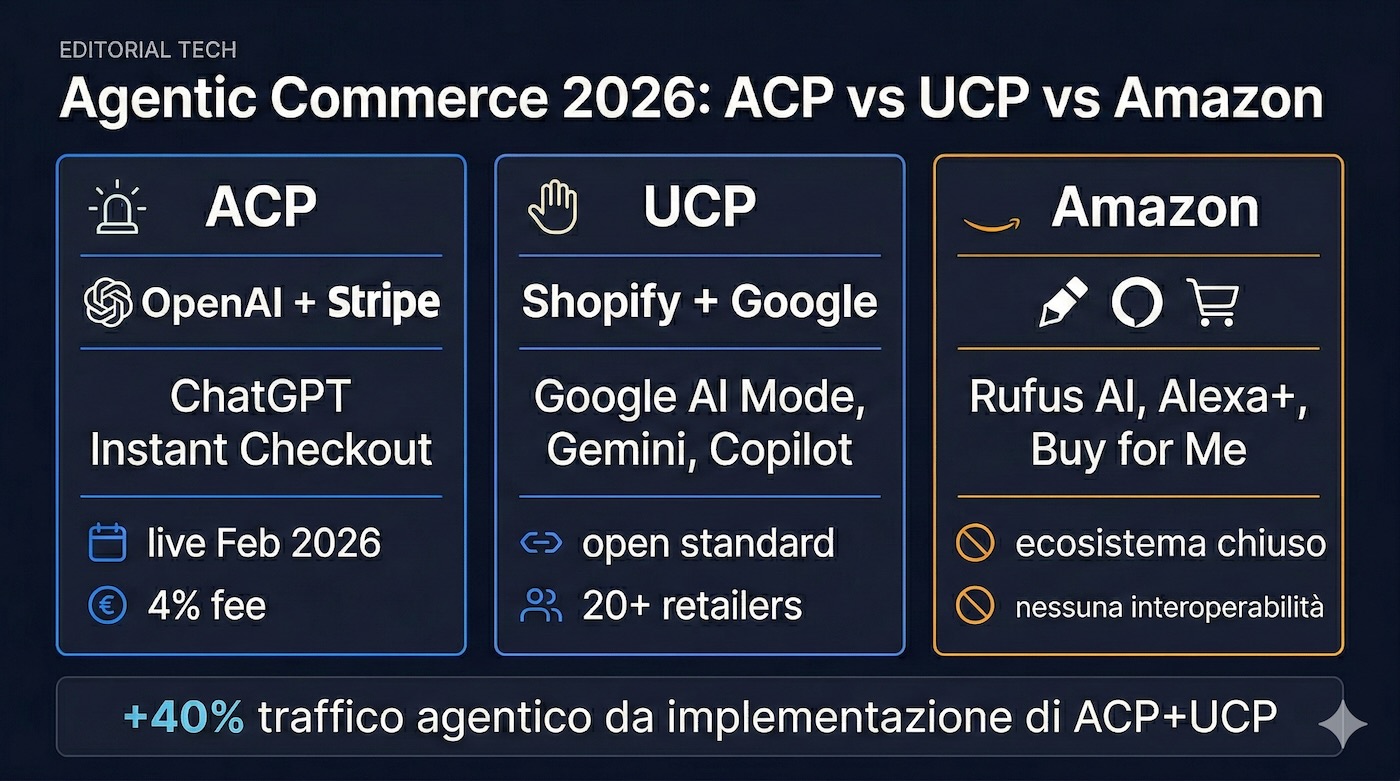
For DTC brands, this opens an unprecedented scenario: ACP and UCP can become a direct route to the customer, reducing dependence on Amazon and its commissions.
A well-structured catalog compatible with both protocols becomes a competitive asset independent of marketplaces.
For the first time, a D2C brand with structured data and compatible APIs can reach 900 million ChatGPT users and 1.5 billion Google AI users without going through Amazon.
Will checkout still be the center of eCommerce?
For over a decade, eCommerce optimization focused on checkout: fewer fields, fewer steps, more speed, more conversion.
Cart abandonment rate has been the dominant KPI.
In the agentic model, however, the decisive moment occurs earlier — not at payment, but in the construction of choice.
If an agent has already:
- Understood the user’s real intent;
- Selected coherent alternatives;
- Justified the proposal with clear reasoning;
- Reduced uncertainty;
then checkout becomes an operational formality.
The traditional funnel (Awareness → Consideration → Conversion) does not disappear. It compresses.
The consideration phase is mediated and synthesized into a structured conversation.
In conversational commerce, conversion happens before payment.
This does not eliminate the need for a high-performing checkout, but shifts strategic focus:
- Quality of the data feeding the agent;
- Consistency between recommendation and real availability;
- Alignment between AI proposal and commercial strategy;
- Trust building before the transaction.
In other words, checkout remains important, but it is no longer where the game is decided.
In the agentic model, the true center of eCommerce is the interaction that precedes the transaction.
How to prepare a Shopify shop today for agentic eCommerce?
Preparation is no longer theoretical: ACP and UCP are production protocols with precise technical requirements. Here is what is concretely needed.
Data and catalog
- Normalize product attributes and variants (title, description, GTIN, availability, price).
- Verify real-time consistency between pricing, promotions and stock.
- Implement complete and updated schema markup (Product, Offer, AggregateRating).
- Produce a product feed according to OpenAI specifications for ACP and Google specifications for UCP, as formats differ.
ACP Technical Integration (ChatGPT Instant Checkout)
- Implement the Agentic Checkout API REST endpoints (checkout session, shipping options, totals).
- Configure webhooks to notify OpenAI of order updates.
- Integrate a payment provider compatible with the Delegated Payment Spec (Stripe is the first certified; other PSPs arriving in 2026).
If you already use Stripe, activation requires only one line of code. - All communication must occur over TLS 1.2+ with a valid public certificate.
Costs to plan
-
OpenAI applies a 4% commission on each purchase completed via Instant Checkout (the customer pays nothing extra). On a €100 order, the total cost between OpenAI commission and Stripe fees is approximately €7.20.
(Source: Opascope, 2026) - UCP (Google) has not yet publicly announced a commission structure at launch.
Governance and monitoring
- Ensure secure and documented API access.
- Monitor and validate AI responses in a controlled environment before go-live.
- Define clear policies on recommendations, margin priorities and excluded products.
AI is enabled by solid infrastructure, not by a plugin.
And today that infrastructure has a name: ACP and UCP.
Conclusion: are we entering conversational commerce?
The integration between Shopify and AI systems, made concrete by already operational agreements with OpenAI, represents an architectural shift.
Agentic eCommerce will no longer be just a sales platform but will become an intelligent decision environment, capable of interpreting intent, building proposals and mediating choice even before checkout.
This implies a deep transformation:
- Centrality of structured and consistent data;
- Governed and secure API access;
- Alignment between AI recommendation and commercial strategy;
- Design oriented to SEO, AEO and GEO.
Brands that start designing AI-compatible architectures now are not chasing a trend — they are building a structural advantage.
Conversational commerce will not replace eCommerce — it will become its upper layer.
In the coming years, the difference between platforms will not lie only in features, but in their ability to dialogue with intelligent systems.
And in this scenario, architecture quality will matter more than feature quantity.
The question is not whether eCommerce will become agentic.
The question is when your brand will be ready.
FAQ on Agentic eCommerce and Shopify
What is agentic eCommerce in simple terms?
It’s a model where an AI system talks with the user, understands intent, and proposes coherent options, guiding them through choice and purchase. It doesn’t just show products — it interprets goals.
What’s the difference between a chatbot and agentic eCommerce?
A chatbot answers predefined questions. An eCommerce agent understands context, analyzes the catalog, compares alternatives, and builds a justified proposal.
It’s a decision system, not just a conversational one.
Does Shopify natively support AI integrations?
Yes. Thanks to its API-first architecture, Storefront API and headless tools, Shopify enables connecting AI models directly to catalog, variants, availability and checkout in a structured way.
What does the OpenAI–Shopify agreement change in practice?
It enables AI systems to query the shop via structured APIs, avoiding HTML scraping and reducing inconsistencies between conversational recommendations and the transactional system.
Does agentic eCommerce really improve conversion?
It can increase conversion rate by reducing friction and uncertainty.
When intent is correctly understood and the proposal is filtered and justified, the decision process becomes shorter.
What impact does it have on SEO, AEO and GEO?
Agentic eCommerce requires clean structured data, semantically organized catalogs, and consistency between content and pricing. Ranking in SERPs is not enough: content must be correctly interpretable by generative models.
Is it only for large brands or also for SMEs?
It’s not limited to large brands. SMEs with well-structured catalogs can also integrate AI systems, as long as they have solid data governance and secure API access.
What are the main risks of agentic eCommerce?
Wrong recommendations, price inconsistencies, compliance issues, or suggestions not aligned with commercial strategy.
Without a coherent data foundation, AI amplifies existing issues.
Will checkout remain central?
Checkout remains important, but in the conversational model the decision happens earlier. Interaction quality becomes more strategic than payment-only optimization.
How do I prepare a Shopify shop today for agentic eCommerce?
By normalizing attributes and variants, implementing complete schema markup, ensuring consistency between pricing and stock, and designing governed API access.
AI is enabled by solid infrastructure, not by a plugin.
What is the Agentic Commerce Protocol (ACP)?
It’s the open standard developed by OpenAI and Stripe that allows AI agents, users and merchants to collaborate to complete a purchase directly in chat.
It’s open source (Apache 2.0 license) and powers Instant Checkout in ChatGPT, live since February 16, 2026 for all U.S. users.
What is the Universal Commerce Protocol (UCP)?
It’s the open standard co-developed by Shopify and Google, announced in January 2026.
It supports REST, MCP, Agent Payments Protocol (AP2) and Agent2Agent (A2A).
It brings Shopify merchants into Google Search AI Mode, Gemini and Microsoft Copilot. It’s endorsed by 20+ retailers including Walmart, Target, Home Depot, Best Buy and Macy’s.
What’s the difference between ACP and UCP?
ACP (OpenAI + Stripe) optimizes conversational discovery and checkout inside ChatGPT. UCP (Shopify + Google) covers the full commerce cycle across multiple AI platforms — Google Search, Gemini, Copilot and beyond.
The two protocols are complementary: merchants implementing both capture 40% more agentic traffic than those using only one.
How much does it cost to sell via ChatGPT Instant Checkout?
OpenAI charges a 4% commission on each completed purchase.
The customer pays nothing extra. On a €100 order, combining the OpenAI commission and Stripe fees (about 2.9% + €0.30), the total cost is about €7.20. There are no fixed monthly fees.
How do I enable Instant Checkout on Shopify?
If you already use Stripe as your payment provider, the technical integration requires only one line of code. Then you must: provide a product feed according to OpenAI specs, implement the Agentic Checkout API REST endpoints, and configure webhooks for order updates.
Participation is open to all Shopify merchants, with no separate application required.
Does Amazon support ACP or UCP?
No. Amazon has not joined either ACP or UCP.
It is developing proprietary agents — Rufus AI, Alexa+ and Buy for Me — inside its closed ecosystem, without external interoperability.
For DTC brands, ACP and UCP therefore represent an alternative channel to reach customers without depending on Amazon and its commissions.
Sources and further reading
Primary references on agentic protocols, Shopify architectures,
market data and structured standards.
OpenAI
Buy it in ChatGPT — Instant Checkout
Official announcement of the production launch of Instant Checkout
and the Agentic Commerce Protocol (February 2026).
OpenAI Developer Docs
Agentic Commerce Protocol (ACP)
Official technical documentation: REST endpoints, webhooks, Delegated Payment Spec
and go-live requirements for Instant Checkout.
Shopify
Universal Commerce Protocol (UCP)
Announcement of the open protocol co-developed with Google:
architecture, partners (Walmart, Target, Home Depot, Best Buy),
integration with Google AI Mode and Gemini.
Shopify Engineering
Building the Universal Commerce Protocol
Technical architecture of UCP: checkout state machine,
discovery and negotiation layers, support for REST, MCP, AP2 and A2A.
Shopify Dev
Storefront API & Hydrogen
Official documentation for headless architectures,
catalog querying and API integrations.
Shopify Dev
Checkout Extensibility
Modern approach to checkout customization (without hacks),
useful in agentic scenarios and integrations with external protocols.
Schema.org
Product, Offer & AggregateRating
Key standards for structured data and citability:
product, offers, availability, reviews.
Google Search Central
Structured data & rich results
Official guidelines on structured data,
rich result eligibility and best practices.
Eurostat
E-commerce statistics for enterprises
Share of European enterprises generating online sales.
Eurostat
Digital economy and society statistics
Official data on eCommerce usage among individuals and enterprises
in the European Union.
Fortune / McKinsey
Agentic commerce will reward the fastest learners
Projection: agentic eCommerce will reach 10% of global retail
in 3–5 years. Analysis of Shopify’s competitive advantage vs enterprise retailers.
AP News
OpenAI enables shopping in ChatGPT
Introduction of Instant Checkout and integration
of the transactional flow within a conversational environment.
W3C
WAI-ARIA Authoring Practices
Reference for accessible patterns: region, label,
disclosure, navigation and UI components.
Continua a leggere
6 minutes of reading

22 minutes of reading

20 minutes of reading

And it consumes less energy.
To return to the page you were visiting, simply click or scroll.