
Advertising & Performance
Programmatic advertising: from data to decision, from decision to performance
A complete guide to programmatic advertising.
Definition, how it works, premium multi-channel inventories, platforms (Adform, DV360, The Trade Desk) and the HT&T method to measure and scale performance.
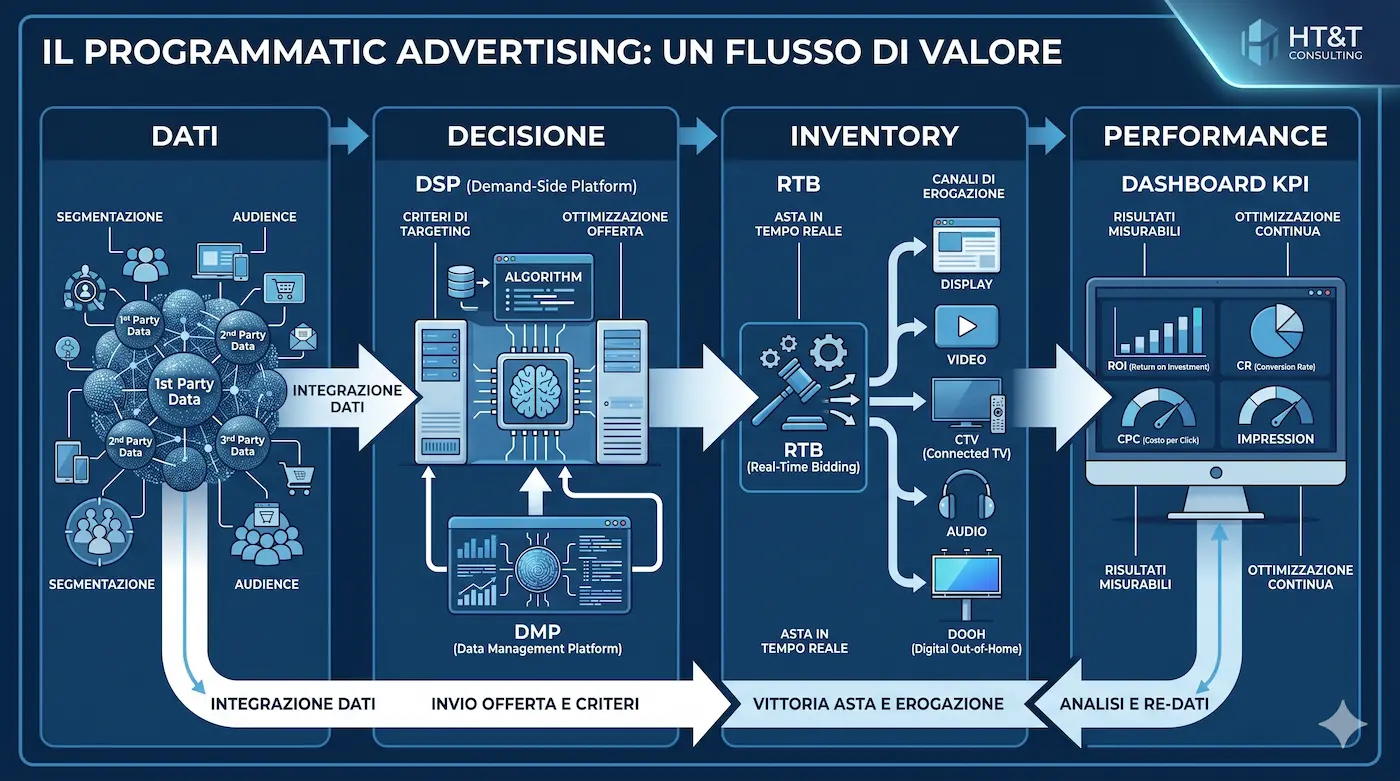
Programmatic Advertising in one definition
Programmatic Advertising is an automated advertising buying system that uses data and algorithms to purchase individual impressions in real time, choosing which user to reach, in which context and with which message, based on the probability of generating a business result.
You do not buy spaces, but signal-based decisions.
What is Programmatic Advertising?
Programmatic Advertising is the automated purchase of digital advertising spaces through technology platforms that operate in real time.
The real difference compared to traditional media buying is not automation itself, but a complete change in perspective.
You no longer buy a space on a website; you buy a qualified audience at the most relevant moment.
Each impression can be evaluated based on concrete signals: behaviour, context, geolocation, device, browsing history and probability of conversion.
This makes advertising more efficient and, above all, more measurable.
The numbers that explain the growth of Programmatic
Programmatic Advertising is no longer a technical niche within media buying, but one of the main infrastructures of digital advertising. International data shows solid growth in automated investments, especially across video, Connected TV and premium digital inventory.
Annual growth of programmatic advertising in the United States in 2025.
Source: IAB / PwC Internet Advertising Revenue Report 2025
Value of programmatic advertising in the United States in 2025.
Source: IAB / PwC Internet Advertising Revenue Report 2025
Value of the European digital advertising market in 2024, up 16%.
Source: IAB Europe AdEx Benchmark 2024
In Europe, growth is driven in particular by video advertising: according to IAB Europe, video led the growth of display advertising with +24.5%, also supported by Connected TV formats.
How Programmatic works in a few milliseconds
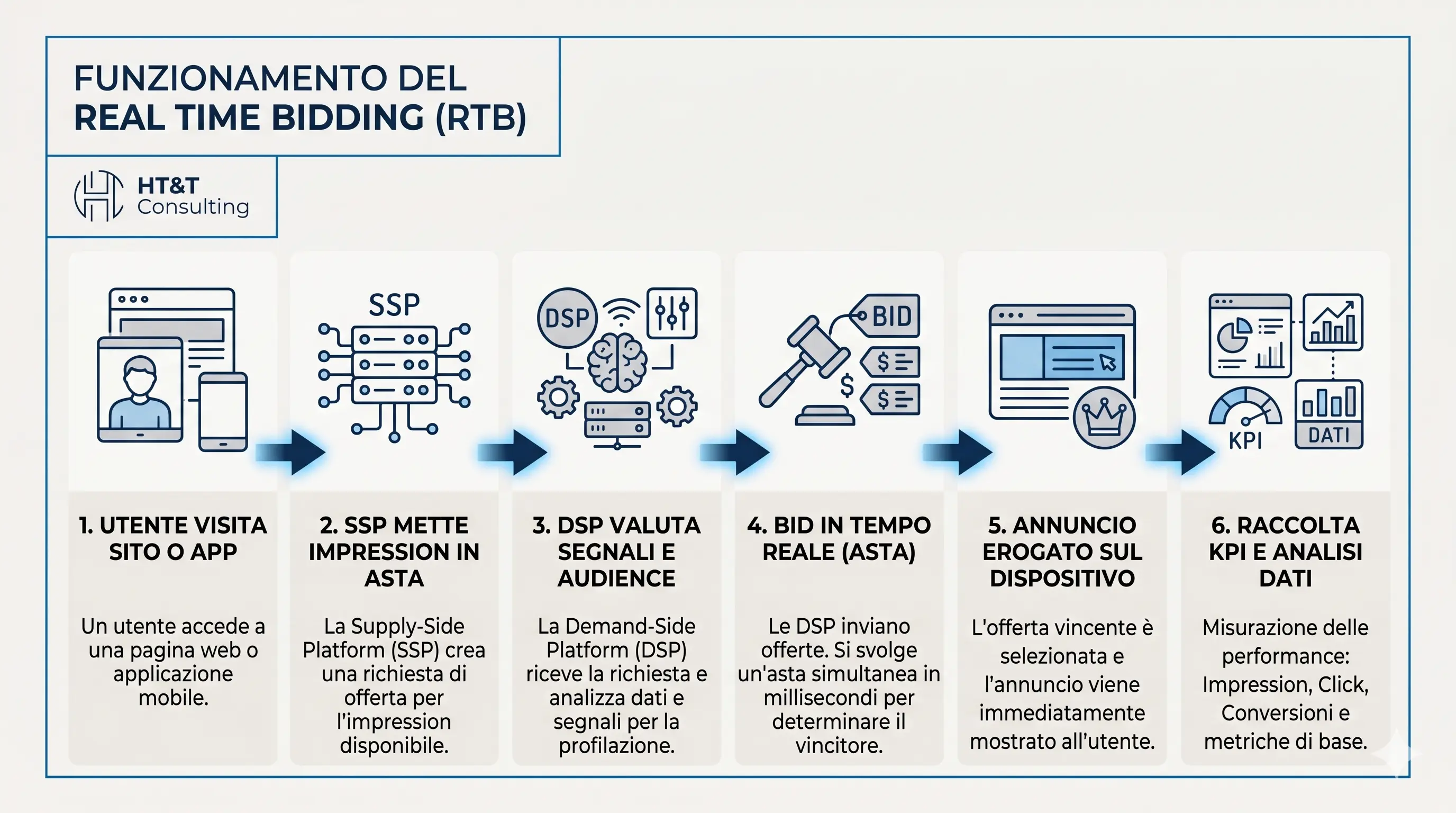
When a user visits a website or opens an app, the advertising space enters a real-time auction.
Demand-side platforms analyse whether that user fits the strategic profile defined for the brand.
If the match is valid, a bid is made; if the bid wins, the ad is served.
- Impression availability on a page, app or digital inventory.
- Auction activation through SSPs and marketplaces.
- Signal evaluation based on user, context, device and objective.
- Real-time bidding through a DSP.
- Creative delivery and collection of performance signals.
The point is to decide which signals matter, with which weights, with which objectives and with which measurement logic.
Why it is a strategic lever today
In competitive markets, generalist advertising is a cost that is difficult to sustain.
Programmatic helps reduce waste and work on precision, efficiency and control. It is no longer just technology, but strategic decision-making.
It is particularly effective when the goal is to manage volumes while preserving quality: qualified audiences, coherent contexts, controlled frequency, and measurement that speaks the language of business KPIs rather than impressions alone.
For this reason, programmatic should be designed within a broader web marketing strategy, where channels, audiences, creativity and measurement work in an integrated way.
“Modern Programmatic does not buy impressions.
It buys probabilities of economic impact.”Matteo Doveri, Agency Director at HT&T
When Programmatic Advertising is not the right solution
Programmatic Advertising is not a universal answer and is not always the most effective choice for every business context.
In particular, it risks being inefficient when the budget is too limited to allow learning and optimization, when tracking is unreliable or incomplete, or when objectives are exclusively tactical and very short-term.
Likewise, without a minimum data foundation or a clear strategy around business objectives, programmatic tends to become simple media buying, losing its strategic value.
For this reason, at HT&T we always assess the real opportunity before proposing the activation of programmatic campaigns.
Programmatic Advertising vs Google Ads: what are the differences?
One of the most frequent questions concerns the difference between Programmatic Advertising and Google Ads .
Although both allow brands to buy qualified traffic, the level of control, available inventory, data governance and omnichannel orchestration possibilities are profoundly different.
Google Ads mainly operates within the Google ecosystem.
Programmatic, on the other hand, allows brands to activate premium inventory across display, video, CTV, audio, in-app and DOOH, with greater flexibility in audience building and incremental measurement.
Premium Multi-Channel Inventories: what does it mean?
Premium multi-channel inventories are not a slogan, but the ability to manage different touchpoints through a single orchestration layer.
The value lies not only in coverage, but also in contextual consistency and delivery quality.
Let’s look at them one by one.
Premium display
Premium display refers to selected inventory on authoritative editorial websites and vertical industry platforms, where context is not a detail but a performance variable.
The quality of the editorial environment directly affects attention, brand perception and probability of interaction.
In programmatic, the value is not the volume of impressions, but the quality of the audience reached.
Working with premium publishers means operating within content environments that are consistent with the message, with high real viewability placements and a level of brand safety that cannot be guaranteed by open and uncontrolled inventory.
This approach reduces waste, controls frequency and improves both attention indicators and traffic quality metrics, making display an effective tool even in mid-funnel and advanced branding strategies.
Video & Connected TV (CTV)
Video advertising in streaming environments and Connected TV (CTV) combines the narrative power of video with the precision of digital targeting.
Unlike traditional online video, CTV operates in lean-back consumption contexts, characterized by a significantly higher level of attention.
Video and CTV campaigns allow brands to work effectively on incremental reach and controlled frequency, with advanced measurement that goes beyond the simple impression and focuses on real coverage, useful exposure and impact on brand recall.
When correctly integrated into the media mix, programmatic video on CTV becomes a strategic lever for advanced branding, able to strengthen brand presence and support the following stages of the funnel, integrating consistently with display, audio and performance-oriented digital channels.
Digital Out Of Home (DOOH)
Digital Out Of Home (DOOH) includes digital screens positioned in physical contexts with a high concentration of people, such as railway stations, airports, city centres and shopping malls.
In programmatic mode, DOOH is not purchased as a single placement, but activated through data-driven logic similar to digital advertising.
DOOH campaigns work on specific locations, time slots and external conditions such as weather, traffic flows or moments of the day, integrating geo-based logic that increases message relevance within the physical context where it is delivered.
It is a particularly effective lever when the brand has a territorial footprint, operates in local markets or wants to strengthen brand pressure in strategic areas, helping increase awareness, memorability and consistency between online and offline presence.
Digital audio
Digital audio includes ads served on music streaming platforms, digital radio and podcast environments, in listening contexts that are often continuous and less fragmented than visual formats.
It is a channel that works on constant brand presence, more than immediate impact.
In programmatic strategies, audio is particularly effective for building frequency and message memorability, thanks to a high attention load and screenless consumption, typical of moments such as commuting, work or daily activities.
When correctly integrated into the media mix, digital audio strengthens overall coverage, supports branding activities and helps maintain communication continuity across mobile audiences or users who are harder to reach with other formats.
In-app advertising
In-app advertising allows brands to operate on mobile inside applications, where the user experience is more stable and continuous than mobile web.
This environment enables work on more reliable signals related to usage, interests and real user behaviour.
In programmatic, in-app is particularly effective for always-on strategies, thanks to the possibility of maintaining a constant and controlled presence over time, reducing the fragmentation typical of other mobile contexts.
When correctly integrated into the media mix, in-app advertising helps strengthen coverage and frequency, supporting both branding activities and performance strategies that require continuity and scale.
Programmatic and funnel: where it generates value
Programmatic Advertising does not work only on the final conversion. Its value changes depending on the funnel stage where it is inserted.
Awareness
It helps increase qualified reach, controlled frequency and presence on premium inventory such as video, CTV, audio and DOOH.
Consideration
It allows brands to reach interested audiences, coherent editorial contexts and differentiated messages based on signals and behaviour.
Conversion
It can support leads, sales and qualifying actions, but it only works with reliable tracking and clearly defined business KPIs.
Programmatic Platforms: Adform, Display & Video 360 and The Trade Desk
At HT&T, we are not tied to a single platform: we select the tech stack based on objectives, markets, data governance and client needs.
We work on enterprise platforms, including Adform, Display & Video 360 (DV360) and The Trade Desk (TTD), directly or together with selected partners.
Adform: solid for omnichannel strategies, with a strong European positioning and a good level of operational transparency when inventory is correctly activated.
DV360: a natural choice for brands already integrated into the Google ecosystem, useful when media mix governance requires continuity with Google tools and data.
TTD: often requested by international companies due to inventory breadth and control over optimization and audience strategy.
The HT&T method: from data to performance
Our work always starts with a simple question: which business results actually need to move?
From there, we build an operating framework that combines data, creativity and continuous optimization.
1) Data Strategy and buyer personas
Every effective programmatic project starts with a clear Data Strategy.
We analyse first-party data coming from websites, CRM systems, eCommerce platforms and lead generation systems,
integrating behavioural signals with the competitive and market context in which the brand operates.
This work allows us to define operational buyer personas, investment priorities and coherent decision criteria,
reducing waste and rationally guiding both bidding logic and creative choices.
The HT&T Programmatic Framework
We have formalised our approach into a four-layer operational model:
- Signal Selection – identifying the most relevant decision-making signals
- Decision Architecture – weighting bidding criteria
- Creative Relevance – message, context and intent alignment
- Incremental Impact Measurement – measuring real business contribution
This model transforms programmatic from simple media buying into a margin-oriented decision system.
Data, consent and governance
An effective programmatic strategy today necessarily requires proper data and consent management.
We prioritise the use of first-party data, reliable tracking and measurement architectures aligned with privacy regulations, avoiding opaque solutions or approaches that depend exclusively on third-party data.
Data governance is not an operational constraint, but an essential condition to guarantee decision quality, performance continuity and long-term strategic sustainability.
In many projects, this also means redesigning the tracking architecture, integrating solutions such as server-side tracking to improve data quality, measurement continuity and control over collected signals.
2) Measurement and business KPIs
An effective programmatic project relies on solid and shared measurement.
We work with events, funnels, attribution models and traffic quality, defining KPIs that speak the language of margin, lifetime value (LTV) and real business objectives, not simple exposure metrics.
For this reason, we connect media strategy to a strong Web Analytics infrastructure. HT&T is one of the very few Italian agencies certified in Google Marketing Platform, a qualification that validates advanced expertise in measurement, tracking quality and data governance supporting marketing decisions.
Discover HT&T Web Analytics.
Incrementality and real measurement
In modern programmatic, it is not enough to know how many conversions happened; it is essential to understand which part of those conversions would have happened anyway.
Incrementality testing makes it possible to measure the real contribution of a campaign through control groups, geo-tests or advanced statistical models.
Optimising only on attribution can generate overestimation.
Optimising on real increment means working on real economic impact.
3) Dynamic creatives (DCO) and relevant messaging
Technology alone does not generate results.
In programmatic, the message only works if it is contextually relevant and aligned with the user’s real intent at the moment of exposure.
For this reason, we work on creative variants and Dynamic Creative Optimization (DCO) logic only when there is a measurable advantage in terms of attention, interaction or traffic quality.
Personalisation is not the goal, but a tool serving performance.
4) Continuous optimisation and transparency
In programmatic, there is no such thing as set and forget.
Every campaign is continuously monitored and optimised based on real performance signals, not vanity metrics.
Transparency is part of the method: we make reporting readable and actionable, clearly showing where the budget is allocated, which decision logics are being used, and which actions are truly impacting business KPIs.
Programmatic, AEO and GEO: being found, chosen and cited
Digital visibility is no longer played only on traditional search engines.
More and more often, information is mediated by answer engines and AI-based systems, which summarise, select and recommend content.
In this context, being present is not enough: brands must be understandable, trustworthy and relevant.
For this reason, we integrate Programmatic Advertising into a broader strategy that includes Answer Engine Optimization (AEO) and Generative Engine Optimization (GEO).
We work on structured content, natural language and informational assets designed to be correctly interpreted by AI systems and recognised as authoritative sources.
This approach allows a brand not only to be found, but to be chosen as the answer and cited as a reference within summaries generated by voice assistants, conversational engines and advanced search platforms.
It is a level of visibility that goes beyond the SERP and strengthens authority over time.
If you want to learn how to design truly AI-ready content and align SEO, AEO and GEO within a coherent strategy, you can explore our dedicated page.
Want to understand whether Programmatic is the right lever for your business?
Programmatic Advertising works when it is part of a clear strategy, with measurable objectives, coherent inventory and a reliable data foundation. It is not a standard solution, but a strategic tool that must be designed according to market context, business priorities and growth opportunities.
If you are considering launching or redesigning a programmatic strategy, we can start with a structured audit: available data analysis, tracking quality assessment, funnel evaluation and definition of sustainable growth hypotheses.
Continua a leggere
20 minutes of reading
22 minutes of reading

29 minutes of reading

And it consumes less energy.
To return to the page you were visiting, simply click or scroll.