Business Email in the Cloud: Why Workspace & 365 Are Strategic

Business email as an infrastructure for work, security and decision-making
Email is not dead: it is the core of digital productivity, and today it must integrate with artificial intelligence to remain strategic.
The evolution of email in the digital world
In today’s digital ecosystem, email still represents, despite the rise of countless communication and collaboration tools, the backbone of every professional interaction. It is the primary channel for internal and external communication, the vehicle for sending critical documents, the foundation for organizing calendars and appointments and, increasingly, the access point to a cloud-based business email system integrated with other work tools.
Yet not all mailboxes are the same, and the distinction between a modern service and an outdated one has become a fundamental dividing line for a company’s productivity, security and competitiveness. In a world increasingly shaped by Artificial Intelligence, having a solution that integrates it is no longer an advantage: it is a necessity.
This is no longer simply a matter of features, but a true strategic necessity: embracing platforms such as Google Workspace or Microsoft 365 is not a luxury, but an imperative driven by technological evolution and the changing needs of the modern workplace.
Why all companies need to adopt Google Workspace or Microsoft 365
To fully understand the scope of this statement, it is necessary to take a step back and analyze the context we come from. For decades, corporate email was mainly managed through on-premise servers or generic provider services. While these approaches worked in the past, today they are limited and inadequate.
The main limitation of legacy email systems lies in their isolated nature. They were designed for a static world, where collaboration happened via attachments and communication was one-way. Today, instead, companies need solutions that enable real-time collaboration, security and agility.
Security in legacy systems
Legacy email services are inherently more vulnerable to cyberattacks. Outdated on-premise servers are easy targets for malware, ransomware and phishing. Spam and antivirus filters are basic, exposing companies to data breaches and operational disruptions.
Relying on unprotected systems is equivalent to leaving the front door wide open. The consequences can be catastrophic for reputation and customer trust. Even cloud solutions provided by hosting companies, while more secure, do not offer the depth of protection delivered by platforms such as Google or Microsoft.
In many cases, the real risk is not the cyberattack itself, but the interruption of business operations, because email is often the first service to go down and the last to be restored in infrastructures that are not designed for high availability.
Scalability in legacy systems
Modern companies need infrastructures that can adapt quickly. On-premise email servers require hardware, maintenance and constant IT resources. Cloud services, by contrast, offer dynamic scalability: users and storage can be added or removed with just a few clicks, eliminating waste and rigidity.
Beyond visible costs, traditional email systems generate a higher TCO due to hidden expenses such as extraordinary maintenance, backup management, security updates, downtime and dependence on internal IT resources that are difficult to scale.
Email on the move
With hybrid and remote work, access from anywhere is essential. Legacy systems offer unintuitive interfaces and unreliable synchronization. Cloud platforms, on the other hand, are designed for mobility, with native apps and seamless synchronization across devices, ensuring operational continuity wherever people work.
Innovation in email
Traditional email services have stood still over time. Cloud platforms, on the other hand, evolve continuously thanks to multi-billion investments in research, security and artificial intelligence. Features such as semantic search, automatic organization and contextual suggestions stem from this ongoing innovation.
Google Workspace: a complete ecosystem for productivity
Google Workspace Business is much more than an email service. It is a central hub for productivity where Gmail, Calendar, Meet, Drive, Docs, Sheets and Slides work in synergy, enhanced by generative artificial intelligence.
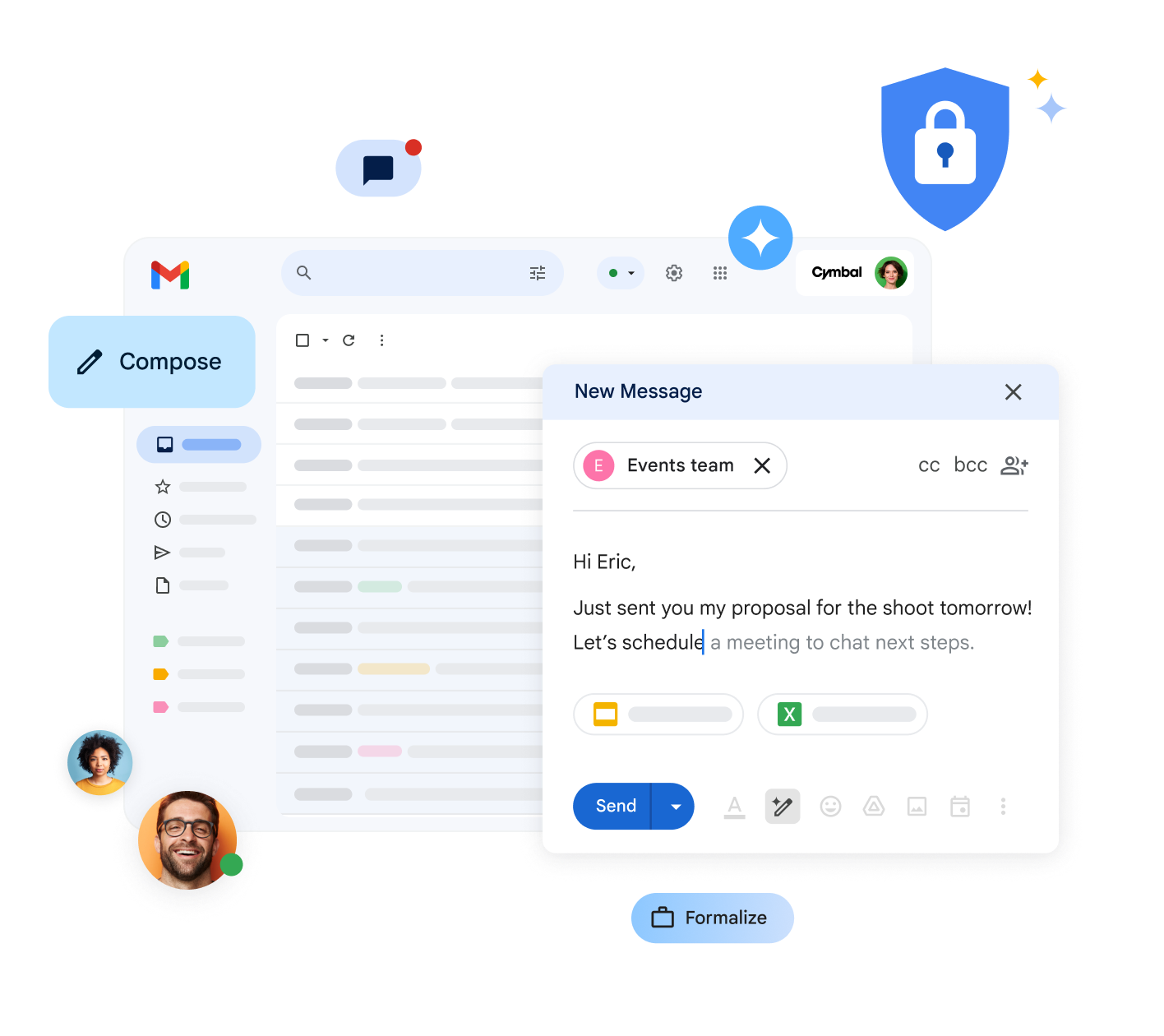
AI supports draft creation, summarizes conversations and suggests priorities. Calendar simplifies scheduling, Meet transforms meetings with automatic transcriptions and translations. Drive, Docs and Sheets enable real-time collaborative work, eliminating duplication and versioning issues.
This integration enables smooth workflows: teams work together on shared documents, discuss changes via chat or video, and centralize files in Drive. The result is less stress, higher productivity and access from anywhere.
The same principles, with differences in approach, also apply to Microsoft 365 Copilot, which integrates AI and similar tools to support business productivity.
GDPR and European regulatory compliance
Cloud platforms from Google and Microsoft comply with GDPR requirements and provide features for auditing, encryption and access control. This allows companies to protect data and demonstrate regulatory compliance.
Beyond security, there is also an economic benefit: reduced maintenance costs and lower demand for internal IT staff, thanks to automation and the reliability of cloud infrastructures.
In this context, email management is no longer just a technical responsibility, but a governance decision that directly involves management, which is required to ensure control, traceability and the proper use of corporate information over time.
The integration of Gemini in Google Workspace
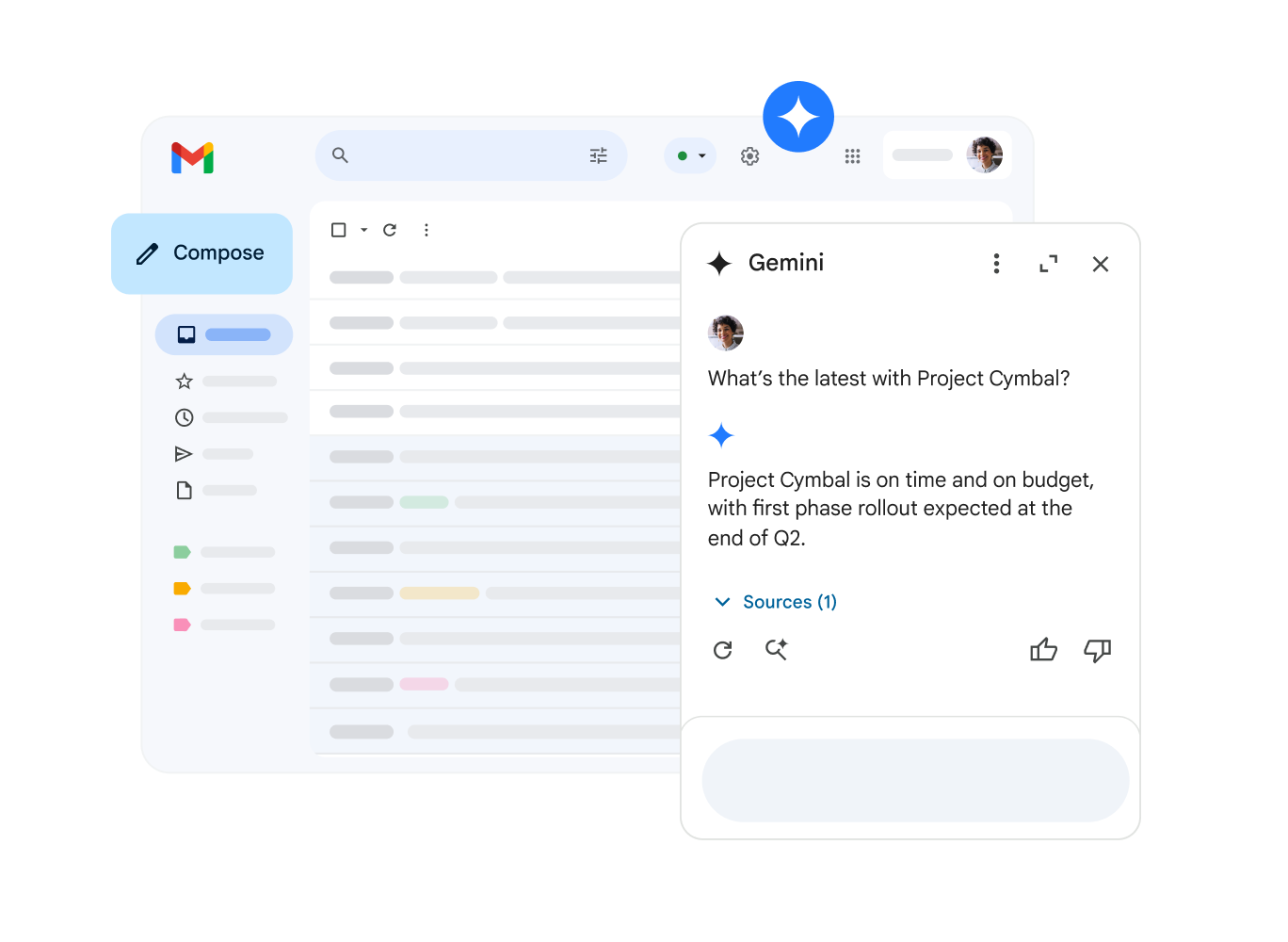
Google’s generative artificial intelligence, Gemini, takes productivity to a new level. Natively integrated into Gmail, Docs, Sheets, Meet and Drive, it acts as an intelligent copilot that automates tasks, synthesizes information and enhances collaboration.
In Gmail, it suggests replies and summaries; in Calendar, it proposes optimal time slots; in Docs and Sheets, it helps write, analyze and visualize data in real time. In Meet, it produces meeting minutes and automatically assigns tasks. Gemini becomes the bridge between AI and human creativity.
This integration allows teams to focus on what truly matters: strategy, innovation and value. Repetitive activities are automated, freeing up time for growth and collective intelligence.
Why email is even more central today than in the past
In recent years, email has taken on an even more critical role than in the past, not because alternative tools have diminished, but because it has become the point of integration between people, processes and increasingly complex digital systems.
In today’s context, marked by hybrid work, distributed supply chains, growing regulatory pressure and the widespread adoption of artificial intelligence, email represents the minimum layer of reliability upon which all other operational activities are built.
From 2024 onwards, email has also become a central issue from a security and digital reputation perspective. Mechanisms such as SPF, DKIM and DMARC are no longer optional, but prerequisites for ensuring operational continuity, brand protection and real deliverability of corporate communications.
Cloud platforms such as Google Workspace and Microsoft 365 respond to this scenario because they do not simply provide an email inbox, but offer an infrastructure capable of adapting over time, absorbing organizational changes, new ways of working and integrations with automation and artificial intelligence systems.
In this sense, email is no longer just a communication tool, but becomes a true decision-making layer, where information, context and priorities are organized, synthesized and made usable more efficiently than with traditional models.
Why email is a decision that concerns CEOs and CTOs
The choice of an email platform is no longer a purely technical decision, nor an operational detail to be delegated exclusively to IT. Today it directly affects a company’s ability to work efficiently, securely and at scale.
For a CEO, email represents a factor of operational continuity, reputation and decision-making speed. Outages, security issues or poorly integrated systems have a direct impact on customers, partners and business results.
For a CTO, email is a structural component of the digital architecture. It affects security, compliance, integration with other systems, data governance and the ability to introduce automation and artificial intelligence in a controlled way.
Platforms such as Google Workspace and Microsoft 365 make it possible to standardize the work environment, reduce infrastructure complexity and shift the focus from day-to-day operations to the design of higher-value solutions.
In this sense, email becomes a strategic choice shared between business and technology, no longer a simple support service.
When email alone is not enough
As advanced and integrated as it may be, email cannot be the only tool on which to base the organization of business work. Even the best platforms show their limits when they are used as a universal container for information, decisions and operational activities.
The first sign of criticality emerges when email becomes the place where everything accumulates: files, approvals, operational requests, strategic decisions and project history. In these cases, inboxes quickly turn into disorganized archives, difficult to manage and heavily dependent on individuals.
Email is also not the ideal tool for managing structured processes, complex workflows, clear responsibilities and progress tracking. Forcing it into this role generates inefficiencies, reduces transparency and increases the risk of errors or misunderstandings.
This is why Google Workspace and Microsoft 365 deliver their maximum value only when they are embedded within a broader digital ecosystem that includes project management tools, CRM systems, structured document management and analytics and reporting platforms.
In this model, email returns to its proper role: a point of integration and coordination, not the only operational tool. It is precisely this distinction that allows companies to grow without losing control, clarity and decision-making speed.
When it makes sense to talk to a consultant
It makes sense to involve a consultant when email begins to show organizational limits, when security becomes a concrete concern or when the company grows and existing systems are no longer able to support new processes and ways of working.
It is particularly useful to engage with an external partner when migrating to the cloud without interrupting operations, when estimating the real cost of email in terms of TCO, or when integrating artificial intelligence and automation in a governed manner.
In these cases, the goal is not to choose a platform, but to design a work ecosystem that is coherent with the company’s needs, avoiding partial solutions or decisions driven solely by urgency.
Conclusion: a strategic investment
Choosing an email platform is no longer a matter of preference, but of competitive strategy. Adopting Google Workspace or Microsoft 365 means investing in productivity, security and innovation.
HT&T Consulting has chosen Google Workspace since its launch: it is an authorized reseller with certified staff able to provide advanced support and consulting.
Contact us to find out how to integrate Google Workspace into your company.
Frequently asked questions
What is the difference between legacy email and cloud services (Google Workspace/Microsoft 365)?
How does the cloud improve email security and deliverability?
Is the cloud GDPR compliant?
How much does moving email to the cloud cost compared to on-premise?
How is migration from existing mailboxes managed?
What happens if the office internet connection goes down?
Is there a vendor lock-in risk?
Why integrate AI (Gemini/Copilot) into email?
Google Workspace or Microsoft 365: how should you choose?
Why should the choice of email involve CEOs and CTOs directly?
What mistakes should be avoided in a migration project?
References
Google Workspace: https://workspace.google.com
Microsoft 365 Business: https://www.microsoft.com/microsoft-365/business
Continua a leggere
9 minutes of reading

12 minutes of reading
6 minutes of reading

And it consumes less energy.
To return to the page you were visiting, simply click or scroll.