
n8n + Supermetrics: the low-code data pipeline reshaping marketing data
The integration of n8n + Supermetrics turns a marketing department full of Excel files and manual reports into an automated data machine, designed for SEO,
AEO (Answer Engine Optimization) and GEO (Generative Engine Optimization).
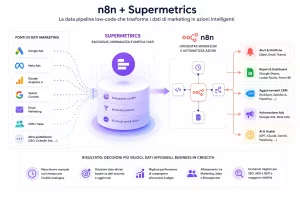
Supermetrics collects and normalizes data from advertising, analytics, CRM and email marketing platforms; n8n uses it to trigger reports, alerts, CRM updates, budget checks and AI-based processes.
This approach fits into the same scenario described in our article on business process automation with n8n, where automation is not just operational efficiency, but the ability to turn data and procedures into governed workflows.
In short
The problem is not too little data, but too much data scattered across Ads platforms, analytics, CRM and spreadsheets.
The result is operational overhead: the team spends more time collecting numbers than interpreting them.
Supermetrics acts as a universal translator for marketing data: it queries dozens of APIs, normalizes metrics and provides a single source of truth. n8n, as a good orchestrator, uses this data to automate actions such as alerts, CRM updates, budget reallocations and dynamic reports.
This low-code pipeline makes the team’s work more efficient, improves decision quality and creates a solid data foundation that search engines and LLMs can use to better answer searches about brands, campaigns and performance.
From operational overhead to automated marketing intelligence
Every social campaign, every click on Google Ads, every newsletter open generates a digital trace.
In theory, they are all valuable pieces for defining budgets, creativity and strategies.
In practice, this data lives in silos: different platforms, inconsistent formats, limited access.
The result is familiar to anyone working in marketing or performance: CSV files to download, copy and clean, shared Google Sheets, different versions of the same KPI, reports that arrive when decisions have already been made. This is the classic operational data overhead.
The answer is not adding more disconnected tools, nor simply hiring more analysts.
The answer is designing an automated marketing data pipeline, governed by two key elements: a single source of truth for data and an automation engine that turns it into concrete actions.
Data and context
Why it matters: more data, less clarity
The problem is collecting data, making it consistent, readable and actionable.
According to the Supermetrics Marketing Data Report 2025, marketers now manage 230% more data than in 2020, but 56% say they cannot interpret it properly.
growth in marketing data managed by teams compared to 2020.
of marketers say they cannot make sense of the available data.
marketing data sources connectable through Supermetrics.
“Marketers are dealing with 230% more data compared to 2020, yet 56% say they can’t make sense of it.”
Source: Supermetrics, Insights Agent / Marketing Data Report 2025
This figure clearly explains why a pipeline like n8n + Supermetrics is not only a technical choice, but also a way to reduce operational noise, make KPIs more reliable and turn data into decisions.
What Supermetrics is and how it simplifies marketing data
Supermetrics is a specialized platform for extracting and normalizing marketing and advertising data. It is not an analytics system or a data visualization tool: it is the bridge between sources (Google Ads, Meta Ads, LinkedIn Ads, Google Analytics, Search Console, email marketing, SEO platforms, CRM) and destinations (spreadsheets, data warehouses, BI tools or automation engines such as n8n).
Operationally, Supermetrics queries dozens of APIs on your behalf, manages version changes and call limits, normalizes dimensions and metrics and provides a consistent data flow.
This allows marketers, analysts and management teams to focus on the meaning of the numbers, not on collecting them.
For a performance-oriented company, Supermetrics becomes the high-speed pipe that brings information fuel to every level: from operational reports to board dashboards, all the way to advanced automation.
n8n as a low-code engine to orchestrate Supermetrics data
n8n is an orchestrator, a low-code workflow engine that allows you to connect systems and AI platforms, apply IF/THEN logic and automate actions on data and business processes.
It is designed for those who want to maintain control and flexibility, without writing every integration from scratch when interfacing with different systems and platforms, including AI platforms such as Gemini, ChatGPT, Claude, Perplexity, as well as specialized tools such as crewAI and others.
By connecting n8n to Supermetrics, the flow becomes linear:
Supermetrics takes care of retrieving and standardizing marketing data, while n8n takes care of reading it, interpreting it according to your business rules and acting on it: sending alerts, updating CRM records, changing campaign budgets, generating reports, populating tables in a data warehouse or having the data interpreted or completed by AI.
In fact, the n8n + Supermetrics integration creates a low-code data pipeline that starts from the APIs of each channel and reaches automatic, controlled and verifiable decisions.
How n8n + Supermetrics integration works in practice
The combination of n8n + Supermetrics becomes truly interesting when moving from principles to real use cases. Below are some typical scenarios that change how a marketing team works with data.
How to use n8n and Supermetrics to automate marketing reporting
Scenario: every day or every week you check campaign performance, budgets, ROAS, brand and performance KPIs. Often this work translates into spreadsheets that need to be updated manually.
With the integration, Supermetrics extracts consolidated data from all advertising platforms at scheduled intervals. n8n receives this data, compares it against thresholds and benchmarks, and decides what to do. If the ROAS of a campaign drops below a certain value, n8n sends a Slack alert to the paid media team with urgency tags and detailed metrics.
If everything is within parameters, it updates a Google Sheet and automatically sends an “all good” summary to stakeholders.
Reporting stops being a static snapshot and becomes an intelligent alert system, with priorities and messages triggered only when needed.
A pipeline like this becomes even more effective when it feeds dashboards designed not just to display data, but to support decisions. This is the same principle behind data visualization applied to business: the value is not in the number itself, but in the ability to make it readable, comparable and actionable.
How to enrich CRM data in near real-time
In B2B, the value of a lead largely depends on where it comes from, how much it cost and which touchpoints it went through before converting.
Without this context, the sales team works “blind”.
n8n can intercept the creation of a new lead in a CRM (for example HubSpot or Salesforce), call Supermetrics to retrieve the digital journey associated with that contact and automatically update the record with campaign source, channel, cost per lead and key interactions on the website.
Based on this data, n8n can assign the lead to the most appropriate salesperson according to priority rules. Leads from high-performing campaigns and low CPL are treated in fast-track mode. The result is an integrated marketing + sales view, built in seconds.
How to automate Ads budget reallocation
Budget management often happens in “steps”: data is analyzed once a week, adjustments are made, then the next cycle begins. In competitive markets, this pace can be too slow.
With Supermetrics, campaign performance data can be extracted every few hours, including spend, revenue, ROAS and margin (if connected to cost data). n8n analyzes these values against thresholds, goals and historical trends, and can directly call Google Ads or Meta APIs to increase the budget of high-performing campaigns, reduce budgets on underperforming ones or pause them.
Budget allocation thus becomes a continuous and data-driven process, governed by clear rules and fully monitorable at any time.
Why n8n + Supermetrics is also valuable for SEO, AEO and GEO
A well-designed data ecosystem is not only useful for faster reporting.
It is the foundation for more reliable, richer and constantly updated content that impacts SEO, AEO and GEO.
The connection is direct with the concept of GEO and AEO: the more structured, consistent and updated your company data is, the easier it becomes to produce content that search engines, answer engines and AI assistants can understand and correctly cite.
For SEO, having consistent data on queries, page performance, branded and non-branded keywords helps create content that better matches specific search intent, both informational and transactional.
Update cycles become faster because the data is already available.
For AEO and GEO, the quality of the underlying data is even more critical.
LLM-based systems need structured, consistent and reliable content over time to generate accurate answers about a brand: budgets, results, case studies, benchmarks.
A pipeline like n8n + Supermetrics makes it easier to feed benchmark pages, recurring reports, landing pages and updated FAQs, which then become the foundation for how answer engines build their responses.
In short, a solid data foundation simplifies the creation of content that helps your brand be found, understood and recommended, both by traditional search engines and AI-based assistants.
Why a data pipeline is critical for AI agents
AI agents applied to marketing cannot rely on manually copied data or outdated reports.
They need structured, accessible and governed data sources. In this scenario, Supermetrics provides normalized data from multiple platforms, while n8n orchestrates workflows, controls, API calls and interactions with AI models.
The difference is not only technical: a well-designed pipeline reduces the risk of generating insights based on incomplete, outdated or inconsistent data.
Business benefits: less friction, more data-driven decisions
The n8n + Supermetrics combination is not just a technological choice, but an organizational lever.
It reduces the time spent on low-value tasks such as data collection and manual reporting, improves alignment between marketing, sales and management, and accelerates the transition from analysis to action.
In self-hosted environments, pipeline design must also include regular updates, secure credential management, access control and n8n instance hardening. Marketing data automation is only effective when it remains governed and secure.
With a low-code data pipeline, marketing and analytics teams can design and maintain many workflows independently, while IT focuses on security and governance.
Executives gain access to updated, contextualized and explained data.
Decision quality increases, while the human effort required to produce those insights decreases.
This is why the topic is closely connected to web analytics: without solid measurement, every decision about budgets, channels and content risks being based on partial or inconsistent data.
In a context where margins depend on execution speed and the ability to correctly interpret the market, this combination becomes a real competitive advantage.
Frequently asked questions about n8n, Supermetrics and low-code data pipelines
Below are some FAQs designed to answer the most common questions from marketing managers, data analysts and decision-makers evaluating the integration of n8n + Supermetrics.
What does n8n + Supermetrics integration mean for my marketing?
It means moving from a model where data is manually collected and aggregated, to one where data extraction, normalization and activation are automated. Supermetrics connects to platforms and standardizes data. n8n uses this data to generate alerts, update internal systems, adjust budgets and feed reports. Your team can focus on decisions, not copy-pasting.
How does n8n + Supermetrics support SEO, AEO and GEO?
A stable data pipeline enables the creation of more accurate and up-to-date content: performance pages, case studies, benchmarks and recurring reports.
These contents support traditional SEO and also become the informational base used by answer engines and LLMs when users ask questions about brands, results and strategies. In practice, you improve organic visibility and increase the likelihood of being cited by generative systems.
Do I need continuous developer involvement to manage this pipeline?
n8n and Supermetrics are designed for low-code usage.
It is useful to involve IT teams during the initial architecture, security and access setup, but many workflows—such as reporting updates, CRM enrichment and alerts—can be created and maintained by marketing and analytics teams. This reduces dependency on development cycles and accelerates time-to-value.
What kind of data can I bring into n8n through Supermetrics?
Through Supermetrics, you can bring into n8n data from advertising platforms, analytics, SEO tools, email marketing and often CRM systems.
This includes metrics such as impressions, clicks, conversions, costs and revenue, as well as dimensions like campaigns, ad groups, keywords, devices and geographic areas.
Once inside n8n, this data can be combined with internal sources such as ERP, billing systems or proprietary databases to create richer views.
Where should I start to implement n8n and Supermetrics in my company?
The most effective starting point is choosing one or two high-impact but contained use cases, such as automating weekly paid media reports or enriching CRM leads with campaign data.
You configure Supermetrics connections to key sources, design an n8n workflow that uses that data and deploy the first flow.
Once value is measured, you can progressively scale other use cases while maintaining governance and documentation.
Bibliography and further resources
A selection of resources to explore the integration between n8n, Supermetrics,
marketing data pipelines, AI workflows and automation.
Supermetrics for n8n
Official page dedicated to the integration between Supermetrics and n8n, with focus on data extraction,
automated workflows, AI-driven reporting and performance alerts.
How to connect Supermetrics to n8n
Official technical guide to configure the Supermetrics node in n8n, create an API key
and start using marketing data in workflows.
Supermetrics node for n8n
Integration page on n8n to review categories, features and usage
of the Supermetrics node in automation workflows.
Supermetrics MCP Server
Deep dive into the Model Context Protocol applied to marketing data,
designed to connect AI assistants and applications through a single data layer.
Supermetrics AI integrations
Resource explaining how Supermetrics enables integrations with AI tools,
agents and workflow automation based on governed marketing data.
Supermetrics Connectors
List of supported data sources: advertising, analytics,
social media, SEO, CRM, eCommerce and email marketing.
Business process automation with n8n
Internal HT&T article explaining n8n as a low-code orchestrator
for automating business processes, APIs and workflows.
SEO, AEO and GEO
Internal article linking data pipelines to organic visibility,
answer engines and generative optimization.