
The digital seismograph of reputation: how to master GEO-AEO and turn online conversations into competitive advantage
SEO, GEO (Generative Engine Optimization) and AEO are no longer three separate acronyms. For a business decision-maker they mean one thing: being found, understood and recommended by search engines, answer engines and LLMs in the markets that matter for the business.
In short
- Answer engines and Large Language Models (LLMs) are becoming the real filter between your brand and your customers: traditional SEO is no longer enough, you need a GEO-AEO strategy that combines SEO, GEO (Generative Engine Optimization) and conversational reputation in AI-generated answers.
- HT&T Consulting has developed a proprietary Advanced Brand Reputation Monitoring (BRMA) system that orchestrates n8n, multiple AI models and web sources to measure how your brand is described and recommended in generative experiences and, when needed, in specific geographic areas.
- For B2B Marketing Directors and multi-regional e-commerce businesses, this means turning complex data into operational actions: new content, course corrections, optimisation on key markets and more qualified leads from queries handled by generative engines and answer engines.
Introduction: from simple ranking to conversational reputation
In the new semantic web, indexing is no longer played only on traditional SERPs. When a potential customer asks an LLM:
“Which consulting agency is the most reliable in Milan?”
or
“Is HT&T Consulting a good choice for e-commerce in Tuscany?”,
the AI does not return a list of links, but a reasoned answer.
In this context, your reputation is no longer just what you state on your website or in your campaigns, but what artificial intelligence says about you based on the digital traces it can access. Ignoring online conversations about your brand, services and competitors is no longer an operational detail: it is a strategic risk that weakens your GEO-AEO (Generative & Answer Engine Optimization) positioning, that is, your ability to be correctly chosen and cited in answers generated by search engines, answer engines and LLMs.
At HT&T Consulting we have built a proprietary Advanced Brand Reputation Monitoring (BRMA) system that does not merely detect mentions, but analyses them “through the eyes” of multiple AIs and translates them into concrete strategic directions. It is our digital seismograph: it measures in near real time how your brand vibrates inside LLM and answer engine outputs across different search contexts, from generic queries to more vertical and local ones.
What GEO (Generative Engine Optimization) is and why it matters for those who decide digital investments
When we say SEO, GEO, LEO and AEO, we are not talking about four separate acronyms, but about four layers of the same problem: how to show up in front of the right people exactly when they ask something to a search engine or to a generative model.
SEO (Search Engine Optimization): making your content discoverable in traditional search engine SERPs.
GEO (Generative Engine Optimization): increasing the chances that your brand is used as a “building block” in answers generated by systems such as AI Overviews, AI Mode, ChatGPT, Gemini, Claude, Perplexity and other generative engines.
LEO (Local Engine Optimization): improving visibility in Google Maps and local searches.
AEO (Answer Engine Optimization): structuring content and signals so that answer engines can extract clear, consistent and up-to-date answers to users’ questions.
For a B2B organisation or a multi-market e-commerce business this means moving from a generic idea of “online visibility” to a very concrete question: when someone asks a generative model “Who are the best partners for furniture in Germany?”, is your brand present, accurately described and recognised as a strong option?
Queries can be vertical (“software for data security in manufacturing SMEs”) or local (“building materials suppliers in Bavaria”), but the point is no longer just page ranking: it is how generative engines assemble the answer and which sources they decide to use.
Our work, from a GEO-AEO perspective, is to ensure that in generative experiences, from AI Overviews and AI Mode through to chat, your brand has all the requirements to be cited and recommended, even when the question has a strong local component.
From SEO ranking to presence inside LLM answers
The main players in the industry – Google, OpenAI, Anthropic, Claude, Grok and others – rely on large datasets to generate their answers. If your company does not leave a digital footprint that is consistent, verifiable and authoritative in the online conversations and sources consulted by LLMs, it is unlikely to be cited as a reference.
There is a second, often underestimated risk: a single negative review or unmanaged criticism, if picked up by several AIs, can turn into a consolidated narrative that is hard to overturn. This has a direct impact on reputation, lead generation and conversion rate in the markets where you want to grow.
Our GEO-AEO approach has a clear goal: proactively shaping the knowledge sources that AI models draw on, to align digital perception as much as possible with your desired strategic positioning.
Our BRMA system: a digital seismograph for GEO-AEO reputation
Advanced Brand Reputation Monitoring (BRMA) is a digital intelligence system designed by HT&T Consulting to monitor and improve brand reputation from a GEO-AEO perspective. Here we explain what it does, not the technical “recipe” behind it.
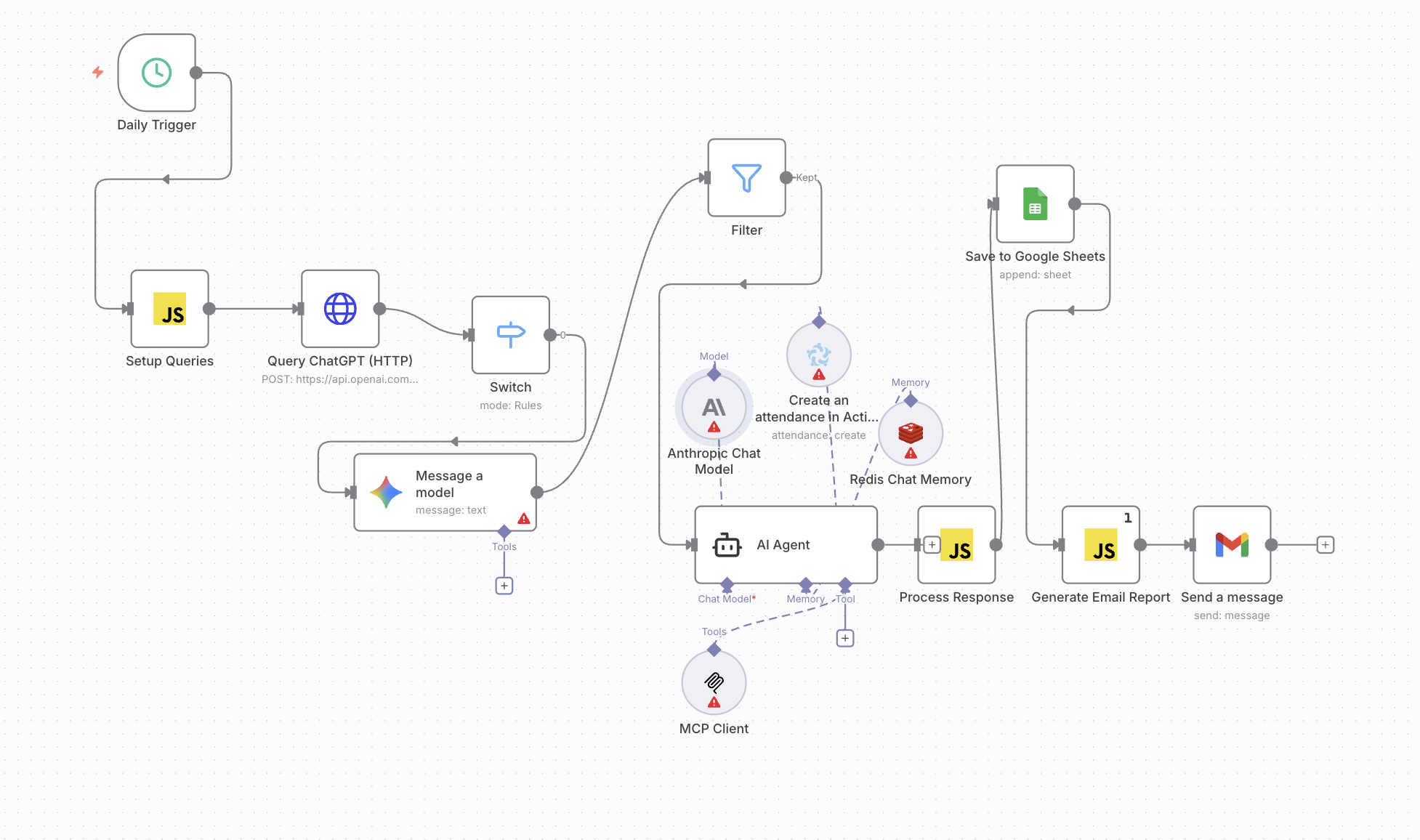
Advanced orchestration with n8n
The heart of the system is n8n, the workflow orchestration platform we use to build flows that are:
automated, because queries are triggered on a schedule;
resilient, because they handle errors, delays and API changes;
scalable, because they can monitor dozens of markets and brands at the same time.
n8n coordinates:
the activation of triggers (daily, weekly, etc.);
the sending of strategic queries (far more advanced than a simple brand name search);
parallel interrogation of different AIs;
analysis of the answer texts, extracting sources and identifying brand mentions;
historical storage of results in tools such as Google Sheets and dedicated databases.
The result is a daily or weekly line check on reputation, without internal operational costs for manual monitoring.
Strategic questions oriented to Geo-AEO
The competitive advantage is not only in the technology, but in the design of the questions. We do not simply ask AIs “What is HT&T Consulting?”, but we craft queries that capture real intents and potential issues, often with a strong geographic flavour:
service perception in specific provinces or regions;
comparison with competitors on pillars such as “Cloud”, “e-commerce”, “data & analytics”;
explicit search for criticism, failures, dissatisfaction related to the brand or management.
This allows us to understand not only whether the brand is present in the answers, but how it is positioned against local or industry competitors in key areas such as Milan, Rome, Florence, Lombardy, Piedmont, Tuscany, North-East Italy and more.
Multi-model LLM interrogation
Brand perception is not identical across all models. That is why we work in a multi-model mode, querying in parallel:
ChatGPT (OpenAI), Gemini (Google), Claude (Anthropic), Grok (X), Perplexity and other relevant conversational platforms.
This approach offers three key benefits:
Risk coverage: we capture the full spectrum of answers a user might receive when using different platforms.
Cross-validation: if several AIs converge on the same sources or the same judgements (positive or negative), the reputational signal becomes a priority.
Mapping differences: we can see where the brand is strong for one model and weak for another, and set targeted interventions for specific ecosystems (e.g. strengthening “Google-friendly” content or fixing informational gaps highlighted on Perplexity).
Strategic report for decision-makers
For a Marketing Director or business owner, the real lever is decision-making, not raw data. Our output, scheduled (we decide together whether it should be daily, weekly or fortnightly), is a concise report, also available by email:
an overview of relevant mentions by geographic area and service line;
insights on competitors that surface in the same answers;
an operational table with questions, AI answers and sources to be managed (to strengthen, correct or leverage).
In this way, GEO-AEO monitoring becomes part of the decision-making routine: not a report to archive, but a basis for content planning, digital PR, operational improvements and localised campaigns.
Who it is indispensable for and which competitive advantage it creates
The BRMA system and the GEO-AEO approach are particularly relevant for two decision-maker profiles: B2B Marketing Directors and owners of e-commerce or multi-regional websites.
B2B Marketing Directors (consulting, IT services, logistics, manufacturing)
If your goal is to be recognised as a thought leader in specific markets (e.g. Rome, Bologna, Florence), GEO-AEO becomes a natural extension of your SEO and content strategy.
The first benefit is proactive brand defence and lead generation: intercepting critical discussions in specialist forums, industry communities or LinkedIn before they become the “official version” in AI answers. This gives you time to step in, clarify and turn a potential issue into a commercial opportunity.
The second benefit is editorial precision: if we see that, for example, Gemini struggles to recognise you as a leader in “supply of building materials in North-East Italy” or as an expert in “occupational safety products in Turin”, you have a clear signal on which new pillar content to create and promote to win that specific GEO-AEO niche.
E-commerce and multi-regional websites
For an e-commerce business, reputation translates into trust, and trust into conversions. If a user asks Claude or Perplexity:
“Which electronics e-commerce sites are the most reliable with fast delivery in Palermo?”,
ideally your brand appears in the answer, supported by solid and up-to-date sources.
The system monitors how services and delivery times are perceived by area. If it emerges that “deliveries in Sardinia” are described as slower by some AIs, that information does not remain abstract: it becomes an input to optimise operations, customer care and local messaging across your digital touchpoints.
The promise: advanced technology, strategic interpretation
The effectiveness of our system does not lie only in tools such as n8n, ChatGPT, Gemini, Claude or Perplexity. The real difference is made by the method: how we design prompts, taxonomies of analysis and operational priorities together with the client.
The strategic prompt engineering we apply is the filter that turns raw data into actionable intelligence broken down by geographic area, business line and positioning goals. It is the part of the know-how you cannot download, but need to build and refine project after project.
In other words, at HT&T we have one of the most sensitive digital instruments we can build today, but its value emerges when it is read and interpreted by a team that understands metrics, markets and international positioning dynamics. Starting from data, HT&T then builds a plan to implement technical and content changes to become relevant on what really matters, moving from a simple SEO plan to a SEO + GEO (Generative Engine Optimization) + AEO plan. After all, HT&T has always been the agency that focuses on digital strategy and consulting.
The next step to master GEO-AEO
In a landscape where answer engines and LLMs are becoming the main gatekeepers between your brand and your customers, GEO-AEO is not a technological whim: it is a growth lever. It is no longer enough to hope to be found; you must work so that your brand is chosen and recommended.
If you are a Marketing Director or a business owner and you want to bring digital reputation management back onto measurable, day-to-day foundations, the next step is simple: stress-test your conversational positioning.
We will then jointly build the optimisation strategy for search engines (SEO) and for LLMs (GEO-AEO) to increase sales and mentions. This approach aims to attract qualified traffic by optimising product and category pages for specific search keywords, and extends to informational content creation and technical optimisation of the site. The goal is to have a site or e-commerce appear among the top search results for queries with purchase intent, or be mentioned as an answer in LLMs when users interact with generative AIs, turning them into customers. Once we know how the engines answer, we can define a technical change plan to improve results.
With HT&T Consulting we can show you, with data and real cases:
not so much how our automation works, but which competitive advantages it creates: more control over the conversations that matter, more consistency across key markets and more concrete business opportunities in the territories where you want to grow.
Frequently asked questions about Geo-AEO, LLMs and BRMA
What is Geo-AEO and how is it different from traditional SEO?
Traditional SEO focuses mainly on the pages that should appear in the SERP, while Geo-AEO focuses on how the brand is narrated and recommended
in AI-generated answers, both in generative experiences and in answers with a local component.
Why are Large Language Models relevant for my online positioning?
If your brand is not present, consistent and well positioned in the sources these models consult, you risk never being cited as a credible alternative, even if your SEO is already well executed.
How does HT&T Consulting’s BRMA system work in practice?
identifies key sources and organises everything into a strategic digest.
The result is not a simple list of citations, but an operational view of where you are strong, where you are weak and which actions to take to improve your GEO-AEO positioning.
Which companies benefit the most from a Geo-AEO project?
and for multi-regional e-commerce businesses that want to increase trust and conversions in specific areas.
In all these cases, the combination of SEO, GEO (Generative Engine Optimization) and AEO makes it possible to align reputation, content and operations with growth goals for each area and market segment.
How long does it take to see results from Geo-AEO and reputation monitoring?
Results on GEO-AEO positioning depend on the starting point: typically, we begin with an assessment, then work on content, sources and messages.
The first measurable changes in AI answers usually appear over a time frame of a few months, in parallel with the evolution of your digital presence.
What kind of data do you collect and how do you use it?
This information is normalised, aggregated and turned into strategic insights for marketing, content, PR and local optimisation decisions.
We do not use the data for individual profiling, but to understand how your brand is represented at market, segment and geographic level.
Bibliography online
-
Generative engine optimization, Wikipedia.
available on:
https://en.wikipedia.org/wiki/Generative_engine_optimization
-
AI features and your website, Google Search Central, official.
Disponibile su:
https://developers.google.com/search/docs/appearance/ai-features
-
Top ways to ensure your content performs well in Google’s AI experiences, Google Search Central Blog, 2025.
Disponibile su:
https://developers.google.com/search/blog/2025/05/succeeding-in-ai-search
-
Answer Engine Optimization (AEO): The Comprehensive Guide for 2025, CXL, 2025.
Disponibile su:
https://cxl.com/blog/answer-engine-optimization-aeo-the-comprehensive-guide-for-2025/
Continua a leggere
12 minutes of reading

4 minutes of reading


And it consumes less energy.
To return to the page you were visiting, simply click or scroll.