
AI Brand Reputation · B2B Buying Groups · Marketing Intelligence
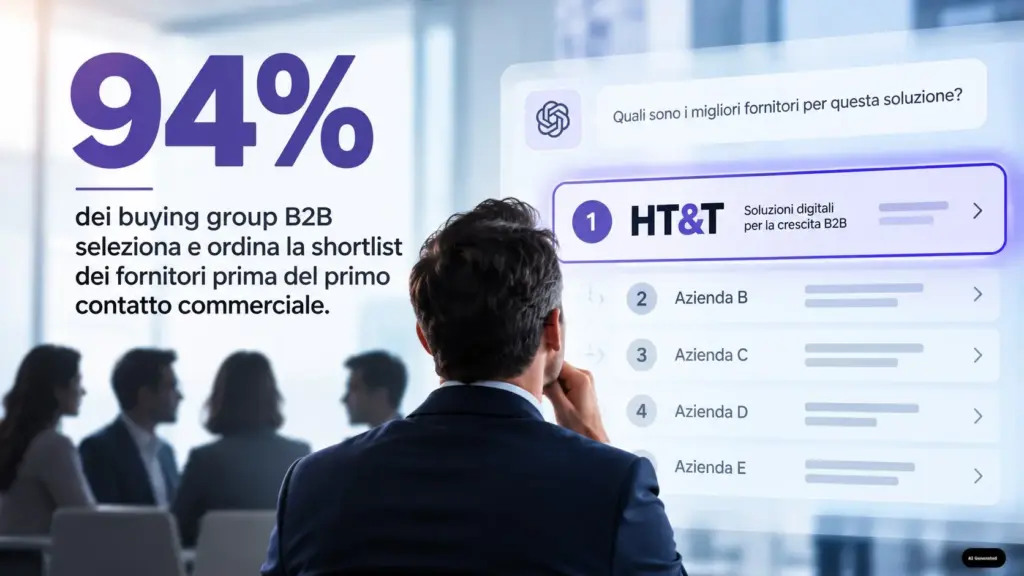
94% of B2B buying groups rank potential suppliers before their first sales contact. In 77% of cases, the initial favorite wins the deal. Meanwhile, artificial intelligence is becoming an integral part of how buyers research and compare alternatives. How can you determine whether your brand is being discovered, accurately represented, and recommended?
Key Takeaways
Visibility in AI-generated responses is an emerging dimension of digital brand reputation. It does not replace SEO, business relationships, or brand authority, but complements them. Measuring it requires representative queries, multiple AI systems, repeated assessments, and competitive benchmarking. This is precisely the challenge addressed by BRMA, HT&T Consulting’s proprietary Advanced Brand Reputation Monitoring system.
The Data Behind B2B Buying Groups
During an exclusive workshop hosted by one of our clients, we brought LinkedIn experts directly into the conversation to explore the evolution of marketing and B2B decision-making processes. This opportunity for discussion reflects how we work alongside businesses: going beyond consulting and operational support to provide access to the expertise, insights, and perspectives of leading players in the digital ecosystem.
During the session, one slide particularly caught the attention of everyone in the room. The figures highlighted a profound shift in how businesses identify, evaluate, and select their suppliers. These findings deserve a closer look, particularly because they come from different research studies and measure distinct aspects of the B2B buying journey.
of B2B buying groups had ranked suppliers on their shortlist by preference before their first sales contact, according to 6sense (2025).
of the time, the supplier initially favored before the first sales interaction was ultimately selected, according to 6sense (2025).
the rate at which B2B buyers are adopting AI-powered search compared with consumers, according to Forrester research cited by Digital Commerce 360 in 2025.
Another 94%, which should not be confused with the first, refers to the use of AI during the purchasing process, as reported in Forrester’s 2025 Buyers’ Journey Survey. 6sense also reports widespread adoption of large language models (LLMs), primarily to summarize reviews and analyze information. This does not mean that AI makes 94% of purchasing decisions, but rather that buyers are increasingly using it to identify, evaluate, and select suppliers.
The most important takeaway is that buyer preferences are formed long before commercial negotiations begin, shaped by prior knowledge, research, comparisons, expert opinions, and, increasingly, AI-powered tools.
B2B Buying Groups Make Decisions Before Contacting You
A buying group brings together the people involved in evaluating and approving a business purchase: technical managers, procurement teams, executives, end users, and other stakeholders. It is not a single decision-maker conducting a single search. Each participant may assess features, risks, costs, and alternatives through different channels.
Imagine a company looking for a partner to integrate a platform with its ERP system. One stakeholder asks an AI assistant which suppliers might be suitable; another checks certifications; a third compares use cases and reliability, relying on word of mouth as well as Google searches. By the time the group meets a sales representative, it may already have developed a preference.
It is important to distinguish correlation from causation: the 6sense research documents the advantage enjoyed by initially preferred suppliers, but does not demonstrate that AI is responsible for creating that preference. AI is, however, an increasingly relevant touchpoint to monitor, as it can contribute to how information is gathered, compared, and summarized.
This connects with our analysis of the Messy Middle in consumer decision-making: purchasing decisions emerge through multiple stages of exploration and evaluation, rather than being determined solely by the final click.
What Happens When a B2B Buyer Asks AI Which Suppliers to Choose?
A question such as “Which Italian companies offer this solution, with support in Tuscany, ERP integration, and proven business references?” may generate a summary featuring company names, capabilities, limitations, and sources. Not all AI platforms respond in the same way: some provide links and citations, others offer comparisons, while others ask for additional details.
For a business, several distinct issues may arise: not appearing among the suggested options; being mentioned only marginally; being described using inaccurate or outdated information; or being cited without being recommended. A single response is not evidence of a systematic problem: AI-generated answers can vary depending on the model, prompt, language, timing, and context.
This phenomenon is part of the broader evolution of Zero-Click Search, where users can consume information without visiting a supplier’s website. Traditional analytics tools can measure actual visits and referrals, but they cannot capture every mention or evaluation generated within AI conversations.
SEO, GEO, and AEO: Three Connected but Distinct Objectives
| Discipline | Objective | Key Question |
|---|---|---|
| SEO | Improve discoverability and visibility in organic search results. | Can users find the content? |
| GEO | Help generative AI systems understand, use, and accurately cite brand information. | Is information about the brand accurately represented? |
| AEO | Make content useful for directly answering users’ questions and search intents. | Is the brand relevant to the answers users are looking for? |
These disciplines are interconnected, and no optimization technique can guarantee a recommendation. For a broader perspective, explore our article on SEO, AEO, and GEO: How AI Is Changing Brand Positioning and our practical guide to Answer Engine Optimization.
How Can You Measure Brand Reputation in AI-Generated Responses?
Brand reputation in AI-generated responses can be measured by systematically querying multiple AI models with a structured set of prompts and analyzing brand visibility, prominence, recommendations, sentiment, competitor presence, and cited sources. Repeating these assessments over time makes it possible to track how a brand’s positioning evolves relative to its competitors.
An SEO ranking report, an online review monitoring tool, or a GA4 dashboard can provide valuable insights, but they answer different questions. They do not systematically reveal whether an AI assistant recommends a competitor instead of your brand, what arguments support that recommendation, or which sources inform the response. Addressing these questions requires a repeatable monitoring framework.
The fundamental distinction is between being mentioned, being relevant, and being recommended. A brand may appear in numerous AI-generated responses without ever being identified as a suitable solution. Conversely, it may be mentioned less frequently but demonstrate strong relevance within a strategically important market segment.
A reliable monitoring framework must also acknowledge its limitations: a predefined set of prompts does not automatically represent every real-world conversation, AI responses are not deterministic, and improvements in monitoring KPIs do not, by themselves, demonstrate an increase in sales.
BRMA: Advanced Brand Reputation Monitoring by HT&T Consulting
To address this challenge, we developed BRMA, a proprietary system (powered by patented software) that combines multi-model AI querying, automated workflows, quantitative analysis, and strategic interpretation. The objective is not to control what an AI model says, but to understand how it represents a brand, benchmark that representation against competitors, and identify measurable opportunities for improvement.
Measurement is only the starting point. BRMA transforms monitoring results into actionable insights and strategic recommendations designed to improve a brand’s positioning in AI-generated responses.
The Questions We Monitor
The process begins with a structured set of questions developed around products, markets, competitors, and user intentions. For example: “Which suppliers are the most reliable for this application?”, “What are the limitations of Brand X?”, “Is X or Y a better choice for a company of this size?”, or “Which providers operate in this geographical area?”. Prompts are grouped by intent and analyzed over time.
The Six Dimensions of the BRMA Framework
| Dimension | What It Measures |
|---|---|
| Visibility | How frequently the brand appears within the monitored set of AI-generated responses. |
| Prominence | How prominently the brand is featured and where it appears within a response. |
| Recommendation | The frequency and context of explicit brand recommendations. |
| Sentiment and Perception | The attributes, strengths, and potential weaknesses associated with the brand. |
| Competitor Share of Voice | The relative presence of competing brands within the same set of queries. |
| Source Intelligence | Sources cited or referenced by AI systems and potential gaps in available information. |
These indicators can be analyzed by AI model, market, topic, and user intent. The reliability of comparisons depends on the consistency of the prompt set, classification criteria, and documentation of the monitoring conditions.
From Monitoring to Strategic Decisions
The BRMA process connects five key activities: monitoring AI-generated responses, measuring performance indicators, interpreting differences, implementing improvements across content and digital presence, and evaluating changes through subsequent assessments. These actions may involve product pages, FAQs, case studies, corporate information, structured data, industry-specific content, and digital PR.
The implementation process is tailored to each organization and typically takes approximately 30 days, from identifying question clusters and configuring the system to launching monitoring activities and developing reporting outputs. The system provides detailed AI responses, performance KPIs, competitive analysis, alerts on potential issues, periodic reports, and interactive dashboards.
From Data to Insights: How BRMA Helps Improve Brand Positioning in AI
The value of BRMA goes beyond tracking mentions or measuring a brand’s visibility. Analyzing responses generated by different AI systems makes it possible to identify reputational risks, competitive opportunities, and areas for improvement, transforming collected data into strategic insights and actionable recommendations.
For example, BRMA may reveal that a brand is frequently mentioned but rarely recommended; that a competitor is associated with distinctive qualities not attributed to the company being analyzed; or that certain products, services, or areas of expertise are underrepresented in responses generated by ChatGPT, Gemini, and Perplexity.
These findings provide the foundation for a targeted action plan to improve brand positioning within the AI ecosystem, focusing on content quality and completeness, source authority, information architecture, and SEO, GEO, and AEO strategies. The objective is not to artificially manipulate AI-generated responses, but to make the brand more recognizable, accurately represented, and relevant to the needs of potential customers.
The Six-Month Follow-Up: Measuring Changes in AI Brand Positioning
The monitoring process does not end with the delivery of insights. After approximately six months, BRMA repeats the analysis using the same set of prompts and monitoring methodology, allowing the new results to be compared with the initial baseline and changes in the brand’s presence within AI-generated responses to be assessed.
This comparison makes it possible to identify changes in mention frequency, prominence, recommendations, brand perception, and positioning relative to competitors. Since AI models and the sources they rely on also evolve over time, results are interpreted in light of these developments, without automatically attributing every improvement to the actions implemented.
BRMA thus becomes a continuous measurement and improvement framework: from establishing an initial baseline and defining strategic actions to evaluating results and identifying further optimization opportunities.
How to Find Out Whether Your Brand Appears in AI-Generated Responses
A useful first step is to examine how leading AI assistants describe your brand and its competitors. You can begin by asking realistic questions similar to those potential customers might use when researching a product or selecting a supplier. Comparing responses from ChatGPT, Gemini, and Perplexity, identifying which companies are mentioned, which are actually recommended, and which sources are cited can already reveal valuable insights.
However, this is an exploratory assessment, not a statistically representative measurement. Responses may vary depending on the model, context, and timing of each query. Obtaining comparable performance indicators and identifying meaningful opportunities for improvement requires a structured methodology, with predefined questions, repeatable assessments, and consistent evaluation criteria.
At the same time, every company should ensure that the information available online is accurate, up to date, and easy to interpret: product specifications, services, certifications, markets served, case studies, and distinctive capabilities. Technical optimization can also help make this information more understandable to search engines and AI systems, as discussed in our article on JSON-LD, AEO, and GEO. However, no individual optimization can guarantee that a brand will be mentioned or recommended in AI-generated responses.
Do You Know How AI Represents and Recommends Your Company?
In B2B markets, buyer preferences can take shape long before the first sales meeting. In consumer markets, AI-generated responses can influence product discovery, comparison, and evaluation. In both cases, brand reputation is no longer shaped solely by reviews, search engines, and social media, but also by how a brand is represented across AI systems.
Appearing in AI-generated responses matters. Understanding why your brand is mentioned, how it compares with competitors, and when it is actually recommended matters even more.
BRMA by HT&T Consulting enables companies to systematically analyze this emerging dimension of digital reputation, identify opportunities for improvement, and track how their competitive positioning evolves over time.
The goal is not to control generative AI responses, but to turn observable data and insights into strategic decisions and measurable improvement initiatives.
Contact HT&T Consulting to explore a BRMA analysis and discover how leading AI systems represent and recommend your brand compared with its competitors.
Frequently Asked Questions
What Is a B2B Buying Group?
A B2B buying group is a group of stakeholders involved in evaluating and approving a business purchase, each with different needs, responsibilities, and decision-making criteria.
Do 94% of B2B Buying Groups Choose Their Suppliers Because of AI?
No. According to 6sense, 94% of buying groups rank suppliers before their first sales contact. Separately, Forrester reports that 94% of B2B buyers use AI at some stage of the purchasing process. These are distinct findings and do not demonstrate that AI determines the final purchasing decision.
How Can You Measure Brand Visibility in ChatGPT and Other AI Assistants?
By using a representative set of prompts, conducting repeated assessments across multiple AI systems, and analyzing KPIs related to brand mentions, prominence, recommendations, perception, competitors, and cited sources.
What Is the Difference Between a Brand Mention and a Recommendation?
A mention means that a brand appears in an AI-generated response. A recommendation means that the brand is explicitly suggested as a suitable option for a particular request. These are two distinct performance indicators.
Does BRMA Replace SEO, AEO, or GEO?
No. BRMA is a monitoring and analysis system that helps inform and evaluate SEO, AEO, GEO, content marketing, and digital PR activities.
Is BRMA Only Suitable for B2B Companies?
No. It can also be applied to B2C brands, e-commerce businesses, and companies operating across different markets or geographical areas, with prompts and KPIs tailored to their specific objectives.
Sources and Further Reading
6sense – Buyer Experience Report 2025
Research on B2B buying groups, supplier shortlists, and purchasing decisions made before the first sales contact.
Forrester – B2B Buyers Make Zero-Click Number One
An analysis of AI adoption throughout the B2B purchasing journey.
Forrester – The State of Business Buying 2026
Insights into the role of stakeholders and human validation of AI-generated information in business purchasing decisions.
Digital Commerce 360 – AI Search and B2B
An overview of research comparing the adoption rates of AI-powered search among B2B buyers and consumers.
Continua a leggere
23 minutes of reading

21 minutes of reading

19 minutes of reading

And it consumes less energy.
To return to the page you were visiting, simply click or scroll.