AI Watermarking: When AI Signs What It Writes
Artificial Intelligence · AI Act · Content Provenance
AI Watermarking: How Claude, Gemini and ChatGPT Are Changing Content Provenance
Anthropic has begun introducing invisible watermarks into texts generated by Claude, making them identifiable by machines. At first glance, this might seem like the beginning of the end for undisclosed AI-generated texts. In reality, it raises a much more interesting issue: detecting the presence of artificial intelligence does not necessarily mean knowing who wrote a piece of content, but rather how much AI contributed to producing that content or who is responsible for it.
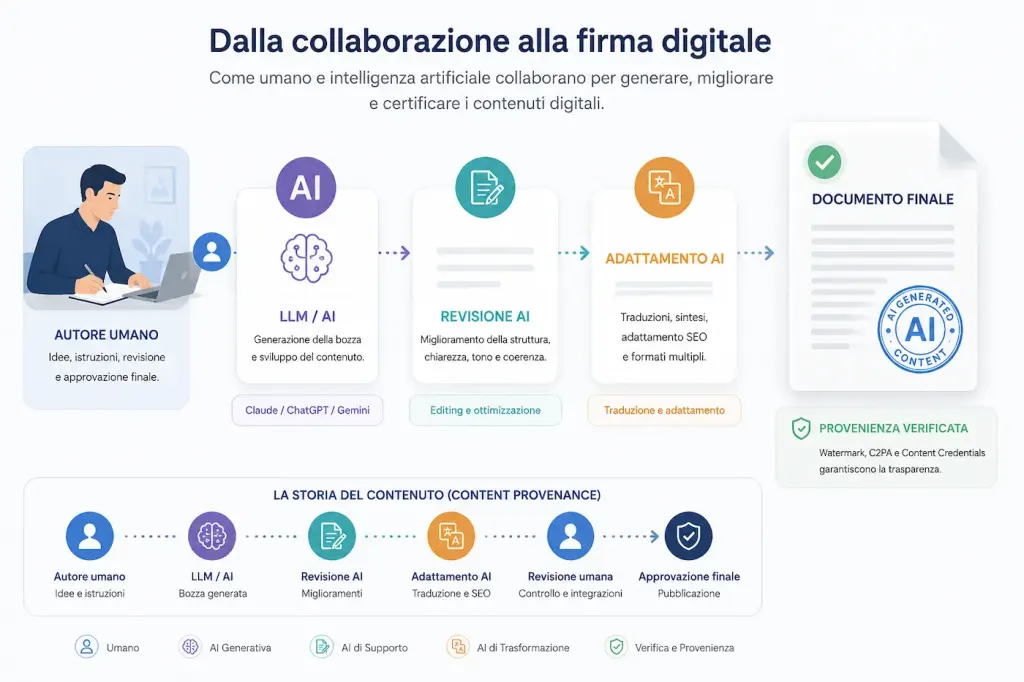
Claude begins leaving an invisible signature in text
For years, we have tried to recognize texts produced by artificial intelligence by looking at their style: sentences that are too polished, dashes that are not typical of our language, recurring structures, certain linguistic expressions, or a suspicious uniformity in the writing.
An entire market has even emerged offering software that claims to determine whether a text was written by a person or by a language model. There are also skills and plugins that promise to make text more closely resemble the writer’s own style.
The problem is that this approach quickly showed its limitations. A human-written text can be classified as artificial, while a text generated by artificial intelligence can be modified enough to avoid detection.
Anthropic is now introducing a different approach: instead of trying to recognize Claude after the text has been produced, Claude itself will leave a mark during generation—an AI watermark.
According to the documentation published by the company, Claude models incorporate a machine-readable watermark that is not perceptible to the reader into the generated text. For supported file formats, Anthropic instead uses digitally signed provenance metadata.
Not surprisingly, this decision fits into the new European framework on the transparency of AI-generated content. From August 2, 2026, the obligations set out in Article 50 of the AI Act have become applicable, including those relating to the machine-readable marking of certain types of content by providers.
But this is where a misunderstanding arises: Finding Claude’s watermark does not necessarily prove that Claude wrote that text!
A watermark can detect Claude, but can it tell us who the author is?
Imagine that a university, a company or a newsroom receives a document, and that a future verification system detects Claude’s watermark within it.
The most immediate conclusion might be:
This text was written by Claude.
But that is not necessarily the case.
Let’s assume that a person independently wrote an article and later asked Claude:
Correct the grammar and punctuation without changing the content.
Or:
Translate this document into English while faithfully preserving its meaning.
Or again:
Make these paragraphs easier to read.
These are prompts that, for example, I regularly use when writing articles.
The resulting text has passed through Claude (or another LLM) and could therefore contain a watermark associated with the system.
However, this does not mean that the ideas, the research, the reasoning or the original text were produced by artificial intelligence.
Anthropic explicitly highlights this limitation in its documentation: a watermark may indicate that Claude participated in the production or transformation of a piece of content, but it should not automatically be interpreted as proof of its complete origin.
Provenance, authorship and responsibility are not the same thing
It is useful to distinguish between these three concepts:
Provenance: which tools and processes participated in the production or transformation of the content.
Authorship: who developed the ideas and substantially created the content.
Responsibility: who decided to use, approve and publish the final result.
A watermark can provide information about provenance, but it is far less capable of answering the other two questions on its own.
A watermark can tell us something about the technical history of a piece of content. It cannot automatically determine who deserves the intellectual credit or who should assume responsibility for it.
Perhaps AI-written text is becoming too simplistic a category
The issue becomes even more evident when we look at how artificial intelligence is actually being used.
Between completely human writing and fully automated generation, there is now a vast middle ground.
Correction
The text is written by a person, and AI only corrects grammar and punctuation.
Revision
A person writes the content, and AI improves its clarity, structure or readability.
Collaboration
The person and the model work together to develop ideas, structure and parts of the text.
Generation
The model produces a complete first draft based on the instructions it receives.
Automation
The content is generated and published through an almost entirely automated process.
Describing all these situations simply as AI-generated content means losing fundamental information.
Let’s consider another example.
A consultant gathers data, interviews and documentation, defines the thesis of a report and personally writes the conclusions. They then use a language model to turn their notes into a more structured first draft.
Who wrote the report?
The answer depends on what we actually mean by the word write.
This issue will become even more evident as AI capabilities are increasingly integrated directly into everyday tools: text editors, web browsers, email applications, CMS platforms, translation systems and collaborative software.
For example, Gmail in Google Workspace, starting with the Business Standard edition, allows users to write emails simply by describing what they want to say, or to improve the tone, formality and correctness of an email according to their preferences.
How an LLM Thinks
To understand why it is possible to embed a watermark in a text, it is useful to take a step back and look, in a highly simplified way, at how modern Large Language Models work.
The current generation of language models is based on the Transformer architecture, introduced by Google in 2017 with the landmark paper Attention Is All You Need. From that moment on, the way artificial intelligence systems were trained on language changed radically. To explore the topic further, Nello Cristianini’s trilogy is highly recommended, particularly Machina Sapiens.
A useful metaphor, used by Cristianini, is that of the exercises commonly found in tests taken by students in American schools.
The teacher gives students a sentence with one or more missing words and asks them to complete it.
The capital of France is ______.
For a person, the answer is immediate. For a machine, until 2007, it was not.
During training, a language model also goes through millions of conceptually similar exercises, but on an enormously larger scale. In some cases, it must predict a hidden word; in others, it simply has to guess what the next token in a sequence will be.
By repeating this process billions of times, the model learns the statistical relationships between words, sentences and concepts, eventually becoming capable of producing coherent and contextually appropriate text.
When we use ChatGPT, Claude or Gemini, the model is not retrieving a pre-written answer from a database: it is continuously predicting the most plausible next token.
For a deeper explanation, I also wrote an article about the evolution of AI beyond Turing’s predictions.
It is precisely here that watermarking comes into play.
If the model has several equally valid words to choose from, it can be guided, imperceptibly, to prefer some over others by following a key known only to the verification system.
From the reader’s point of view, nothing changes: the sentence remains perfectly natural. From a statistical point of view, however, after hundreds or thousands of tokens, a particular signature emerges that can later be detected.
The signature can be hidden in the probabilities of words
Let’s look at an example. Suppose the model has to complete the following sentence:
The CEO of HT&T has decided to…
The model might consider several continuations to be plausible:
| Possible token | Hypothetical probability |
|---|---|
| adopt | 28% |
| implement | 24% |
| introduce | 20% |
| use | 12% |
| develop | 8% |
The values are purely illustrative and are intended only to explain the underlying principle.
Normally, the model selects the next token based on this probability distribution and on the parameters used during generation.
A watermarking system can subtly influence this choice. A key or function known to the system can, for example, favor certain contextually appropriate tokens over others under specific circumstances.
A single choice means virtually nothing. However, by repeating this process across dozens or hundreds of tokens, a particular statistical fingerprint can emerge within the text.
1
The model calculates the possible next tokens.
2
The system imperceptibly adjusts some probabilities.
3
The text is generated normally for the reader.
4
A detector later searches for the statistical signature.
The reader simply sees a natural sentence. The detector, however, can analyze a sufficient amount of text and verify whether the linguistic choices follow the expected statistical distribution.
The signature does not necessarily have to be embedded in the file itself; it can instead be distributed across the linguistic decisions made by the model during text generation.
Is this what Claude is actually doing?
As of August 2026, we know that Anthropic explicitly refers to watermarks embedded in texts generated by Claude.
We also know that the watermark is designed to remain associated with the text even after it has been copied and pasted, and that the company plans to provide tools capable of detecting its presence.
However, the exact algorithm used by Anthropic has not been publicly disclosed.
Based on the information currently available, it is therefore not correct to claim that Claude necessarily uses a specific statistical scheme, a particular token selection strategy, or the same method adopted by other providers such as Google.
What has just been described is the general principle behind several watermarking techniques for Large Language Models and is useful for understanding how it is technically possible to leave a signature within a text without simply inserting metadata or hidden characters.
Claude, Gemini and ChatGPT
When discussing watermarking applied to artificial intelligence, it is easy to assume that all major models are following the same path.
In reality, the opposite is true.
Anthropic, Google and OpenAI share the same overall objective—improving transparency and trust in AI-generated content—but they are pursuing it through different approaches.
Three companies, three strategies
Anthropic focuses on invisible watermarking for text generated by Claude.
Google is developing an ecosystem called SynthID, which can be applied to text, images, audio and video.
OpenAI is investing primarily in content provenance through open standards such as C2PA and verification tools.
The result is that today there is no single answer to the question:
How do you sign AI-generated content?
Google and SynthID: the statistical signature of AI-generated content
While Anthropic has attracted attention with Claude, Google has been working on this topic for longer through a project called SynthID.
Contrary to what is often reported, SynthID is not simply a watermark for images. It is a family of technologies designed to help identify AI-generated content across different formats:
- text;
- images;
- audio;
- video.
The underlying philosophy is always the same: introducing a signal that is difficult for humans to perceive but detectable by an authorized verification system.
How does SynthID Text work?
Google is one of the few companies that has publicly explained the general principle behind its system.
During generation, the model does not select each word solely according to the highest probability. Instead, an internal function imperceptibly adjusts certain linguistic choices according to a key known to the system.
The text remains perfectly natural: the reader notices no difference.
However, by statistically analyzing a sufficient number of tokens, a detector can verify whether that particular fingerprint emerges.
Why is it so difficult to notice?
The modification does not affect the meaning of the sentences but rather the probability with which the model selects perfectly valid words that fit the context.
For the reader, the result is indistinguishable from a normal piece of generated text.
This is precisely why many researchers refer to it as a statistical watermark rather than a watermark in the traditional sense of the term.
SynthID Is Not a Perfect Solution Either
As Google explains, its robustness depends on several factors:
- how much text is analyzed;
- how many modifications it undergoes afterwards;
- whether the content is substantially rewritten;
- whether it is translated or reworked by other models.
In other words, a watermark is not absolute proof. It is a signal that increases the likelihood of recognizing the participation of a particular system.
The difference is significant: a traditional digital signature can verify the integrity of a file, whereas a statistical watermark looks for compatibility with a particular generation process.
What About ChatGPT/OpenAI?
OpenAI has not announced a public adoption comparable to the one described by Anthropic or to Google’s algorithms.
In recent years, OpenAI has chosen to invest primarily in content provenance, that is, the ability to demonstrate the origin of images and other content through shared standards.
Images generated with ChatGPT and through the API use systems compatible with C2PA and Content Credentials, accompanied by public verification tools.
For text, however, OpenAI has not publicly announced an invisible watermark similar to the one described by Anthropic.
This does not mean that the issue is being ignored, but rather that, at least for now, OpenAI appears to be pursuing a different approach.
Claude, Gemini and ChatGPT Compared
| Aspect | Claude | Gemini | ChatGPT |
|---|---|---|---|
| Text | Embedded machine-readable watermark | SynthID Text | No public watermark announced |
| Images | C2PA | SynthID + C2PA | C2PA + Content Credentials |
| Main objective | Content detectability | Cross-platform detectability | Verifiable provenance |
| Verification | Dedicated detectors | SynthID detector | Content provenance verification tools |
Will All of This Be Enough?
Looking at the strategies adopted by Anthropic, Google and OpenAI, it becomes clear that none of them considers a single solution to be sufficient.
Those investing in watermarking continue to invest in provenance.
Those developing provenance standards continue to study recognition systems.
This is a sign that the issue goes far beyond simply identifying AI-generated content.
The AI industry seems to have understood that trust will not depend on a single technology, but on the ability to combine watermarking, provenance, digital signatures and human responsibility.
And this combination of different technologies raises a new question: what happens when a piece of content is modified, rewritten or transformed by several different models?
This is where the AI Act, the phenomenon of AI laundering, and a question that will probably accompany us for years to come come into play:
If a document passes through Claude, then ChatGPT, then Gemini, and is finally reviewed by a human, who can really sign it?
Perhaps We Are Still Asking the Wrong Question
We are focusing on a single issue.
How can we tell whether a text was written by AI?
It is a legitimate question, and the right one for the moment.
But it risks becoming obsolete very quickly.
More and more software applications are integrating artificial intelligence directly into the tools we use every day.
- A text editor automatically corrects grammar.
- An email client suggests entire sentences.
- A CMS generates the SEO title and meta description.
- A translation system rewrites content in multiple languages.
- An AI assistant generates FAQs together with the corresponding JSON-LD.
At that point, asking whether a document was written by artificial intelligence becomes almost meaningless.
In my opinion, the real question should be: what contribution did each participant make to the creation of the content?
Conclusions
This article originated from an observation made by one of my colleagues. After reading several texts that were formally correct and flawlessly translated, he told me quite bluntly: “These texts were written by artificial intelligence!” From that moment on, I started wondering whether the real issue was recognizing AI-generated content or, rather, understanding what truly makes content original and valuable today.
Anthropic’s announcement may be remembered as one of the first steps toward a new era of artificial intelligence—not so much because Claude has introduced a watermark into its texts, but because it forces all of us, collaborators included, to reconsider a concept we had always taken for granted: authorship.
For centuries, a document normally had a single author. Today, it may involve one person, three language models, a machine translation system and a human editor all working on the same content. And someone still has to take responsibility for the final result.
Claude’s watermark probably represents only the first chapter of this story.
And if the person taking responsibility does not understand the subject, does not contribute the original idea, does not build the structure, does not apply critical thinking and does not perform a final review, that formally correct content will simply become one of many—perhaps even an inaccurate one—destined to become digital waste.
Frequently Asked Questions
Does Claude’s watermark prove that a text was written by AI?
No. It may indicate that Claude participated in generating or transforming the content, but it does not automatically prove that the entire text was written by artificial intelligence or identify who its author is.
What is Google’s SynthID?
SynthID is a family of technologies developed by Google to embed invisible signals into AI-generated content. It can be applied to text, images, audio and video and, under certain conditions, makes it possible to verify the content’s provenance.
Does ChatGPT embed invisible watermarks in text?
At present, OpenAI has not publicly announced a text watermarking system comparable to the one described by Anthropic. Instead, the company primarily invests in C2PA, Content Credentials and tools for verifying the provenance of multimedia content.
What is the difference between a watermark and C2PA?
A watermark introduces a signal into the content or the generation process. C2PA, on the other hand, is a standard that records verifiable information about the provenance of a file and the modifications it has undergone.
Will there eventually be a system capable of reconstructing the complete history of a piece of content?
Today, no universal standard of this kind exists. However, the evolution of watermarking, C2PA, digital signatures and provenance systems suggests that, in the coming years, solutions may emerge that can document the entire lifecycle of a piece of content.
Sources and Further Reading
Anthropic
How Claude Marks AI-Generated Content
Official documentation on Claude’s text watermarking, C2PA and content detection systems.
https://support.claude.com/en/articles/16266773-how-claude-marks-ai-generated-content
Google DeepMind
SynthID
Official documentation describing Google’s SynthID technology for text, images, audio and video.
OpenAI
Advancing Content Provenance for a Safer, More Transparent AI Ecosystem
OpenAI’s approach to content provenance, C2PA, Content Credentials and verification tools.
European Union
Regulation (EU) 2024/1689 – AI Act
Official text of the European Artificial Intelligence Act, including Article 50 on transparency obligations for AI-generated content.
Continua a leggere
27 minutes of reading
15 minutes of reading

And it consumes less energy.
To return to the page you were visiting, simply click or scroll.