
What Is C2PA and Why It Will Change the Web
In the era of generative artificial intelligence, a photograph can no longer be considered authentic simply because it looks real. Images, videos, audio recordings and documents can now be created or manipulated by increasingly sophisticated AI systems (Google has recently announced the integration of Google Pics into Google Workspace), often without leaving any visible traces detectable by the human eye.
It is therefore becoming essential to know not only whether an image, video or audio file is genuine, but also where it comes from, who created it and what transformations it has undergone.
This is exactly the challenge addressed by the C2PA (Coalition for Content Provenance and Authenticity): an open technical standard that allows digital content to carry verifiable information about its origin and history.
The Key Concept
C2PA does not attempt to determine whether an image is real by analysing its pixels. Instead, it records verifiable information describing how the file was created, edited and published.
This represents a fundamental shift in perspective: moving from detecting fake content to verifying content provenance.
What Is C2PA?
The Coalition for Content Provenance and Authenticity (C2PA) is an industry initiative created to establish a common standard that enables devices, software, platforms and publishers to record and verify the provenance of digital content.
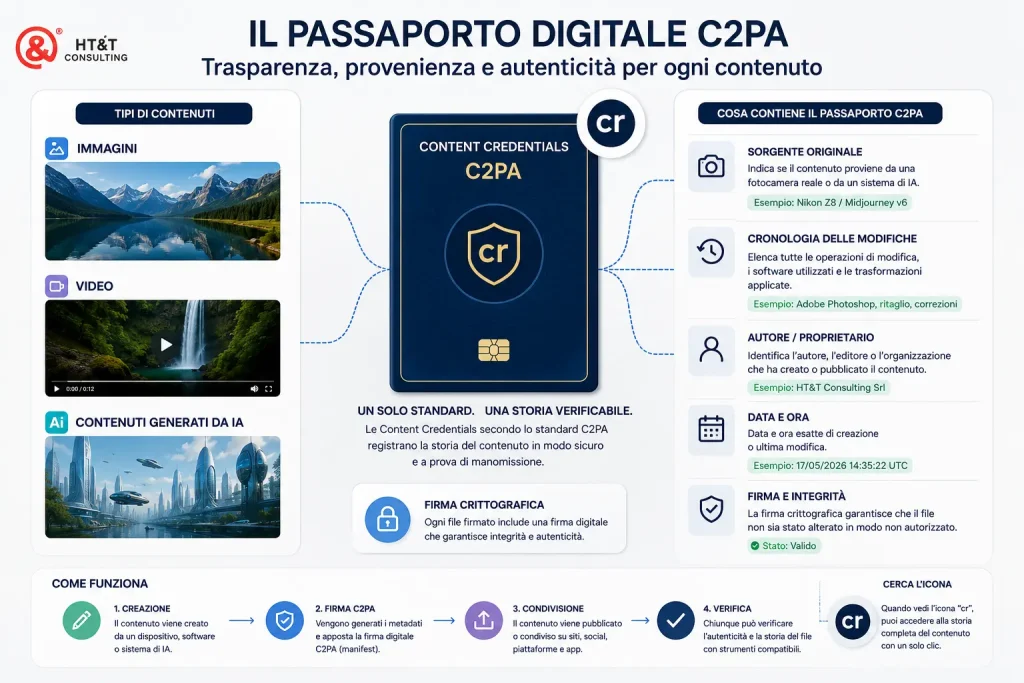
The C2PA specification makes it possible to associate an image, video, audio file or document with a set of cryptographically signed metadata. These metadata are commonly presented to users as Content Credentials.
The simplest way to understand them is to think of a digital passport. A file can carry information about the device or software that created it, the edits it has undergone and the organizations or individuals who chose to sign it.
Another widely used definition is “nutrition labels for digital content.” Just as a food label does not tell you whether a product is good or bad but explains its composition and origin, Content Credentials do not tell users what to believe—they provide additional information that helps them make an informed decision.
How Do Content Credentials Work?
When digital content is created or edited using a compatible device or software application, a C2PA Manifest can be generated. This manifest contains claims describing the file and is associated with a digital signature.
The signature enables verification systems to determine whether the information remains consistent with the content itself. If either the file or its manifest is altered in a way that falls outside the declared provenance chain, the verification process can indicate that the integrity of the content is no longer valid.
The Provenance Chain in Five Steps
Creation
A camera, smartphone or generative AI system creates the content.
Signing
The device or software associates the file with a cryptographically signed manifest.
Editing
Compatible applications record operations such as cropping, colour adjustments or compositing.
Publishing
The publisher or brand publishes the content while preserving, whenever possible, its Content Credentials.
Verification
Users or platforms can inspect the available information and verify its integrity.
What Information Can Be Recorded?
The exact information depends on the device, software and publishing choices involved. A manifest may include, for example:
- the device or application used to create the file;
- timestamps associated with specific operations;
- editing actions declared by compatible software;
- whether artificial intelligence tools were used;
- the organization or individual who digitally signed the content, when applicable;
- links to previous or derived versions of the same asset;
- declared rights information and usage preferences defined by the creator.
The metadata does not necessarily include the personal identity of the author. The standard is designed to support different attribution levels while avoiding the use of provenance as a tool for indiscriminate tracking.
What Does C2PA Actually Certify?
One of the most common misconceptions is that C2PA provides absolute proof that everything shown in an image is true.
It does not.
C2PA verifies that specific claims about a file’s provenance are associated with a valid digital signature and that the declared chain of modifications has not been compromised. However, it cannot automatically determine whether a photographed scene was staged, whether a caption is accurate or whether the subject portrayed is telling the truth.
Provenance Is Not the Same as Truth
A photograph may be technically authentic while still depicting a staged event. A video may be original but presented out of context. A valid digital signature demonstrates the integrity of an information chain—not the absolute truthfulness of every interpretation attached to the content.
The real value of C2PA lies in reducing uncertainty. It makes it possible to distinguish, for example, between a photograph signed at the moment it was captured, a version that was later edited and an image generated entirely by an artificial intelligence system—provided that every tool involved properly supports the standard.
The “CR” Icon and the User Experience
Content Credentials may be represented by a dedicated visual indicator, commonly referred to as the CR icon.
When a website, application or platform supports this feature, users can click or tap the icon to view a summary of the available information, including the declared origin, tools used, recorded edits and verification status.
The goal is to make a sophisticated cryptographic technology understandable through a simple interface. Users do not need to interpret digital signatures or technical metadata—they simply need to know whether a verifiable history exists for the content.
Looking ahead, this indicator could play a role similar to the HTTPS padlock in web browsers: not a guarantee that the content is true, but a recognizable sign that it is backed by a technical layer of provenance and verification.
Who Is Adopting C2PA?
C2PA is no longer merely an experimental project. The standard is supported by a growing ecosystem that includes technology companies, device manufacturers, news organizations, digital platforms, software providers and organizations involved in content verification.
Adoption is developing mainly across four areas.
Capture Devices
Some professional camera manufacturers have started integrating systems capable of signing images at the moment they are captured. This is one of the most important steps, because a provenance chain is stronger when it begins together with the original content.
Creative Software
Editing and production applications can record the transformations made to a file and add new claims to its history, preventing every intervention from necessarily breaking the provenance chain.
Publishers and Organizations
News outlets, institutions, agencies and companies can sign the content they publish, giving the public a way to distinguish original assets from altered, copied or decontextualized versions.
Platforms and Infrastructure
Social networks, search engines, browsers, CDNs and content management systems play a decisive role: they must preserve, read or recover Content Credentials while files are being distributed.
The challenge is not simply to add credentials when content is created, but to preserve them throughout its entire lifecycle. A photograph may be correctly signed by a camera, edited with compatible software and then lose its metadata when compressed by a social network, transformed by a distribution system or shared through WhatsApp.
To address this weakness, the ecosystem is developing so-called Durable Content Credentials: systems that combine metadata, digital fingerprints and invisible watermarks, allowing provenance information to be recovered even when some of the data embedded in the file has been removed.
C2PA and SynthID: Two Different Technologies Addressing the Same Challenge
C2PA is often compared with SynthID, the watermarking technology developed by Google DeepMind to identify content generated by artificial intelligence.
The two solutions are not equivalent and should not necessarily be regarded as competing technologies.
| Technology | Principle | Main Strength | Main Limitation |
|---|---|---|---|
| C2PA | Associates the file with signed metadata and claims describing its provenance. | Can provide a clear and understandable history of how the content was created and modified. | The data may be lost when platforms and tools do not preserve the provenance chain. |
| SynthID | Embeds an imperceptible digital signal directly into generated content. | Can withstand various transformations, including compression and resizing. | Detection depends on tools and models compatible with that specific watermark. |
| Forensic Analysis | Looks for statistical, visual or structural anomalies within the file. | Can also be applied to content without credentials or watermarks. | It often produces probabilistic assessments rather than definitive proof of provenance. |
C2PA Describes the History of a File
The main strength of C2PA is transparency. When the provenance chain is preserved, users can understand which tools were involved in creating the content and which steps were formally declared.
SynthID Embeds a Signal into the Content
SynthID works instead as an invisible digital watermark. The signal is embedded within the structure of an AI-generated image, video, audio file or text so that it can later be detected by compatible tools.
The Most Robust Strategy Uses Multiple Layers
Signed metadata provides explainability, while watermarks can make provenance information more resilient to removal. Forensic technologies remain useful when neither credentials nor embedded signals are available.
There Is No Single Infallible Indicator
The future infrastructure of digital trust will probably consist of multiple layers: cryptographic credentials, watermarks, digital fingerprints, forensic analysis, source reputation and editorial verification.
C2PA and the EU AI Act: What Does Article 50 Require?
Article 50 of the European Union AI Act introduces transparency obligations for certain AI systems and for content generated or manipulated using artificial intelligence.
In particular, providers of systems capable of generating synthetic content must ensure that their outputs are marked in a machine-readable format and can be detected as artificially generated or manipulated.
Disclosure obligations also apply to certain categories of content, including deepfakes and some texts published to inform the public about matters of public interest. The exact requirements, exceptions and methods of disclosure depend on the context in which the content is used.
Most provisions of the AI Act become applicable from 2 August 2026. This makes content traceability an operational issue for platforms, AI system providers, publishers, agencies and companies that create or distribute synthetic media.
C2PA Does Not Automatically Guarantee Compliance
Adopting C2PA may contribute to transparency and machine-readable marking, but it does not automatically mean that an organization complies with every obligation under the AI Act.
Compliance also requires internal procedures, use-case assessments, visible disclosures where necessary, supplier management, evidence retention and human oversight.
Why Have These Technologies Become Essential?
Fighting Disinformation
A publisher can release signed images and provide a verifiable reference against altered copies, false attributions or content shared outside its original context.
Protecting Corporate Reputation
An organization can make its official content recognizable and reduce the risk that manipulated images or videos are incorrectly attributed to the brand.
Strengthening Attribution
Photographers, creatives and content producers can associate provenance information and details about the creation process with their work, while respecting the privacy choices supported by the implementation.
Managing AI-Generated Content
Companies and publishers can distinguish more clearly between content captured in the real world, content modified with generative tools and assets produced entirely by artificial intelligence.
Supporting Compliance
Technical marking and the preservation of provenance information may become important components of the compliance processes required by European regulation.
Rebuilding Trust
In an environment saturated with synthetic content, providing verifiable information about origin can become a distinguishing factor for publishers, companies and institutions.
A Practical Example: A Manipulated Corporate Photograph
Imagine that a company publishes a photograph of a new production facility. The original file is signed when it is created and published with Content Credentials.
A few weeks later, an external party downloads the image, alters a sign and uses the modified version to support a false news story.
C2PA cannot physically prevent the manipulated copy from being created or distributed. It can, however, provide a verifiable reference that helps establish which file was originally published by the company and which version does not belong to the original provenance chain.
- The company stores and publishes the signed original.
- The altered copy does not contain valid credentials or presents a different provenance chain.
- Journalists, platforms and users can compare the different versions.
- The company can demonstrate more reliably which content it actually released.
This capability is particularly relevant for press releases, corporate imagery, video statements, technical documentation, advertising campaigns and content intended for regulated markets.
C2PA, SEO, AEO and GEO: What Is the Impact on Visibility?
C2PA is not currently a declared SEO ranking factor, and it would be misleading to claim that adding Content Credentials automatically improves rankings on Google.
Its potential impact concerns a different level: the ability of digital systems to assess the provenance, declared authenticity and reliability of an asset.
SEO: Improving the Quality of the Information Ecosystem
For search engines, understanding the origin and transformation history of an image may become useful for distinguishing original content from copies and manipulated versions. C2PA may also strengthen the management and protection of proprietary digital assets.
AEO: Answers Based on More Verifiable Sources
Answer engines must decide which sources to use when generating a summary. The availability of verifiable provenance information could become one of the signals used to assess the reliability of multimedia content associated with a source.
GEO: Authority within Generative Systems
In Generative Engine Optimization, visibility does not depend solely on being indexed. It also depends on being recognized as a reliable, original and citable source.
A brand that publishes proprietary data, signed documents, original images and clearly attributed content builds an information asset that is easier to verify than one based on anonymous material with no documented history.
A New Dimension of Authority
On the traditional Web, authority was based primarily on reputation, links, citations and editorial quality. On the generative Web, the ability to demonstrate the technical origin of content may become increasingly important.
For HT&T, C2PA should therefore be understood as part of a broader evolution: the creation of a trust infrastructure in which content, sources, authors, data and AI systems can be connected through verifiable signals.
The Limitations of C2PA You Need to Know
C2PA represents an important infrastructure, but it cannot solve the problems of disinformation and digital manipulation on its own.
The Absence of Credentials Does Not Prove That Content Is Fake
The standard is still being adopted. Millions of authentic pieces of content are created every day without a C2PA manifest. An unsigned file is simply a file for which that specific provenance chain is not available.
Credentials Can Be Removed
Conversions, screenshots, social networks, messaging systems, content management systems, CDNs and optimization tools may remove or interrupt embedded metadata.
Someone Can Photograph a Screen
Even when the original file is protected, someone can display it and create a new photograph or recording. The new asset does not automatically retain the original provenance chain.
Claims Depend on Who Signs Them
Cryptography makes it possible to verify that a claim comes from a particular signer and has not been altered. Trust, however, also depends on the reliability of the device, software or organization that produced the claim.
Platforms Need to Cooperate
The standard delivers its greatest value only when the entire supply chain supports the creation, preservation and display of Content Credentials.
Privacy Must Be Carefully Designed
Recording too much information about the author, location or device could expose sensitive data. Every implementation must therefore balance transparency, data minimization and the protection of individuals.
C2PA Adds Context, but Does Not Replace Human Judgment
Content Credentials should be evaluated together with source reputation, editorial verification, context, available evidence and other analytical tools.
How Could C2PA Change the Web in the Coming Years?
For more than thirty years, the Web has grown by prioritizing the ease with which content can be copied, modified and redistributed. This characteristic helped the Web expand, but it also made it difficult to preserve the connection between a piece of content and its original source.
Generative artificial intelligence has made this problem even more evident. Advanced technical skills are no longer required to create a realistic photograph, simulate a voice or modify a video.
In the coming years, we may therefore see the emergence of a Web divided into two broad layers:
- content with verifiable and accessible provenance information;
- content without a documented provenance chain, which will require additional verification.
This does not mean that the first category will always be true and the second always false. It means that provenance could become a new variable in the assessment of trust.
Browsers, search engines, social platforms, generative systems and business software may use these signals to display warnings, recover the history of an asset or distinguish original content from derived versions.
For brands, the ability to produce verifiable content could become a reputational advantage. For publishers, it could become part of the trust relationship with readers. For platforms, it could serve as a tool for managing the risk of disinformation at scale.
Our Perspective
At HT&T Consulting, we see C2PA not merely as a standard for images and videos, but as one component of a broader infrastructure for digital trust.
On the Web of the future, declaring who produced a piece of content, which tools were used and which transformations were applied will become increasingly important. This will affect corporate communications, news publishing, advertising and the content used by artificial intelligence systems.
The real challenge will not be to eliminate every false piece of content, which is probably an unrealistic goal. It will be to make it easier to recognize the content that can demonstrate transparent, verifiable and consistent provenance.
Conclusion
C2PA introduces a fundamental shift. Instead of relying entirely on the ability to detect manipulation, it makes it possible to build a verifiable history of a piece of content from the moment it is created.
It is not an infallible solution and it does not automatically certify the truth of what we see. It can, however, provide users, companies, publishers and platforms with something that has often been missing until now: a technical connection between a file and its declared origin.
Together with invisible watermarks such as SynthID, editorial verification systems and forensic analysis tools, Content Credentials can help make the digital ecosystem more transparent.
For organizations, the right time to address this issue is now: map the tools being used, establish rules for synthetic content, preserve evidence and prepare for the transparency obligations introduced by the AI Act.
Key Takeaway
For years, the central question of the Web was: “Where can I find this information?”
In the age of artificial intelligence, the question becomes: “Can I verify where it came from?”
C2PA is one of the first standards designed to provide a concrete answer.
Frequently Asked Questions about C2PA and Content Credentials
What is C2PA?
C2PA, the Coalition for Content Provenance and Authenticity, is an organization that develops an open standard for associating digital content with verifiable information about its origin and the modifications it has undergone.
What are Content Credentials?
Content Credentials are provenance information associated with a piece of content according to the C2PA standard. They may indicate how the file was created, which tools modified it and whether artificial intelligence systems were used.
Can C2PA determine whether an image is real?
Not in an absolute sense. C2PA can verify the validity of the provenance chain and the signed claims associated with a file, but it cannot automatically determine whether the scene is authentic, correctly contextualized or accompanied by an accurate description.
Is an image without Content Credentials fake?
No. Many devices, software applications and platforms do not yet support the standard. The absence of credentials simply means that no verifiable C2PA history is available for that file.
Can Content Credentials be removed?
Yes. Compression, conversion, screenshots, resizing and uploads to incompatible platforms may remove metadata. This is why Durable Content Credentials, watermarks and complementary recovery systems are being developed.
What is the difference between C2PA and SynthID?
C2PA records signed metadata describing the provenance and history of a file. SynthID instead embeds an imperceptible watermark directly into generated content. The two technologies can be used together.
Is C2PA mandatory under the AI Act?
The AI Act requires certain AI-generated or AI-manipulated outputs to be marked in a machine-readable format and introduces specific transparency obligations. The regulation does not necessarily require C2PA as the only permitted technology, but the standard may help satisfy some of the technical and documentation requirements.
Does C2PA improve SEO rankings?
There is currently no evidence that C2PA is a direct ranking factor. It may, however, improve the management of asset provenance and, over time, provide useful signals to search engines and generative systems.
Should a company already adopt Content Credentials?
Companies should at least assess their adoption for corporate, sensitive or AI-generated content. The first step is to verify tool compatibility and establish an internal policy on content transparency.
How can I verify a file’s Content Credentials?
You can use verification tools compatible with the C2PA standard by uploading the file or selecting the Content Credentials icon when it is displayed by a website or application.
Sources and Further Reading
To learn more about the C2PA standard, Content Credentials, SynthID and the transparency obligations introduced by the AI Act, we recommend the following sources.
C2PA Technical Specification
Coalition for Content Provenance and Authenticity
The official technical specification describing manifests, signatures, claims and verification mechanisms.
How Content Credentials Work
Content Authenticity Initiative
An accessible explanation of how Content Credentials work and which tools are currently available.
Verify Content Credentials
Content Authenticity Initiative
An online tool that allows users to verify the Content Credentials embedded in images, videos, audio files and documents.
SynthID
Google DeepMind
The official documentation for the watermarking technology used to identify AI-generated content.
European Artificial Intelligence Act
European Union
The official text of Regulation (EU) 2024/1689, including the transparency obligations set out in Article 50.
C2PA Explainer
Coalition for Content Provenance and Authenticity
An introductory guide explaining the objectives, architecture and use cases of the standard in less technical language.
Continua a leggere
22 minutes of reading

17 minutes of reading


And it consumes less energy.
To return to the page you were visiting, simply click or scroll.