
A sporting event, a digital communication case study
When global attention focuses on Milano-Cortina 2026, the temptation is to tell the story only through the lens of sport.
In reality, for those who work in marketing and digital communication, it is also an interesting system to observe: brand, reputation, governance, content, data, technology and stakeholders move together, often under pressure.
What happens when a brand is under global scrutiny, distributed across multiple locations and channels, and cannot afford inconsistency?
Milano-Cortina 2026 will be followed primarily as a digital experience: micro-content, reactions and real-time sharing.
That is why it is a perfect case study on attention, consistency and reputation.
Summary
Milano-Cortina 2026 is a strong example of contemporary communication: a brand living across multiple places and channels, a narrative that must remain consistent without a single central hub, sustainability that is credible only if it becomes legacy, and technology that works best when it is invisible. For marketing teams, the key words are: governance, community, reputation and content design.
1) Network strategy: communicating without a single center
An event distributed across a metropolis, mountains, different venues and territories with strong identities creates a challenge typical of digital: maintaining narrative consistency in a non-centralized system.
There is no single dominant touchpoint. The brand expresses itself through multiple contexts, audiences and languages.
For a company, this is similar to what happens when the brand truly lives across search, social, media, retail, customer care and community: the message cannot simply be copied and pasted everywhere. You need a clear core (positioning and values) and a coherent adaptation for each channel.
If your organization is distributed (teams, partners, markets), the useful question is not who approves everything, but do we have rules, toolkits and processes that protect consistency and speed at the same time?
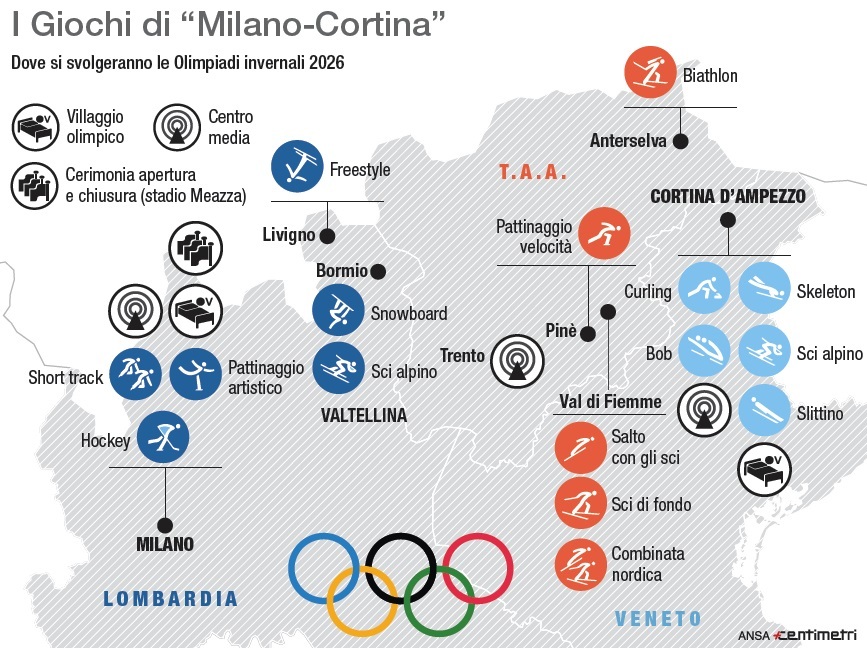
Milano-Cortina 2026 is an event distributed across multiple territories, with direct implications
for governance and communication.
2) Legacy and credible sustainability: when reputation depends on choices
In marketing, sustainability has become a delicate area: generic statements and vague promises can easily turn into skepticism.
That is why it is interesting when a green narrative is tied to verifiable choices and the idea of legacy: not just communicating, but making communication defensible.
For a business, the lesson is highly transferable: a sustainable positioning holds only if it translates into processes, supply chain decisions, data governance, product choices and customer experience. Reputation is not optimized downstream; it is designed upstream.
3) Futura: the brand as a participatory process
The name Futura and the idea of a light, minimal sign carry a very current concept: a brand is not only visual identity, it is a process that lives through interaction with the public.
Digitally, this happens every day: comments, remixes, UGC (user-generated content), interpretations and conversations shape brand perception.
For communicators, the lesson is not “run votes,” but design real spaces and moments for participation, where the community can contribute without creating chaos. Co-creation works when there is clear direction: what can change, what cannot, and what benefit people get from participating.
4) Managing the unexpected: reputation, speed and message control
Major events and major brands share a problem: they operate in contexts where the unexpected is inevitable.
From a marketing perspective, the interesting part is not avoiding mistakes at all costs, but building a system that reduces damage when they happen: clear guidelines, sustainable approval flows, channel coverage and the ability to respond consistently.
In practice, this translates into three qualities that often conflict with one another but must be balanced: agility (decide fast), precision (avoid missteps) and vision (not chasing the wave of the moment).
If your brand were live for weeks, with attention amplified by social media, what would your weak points be? Customer care, tone of voice, content governance, or the gap between promises and delivery?
5) Technology and the human touch: when digital works because you don’t see it
In complex events, technology enables almost everything: security, access, flows, connectivity, data layer.
But communication does not win because it is more technical; it wins when it makes the experience simpler, clearer and more human.
For a digital agency, this is a useful reminder. We can have perfect data and advanced tools, but if we do not translate complexity into an understandable experience and a story that creates trust, technology remains a cost, not an advantage.
Conclusion: relevance is not volume, it is consistency
Milano-Cortina 2026 is interesting because it brings together, under the spotlight, problems many businesses face every day: distributed ecosystems, exposed reputation, sustainability that must be proven, content that must be designed, and technology that must be governed.
If there is one message worth taking away, it is this: relevance is built when a brand stays consistent between what it promises, what it does and what people say about it.
If you want to use events, trends and attention peaks to build authority (not just traffic), you need a clear strategy built on content architecture, governance, measurement and a positioning that holds over time.
And now Forza Italia and Forza Azzurri! And enjoy the Winter Olympics, everyone!
FAQ
Why is Milano-Cortina 2026 relevant for digital marketing?
Because it is a real case of multi-touchpoint communication: brand, content, reputation and community must remain consistent
in a distributed, high-exposure ecosystem, with fast timing and amplified attention.
What does the concept of “Futura” teach a brand?
That a brand is a process: people contribute to brand perception through interactions and conversations.
That is why you need direction, formats and participation rules, not just creativity.
How can you prevent sustainability from becoming a reputational risk?
By tying claims to verifiable choices and a concrete legacy: processes, governance and design decisions that make communication defensible.
What is the most “operational” lesson for a marketing team?
Design the content architecture before production: a central message, channel-specific adaptations, toolkits, workflows and measurement.
In high-visibility environments, consistency matters as much as creativity.