Oltre il #cancelletto: la transizione dall’indicizzazione alla predizione

From the era of hashtags to predictive algorithmic selection: how the logic of online visibility is changing.
For a long time, the digital ecosystem operated under the sign of a promise of transparency and algorithmic meritocracy, perfectly embodied by hashtags. These symbols preceded by a hash sign represented a simple and reassuring social contract: if you know how to choose the right words, your content will be found.
if you know how to choose the right words, your content will be found.
It was, essentially, an orderly and categorized world. Every post had its geographical and thematic placement, a specific location within the digital archive. Every location attracted an audience interested in that specific topic. And that audience moved with a clear intention, guided by shared categories and active search. Visibility was the direct result of the meeting between the user’s explicit search and the relevance of the labeled content. In this context, hashtags transcended their nature as simple words: they were true cognitive infrastructures that enabled the organization and navigation of shared knowledge.
The End of the Classification System
Today, that system has not so much been dismantled as it has been surpassed by a model of greater complexity and power. We are no longer in an era of mere content classification, but in one of interpretation, evaluation, and real-time orchestration. The new architecture of visibility does not simply catalog what has been produced; it anticipates its value and determines its path of distribution.
When Discovery Stops Being a Choice: The Rise of Algorithmic Selection
The real transformation did not coincide with the removal of minor features, such as the ability to “follow” a hashtag on Instagram. The decisive shift was the deep integration of artificial intelligence systems capable of multimodal content understanding. These systems no longer process only textual metadata; they understand content in its entirety, analyzing language, images, audio, and, crucially, human behavior.
Every post stops being a static object to be labeled and becomes a dynamic flow of signals: semantic analysis of the text, visual and stylistic recognition, observation of viewing time, identification of the diffusion network, and geographic/demographic context.
As a result, visibility has changed its origin: it no longer arises from the correct placement in a predefined category, but from an algorithmic prediction of value. Content no longer waits to be searched for: it is actively selected and proposed to the user.
Content no longer waits to be searched for: it is actively selected and proposed to the user.
From the Era of Maps to the Era of Predictive Recommendations
In the previous model (intent-driven discovery), the user was the architect of their own journey. They actively followed hashtags, explored pages and profiles, and actively searched for inspiration. The digital journey was based on explicit intention.
In the current model (probability-driven discovery), the platform acts as an omniscient navigator that anticipates those paths. The algorithmic proposal does not aim to provide what the user is searching for at that precise moment, but what, with the highest probability, will keep them engaged in the experience. Discovery shifts from the axis of intention to that of probability.
The Same Logic, Three Different Platforms
The transition from indexing to prediction is not an anomaly limited to Instagram, but the expression of a systemic model that is redefining the entire platform ecosystem.
On TikTok, hashtags survive as secondary semantic signals. The real indexing system consists of audio, on-screen text, visual rhythm, and viewing behavior. The algorithm does not classify; it interprets experiences.
On LinkedIn, hashtags maintain a formal categorization function, but they are no longer a distribution engine. The feed is driven by dwell time, in-depth comments, shares, and relational signals within a closed network. Here too, visibility is predictive, not declarative.
Instagram is simply the point where this change has become more visible, not its center. The three platforms are converging toward the same architecture: a system that does not organize content, but anticipates attention.
The New Role of Hashtags: Secondary Support Signals
Despite this shift, hashtags have not disappeared at all. Their function has simply been drastically reduced: from pillars of distribution to support signals.
Their current value is limited to helping confirm context, facilitating niche searches (often outside the main recommendation flow), and clarifying the topic for the algorithm in the absence of stronger metadata. They are no longer the engine of distribution, they do not activate large-scale discovery, and they do not build the core audience. Their power has been entirely absorbed by more sophisticated systems that measure the fundamental metric of the new ecosystem: sustained attention.
SEO Has Evolved, Moving Inside Platforms
The decline in the importance of hashtags is explained by a crucial shift: content discovery no longer happens only through traditional search engines, but directly within social platforms.
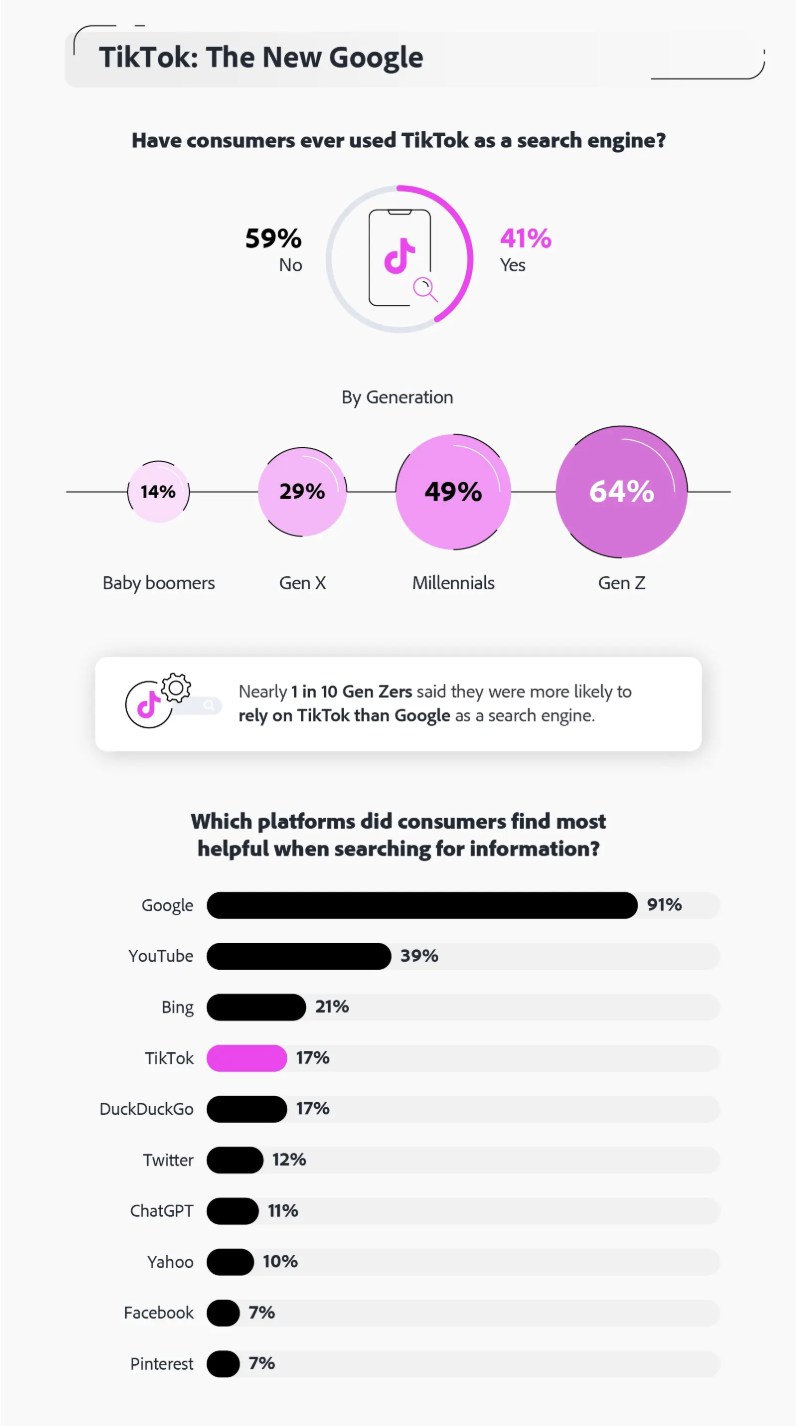
According to an Adobe survey, about 41% of Gen Z today use TikTok and Instagram as primary sources for searching information, products, places, and inspiration, preferring them over Google.
This trend has revolutionized how algorithms interpret content.
In particular, Instagram has significantly strengthened indexing based on keywords present in captions. The goal is not to apply SEO in the traditional sense, but to allow the algorithm to use the description as a semantic field to understand and classify the content.
An experiment conducted by Hootsuite Labs demonstrated that posts integrating relevant keywords naturally within the text achieve up to a 30% increase in visibility compared to those relying solely on hashtags.
The discovery function has not disappeared; it has transformed its infrastructure. It is no longer a manual categorization action (hashtags), but an automatic predictive semantic indexing process.
The New Levers of Visibility
Success today is based on the ability to provide the algorithm with the strongest predictive signals, which are intrinsically linked to the quality of the user experience.
1. Language as enhanced semantic metadata:
Hooks, captions, subtitles and audio tracks are analyzed in depth for their semantics and emotional resonance. Text, therefore, no longer simply describes what the image or video shows; it acts as an active element that positions the content within the recommendation network, defining its affinities.
2. Private sharing as a strong signal of trust
Private communication channels (direct messages, group chats, forwards) have become the new invisible ranking factor. When content is actively sent to a contact, the platform decodes a level of relational value, personal relevance and emotional resonance that far exceeds a public like. In this context, trust (in recommending content to a peer) becomes an extremely powerful metric.
3. Engagement as an indicator of immersive experience
The system has evolved beyond simply measuring the quantity of interactions (such as old-style likes). It now observes the quality of the experience: dwell time on the content, replays, saves and shares. Every micro-action is data that describes how the person is experiencing the content. Visibility emerges from the quality of attention generated, not from the mere quantity of superficial interactions.
4. Consistency as algorithm training
Sustainable growth is reserved for those who provide the system with a clear and consistent understanding of their niche and target. Thematic and stylistic repetition over time is not a limitation, but a strategy. It allows the algorithm to build affinity clusters and precisely define distribution directions. Consistency defines your identity for the algorithm, enabling targeted and effective recommendation.
The Breaking Point: Designing Attention Ecosystems
Creating content today means actively designing a coherent and valuable attention ecosystem.
Every post is a node within a network. Every reaction, every delayed scroll, every private share is a signal. And every signal, without exception, feeds a real-time predictive map that determines where, when and how the content will appear.
The fundamental question for the modern creator has shifted from: “How do I get found?” to “Why should someone stay?”
How do I get found? to “Why should someone stay?”
In Summary:
The decline of hashtags from their central role is not a mystery; it is the logical consequence of algorithmic evolution toward prediction. We have moved from the era of discovery based on labels to the era of algorithmic selection based on performance.
Visibility today is earned through content intrinsically capable of generating retention, encouraging relationships and stimulating emotional and cognitive resonance. In this evolved context, success does not go to those who chase fleeting trends, but to those who know how to design attention with consistency and value.
FAQ:
Have hashtags become completely useless for visibility?
No, they have not disappeared, but their role has been drastically reduced. Today they function as secondary support signals that help the algorithm confirm context or facilitate searches in very specific niches, but they are no longer the main engine of content distribution.
What is the difference between the old discovery model and the current one?
The old model was based on intention (intent-driven), where users actively searched for content through labels and categories. The current model is based on probability (probability-driven): the platform acts as a navigator that anticipates users’ desires, actively selecting and proposing content that is most likely to retain attention.
How has artificial intelligence changed post classification?
Current systems no longer limit themselves to reading textual metadata (such as hashtags), but instead perform multimodal understanding. AI simultaneously analyzes language, images, audio, visual rhythm and user behavior in real time to interpret the overall content experience.
Is it true that people use social platforms as if they were Google?
Yes, this is a significant trend, especially among younger generations. According to an Adobe survey, about 41% of Gen Z use TikTok and Instagram as primary sources for searching information, products and inspiration, preferring them over traditional search engines.
What can I do to increase the visibility of my content without relying on hashtags?
The most effective strategy today is to focus on internal platform SEO and on the quality of the experience. A Hootsuite experiment showed that using relevant keywords naturally within captions can increase visibility by up to 30%. In addition, it is essential to create content that stimulates private sharing (DMs) and sustained attention (dwell time and replays).
Sources and References
Studies and research cited in the article.
-
Hootsuite Labs — Instagram SEO vs Hashtags Experiment
Experimental analysis of the impact of keywords compared to hashtags on post visibility.
-
Adobe — Using TikTok as a Search Engine
Research on the use of TikTok and Instagram as search engines by Gen Z.
https://www.adobe.com/express/learn/blog/using-tiktok-as-a-search-engine
Continua a leggere
16 minutes of reading

9 minutes of reading


And it consumes less energy.
To return to the page you were visiting, simply click or scroll.