Why ignoring accessibility today is a strategic (and wrong) decision

Why ignoring accessibility today is a strategic (wrong) decision
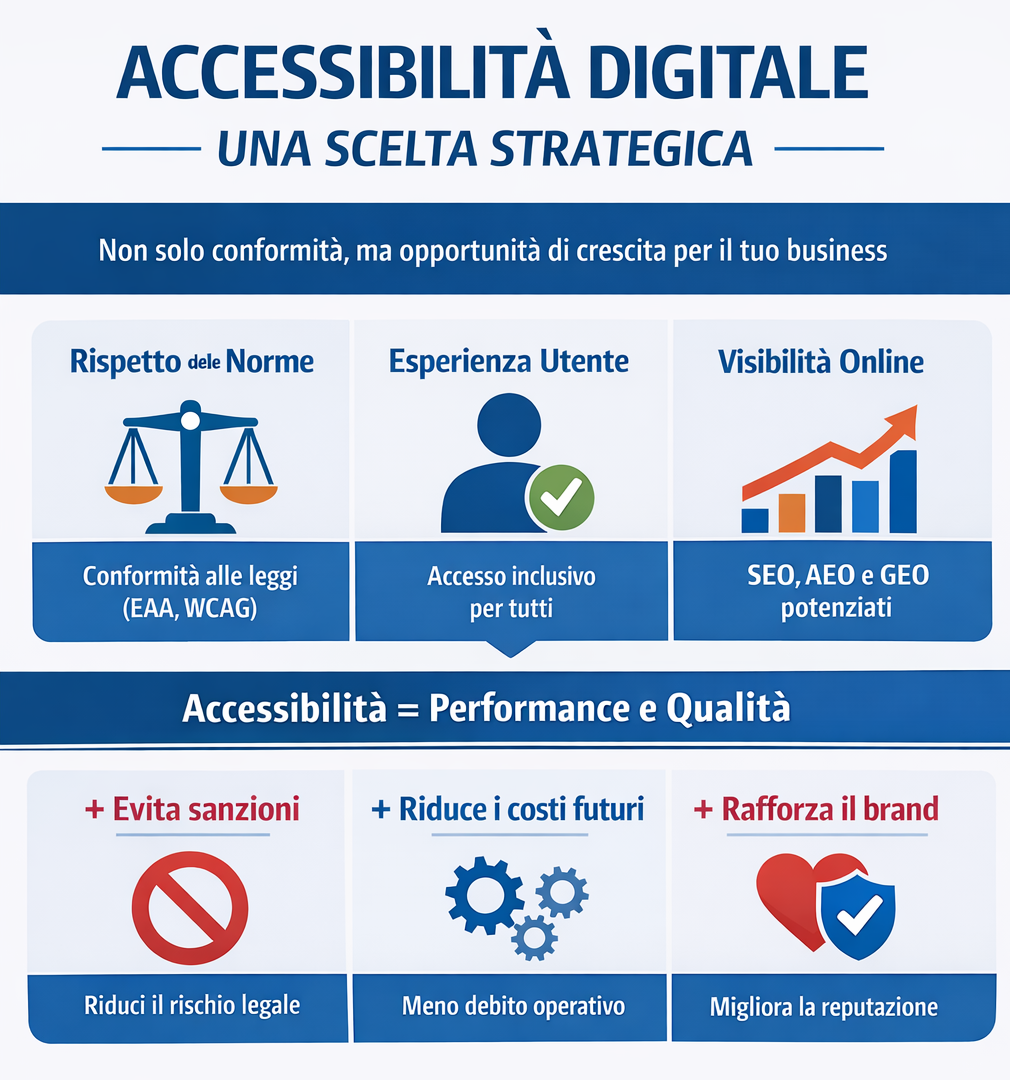
Digital accessibility is no longer a technical or regulatory topic. It is a decision that affects risk, reputation, market reach, and business sustainability.
Accessibility is no longer a nice to have option
For many years, digital accessibility was perceived as a marginal topic, relevant only to a niche of users or to public projects subject to specific obligations. In practice, it was often confined to a technical checklist, addressed late or postponed indefinitely.
Today, this approach no longer holds. Accessibility has fully entered the scope of strategic decision-making because it directly impacts potential revenue, legal exposure, brand reputation, and the overall quality of the digital experience.
Ignoring it does not mean postponing an improvement. It means consciously accepting a risk.
Accessibility means market access, not just inclusion
Talking about accessibility only in ethical terms is reductive. Accessibility is first and foremost a matter of market access. Users with permanent, temporary, or situational disabilities represent a significant share of the active population. Added to them are elderly users, people with technological limitations, and non-ideal usage contexts.
A website, platform, or digital service that is not accessible automatically excludes part of this audience. Not because they are not interested in the offering, but because they are unable to use it in practice.
From a business perspective, this is a direct loss of opportunity. From a strategic perspective, it distorts data interpretation: lower conversions, higher bounce rates, funnels that appear not to work even though the real issue is not the product or the message.
The risk is not theoretical: it is operational and legal
There is, however, a cost that is rarely budgeted for: the cost of inaction. A non-accessible digital project generates daily friction in the form of support requests, interrupted user journeys, missed opportunities, and subsequent rework. Fragmented costs, difficult to measure individually, but which over time significantly impact operational efficiency and the company’s ability to scale smoothly.
With the entry into force of new European regulations on digital accessibility, in particular the European Accessibility Act, accessibility definitively stops being a recommendation and becomes a requirement.
This means that non-compliant websites, e-commerce platforms, applications, and digital services may expose companies to penalties, disputes, and forced remediation requests, often under tight timelines and at much higher costs compared to a preventive approach.
But the most underestimated risk is not the legal one. It is the reputational risk. In a context where transparency, responsibility, and attention to people are integral to brand value, being perceived as not accessible can generate damage that is difficult to recover from.
Accessibility and experience quality move in the same direction
A common mistake is to consider accessibility as a constraint that penalizes design, creativity, or performance. In reality, the opposite often happens.
Accessibility principles (clarity, consistency, readability, predictability) are the same principles that improve the experience for all users. An accessible interface is more understandable, more usable, and more robust over time.
Increasingly, accessibility also affects content visibility and interpretation by search engines and artificial intelligence–based systems. Proper semantic structures, clear text, logical hierarchies, and predictable interactions make content easier to read not only for users, but also for algorithms that index, summarize, and return it as an answer.
This has a direct impact on SEO, performance, conversion rates, and error reduction. It is not a compromise; it is an alignment.
Accessibility, SEO, AEO and GEO: today they speak the same language
In recent years, digital accessibility has taken on a central role also with respect to online visibility. Not only for users, but for the systems that read, interpret, and return content: search engines, answer engines, and AI-based platforms.
Proper semantic structures, clear logical hierarchies, understandable text, predictable navigation, and accessible components are the same elements that allow Google to better understand a page, index it correctly, and evaluate its quality over time. In this sense, accessibility does not just improve experience: it improves SEO.
The topic becomes even more relevant with the evolution toward AEO (Answer Engine Optimization) and GEO (Generative Engine Optimization). Answer systems and generative models do not read a website like a human user: they analyze structure, context, semantic relationships, and content clarity. A confusing, unstructured, or ambiguous interface is harder to interpret, summarize, and cite.
In practice, a non-accessible website is also less readable for artificial intelligence systems. This reduces the likelihood that content will be used as a source, answer, or reference in new search and information-generation environments. In addition, ARIA structures themselves contain keywords and provide content signals to bots.
From this perspective, accessibility becomes a cross-functional lever: it improves human experience, reduces regulatory risk, and increases the ability of content to be understood, valued, and returned by systems that now mediate a growing share of digital traffic and visibility.
CMS, technology stack and accessibility: where problems really start
When talking about accessibility, the debate often focuses on design, content, or individual errors to fix. In reality, a significant portion of issues arises much earlier, at the level of technical architecture and technology stack.
CMSs, frameworks, and development tools are not all equivalent from an accessibility standpoint. Not because they are inherently “good” or “bad,” but because they offer very different levels of control over the generated code, semantic structure, and behavior of interactive components.
Some systems generate relatively clean, predictable, and semantically coherent HTML, facilitating proper use of headings, ARIA landmarks, roles, and content relationships. Others—especially when combined with visual builders, heterogeneous plugins, or layered customizations over time—produce redundant markup, deeply nested structures, and an abundance of meaningless div elements with JavaScript dependencies that are difficult to govern.
This has a direct impact on accessibility, but also on SEO, performance, and the ability of AI-based systems to correctly interpret the page. A complex and non-semantic DOM is harder to navigate for a screen reader, but also harder to understand for a search engine or an answer engine.
The key point is not the technology itself, but the degree of governability it allows. In a governable stack, rules are clear: how a page is structured, how a component is built, which attributes are mandatory, which interactions must be keyboard-accessible, and how focus is managed. In an ungoverned stack, every new feature becomes an exception, and every intervention a one-off fix.
This is why, in many projects, accessibility is perceived as costly or limiting. Not because it inherently is, but because it is applied retroactively on foundations that were never designed to support it. The result is an accumulation of workarounds, overrides, and partial solutions that increase complexity instead of reducing it.
More structured or flat CMSs, well-designed headless systems, and modern frameworks instead allow accessibility to be set as a systemic property: reusable components, coherent design systems, and replicable interaction patterns. This requires real expertise and a clear architectural vision, because a powerful stack, if used without method, can generate even more severe problems.
In this sense, technological choice is never neutral. It affects code quality, ease of testing, regression prevention, and the long-term sustainability of accessibility. A well-designed digital ecosystem makes accessibility part of the development flow; an improvised one turns it into technical, operational, and reputational debt.
This is also why, in some contexts, CMSs like Statamic (which we often use for communication projects) are particularly suitable for projects where accessibility, control, and markup quality are central. Statamic is a flat-file CMS oriented toward content structure rather than plugin layering, and it allows fully governable templates, clean semantic HTML, and intentionally built components.
Accessibility, therefore, is not a feature to add nor a checklist to tick. It is a direct consequence of architectural decisions made early—or postponed for too long.
Why automated tests are not enough
Many projects claim to be accessible because they pass automated tests or standard analysis tools. These tools are useful, but they only cover part of the problem.
Automated tests detect obvious syntactic errors, but they cannot evaluate the real quality of the experience: content clarity, navigation logic, interaction predictability, or proper focus management.
The most critical issues often emerge only through manual testing: keyboard-only navigation, real screen reader usage, complex flow simulations, and verification of dynamic component behavior. It is in these contexts that frictions appear which automated tools do not detect.
This approach is relevant not only for users with disabilities, but also for the overall quality of the digital product. AI systems and answer engines, in fact, analyze content more like a screen reader than a visual browser: they read structure, order, and semantic relationships.
Relying exclusively on automated tests therefore creates a false sense of compliance. Truly reliable access requires periodic verification, awareness of tool limitations, and clear responsibility for maintaining quality over time.
Why accessibility is a management decision
Accessibility cannot be delegated exclusively to developers or designers. It is a choice that concerns how a company designs, measures, and governs its digital touchpoints.
It means setting priorities, allocating budgets, defining responsibilities, and accepting that digital quality is not measured only in terms of speed or functionality, but also in inclusivity and reliability.
When accessibility is addressed from the outset, it becomes an integral part of digital architecture. When it is ignored, it turns into technical, operational, and reputational debt.
From principle to practice: how to truly govern accessibility
Translating accessibility into practice does not mean chasing abstract compliance or applying isolated fixes. It means embedding accessibility into the normal decision-making processes that govern a digital project.
In practical terms, this means addressing accessibility in at least three key moments: during analysis and design, to avoid structural errors; during development, to ensure markup consistency and quality; and over time, through periodic checks that detect regressions and regulatory or technological changes.
When one of these levels is missing, accessibility stops being governable and becomes a set of reactive interventions, often disconnected from business context and difficult to maintain over time.
The point is not doing everything at once, but knowing what has priority, which risks are real, and which interventions produce measurable value. This holistic view allows accessibility to shift from perceived cost to quality lever, reducing uncertainty, operational friction, and future corrective work.
In other words, accessibility works only when it stops being an isolated technical topic and becomes part of digital product governance.
When to talk to a consultant
It makes sense to involve an accessibility consultant when the topic stops being a theoretical question and starts generating operational friction, decision-making uncertainty, or business risk.
This typically happens when a website or digital platform has grown over time without a structured vision, when multiple vendors are involved in the same ecosystem, or when accessibility emerges only after reports, external audits, or new regulatory requirements.
It is also useful to engage a partner when the goal is not merely compliance, but understanding which interventions truly make sense in relation to the business, avoiding standardized or purely technical approaches that risk creating more complexity than value.
In these cases, the consultant’s role is not to fix individual errors, but to help the company read the problem as a whole, defining priorities, responsibilities, and a sustainable path over time.
Ignoring accessibility today costs more than it seems
Ignoring accessibility today is not an oversight, but a choice. A choice that exposes the company to avoidable risks, limits potential market reach, and weakens brand credibility in the medium term.
Addressing it in a structured way, on the other hand, makes it possible to build stronger foundations, reduce future uncertainty, and align digital assets with real business objectives.
This is not a matter of compliance. It is a matter of vision.
The question, therefore, is not whether to address digital accessibility, but when to do so and with what level of awareness. Postponing today simply shifts the problem forward, when it will be more expensive, more urgent, and less governable.
Continua a leggere
14 minutes of reading

22 minutes of reading

18 minutes of reading

And it consumes less energy.
To return to the page you were visiting, simply click or scroll.